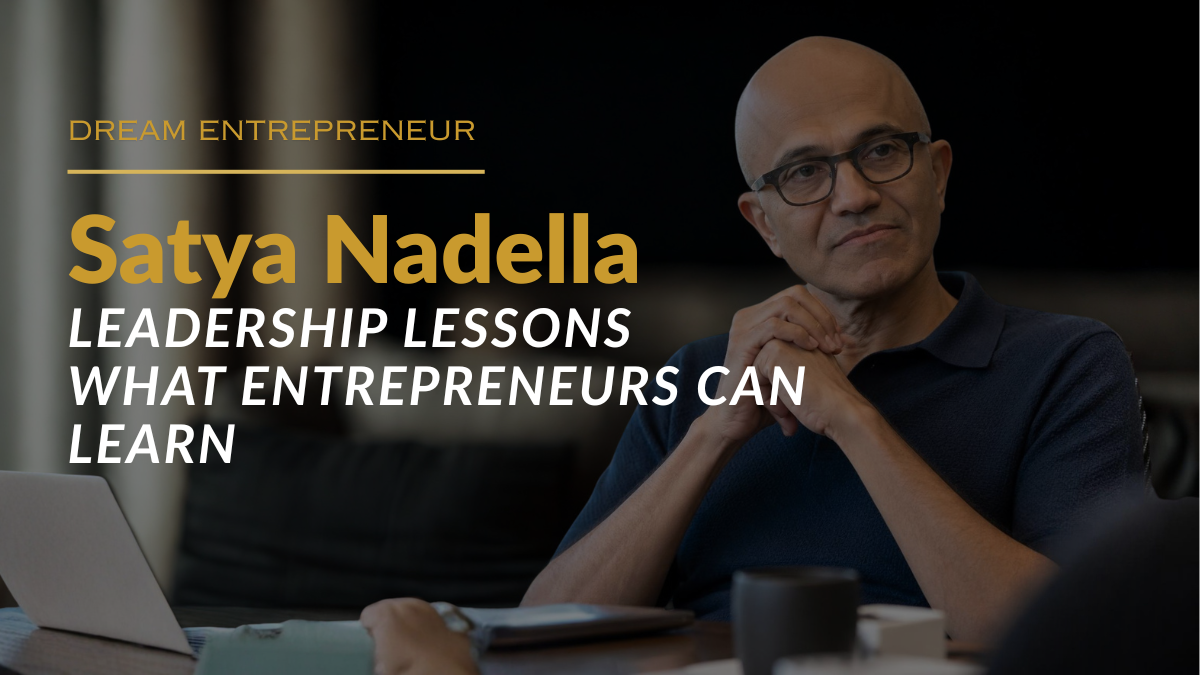
When Satya Nadella became Microsoft’s CEO in February 2014, he inherited one of the world’s most recognisable technology companies at a time when the industry was changing rapidly. Microsoft had enormous strengths, but it also needed to adapt to a world increasingly shaped by cloud computing, mobile devices and new forms of digital competition.
What followed makes Nadella’s leadership style worth studying for entrepreneurs.
The most useful Satya Nadella leadership lessons are not about copying Microsoft’s size, technology or resources. They are about learning how to build a customer-focused culture, stay open to change, encourage learning, think beyond the existing business and lead people with empathy.
For a startup founder or small-business owner, these principles can be applied even with a team of two or three people.
Table of Contents
Who Is Satya Nadella and Why Is His Leadership Worth Studying?
Satya Nadella joined Microsoft in 1992 and spent more than two decades working across different parts of the company before becoming CEO in 2014. Before becoming CEO, he led Microsoft’s Cloud and Enterprise group and was closely involved in the company’s move toward cloud computing. You can also explore Satya Nadella’s official Microsoft leadership profile for his professional background and current role.
His leadership became associated with a broader shift in Microsoft’s strategy and culture. Early in his tenure, Microsoft emphasised a mobile-first, cloud-first direction and a stronger focus on empowering customers rather than simply protecting existing products.
That does not mean Nadella alone transformed Microsoft. Microsoft’s results have depended on thousands of employees, products, acquisitions, investments, partners and market conditions. The better entrepreneurial lesson is that a leader can influence the direction and culture that allow an organisation to respond to change.
For entrepreneurs, these Satya Nadella leadership lessons are more useful when viewed as principles for making better decisions rather than as a formula for copying Microsoft’s success.
Why Satya Nadella’s Leadership Style Matters for Entrepreneurs
Small businesses often face a problem similar to large companies: success can create resistance to change.
A founder may become attached to the product that generated the first customers. A team may continue using an old process because “that is how we have always done it.” Employees may hesitate to question decisions made by the founder.
This is closely connected to developing an entrepreneur mindset, where learning, adaptability, and continuous improvement become part of how you approach business decisions.
Nadella’s approach offers a different model. Leaders need enough confidence to have a clear direction, but enough humility to keep learning.
Microsoft’s recent annual report continues to describe its culture around a growth mindset, experimentation, evaluation, and continuous improvement.
Microsoft’s 2025 Annual Report provides additional context on the company’s strategy, business performance, culture, and long-term priorities.
For entrepreneurs, this means leadership is not simply about giving instructions. It is about creating an environment where better decisions can emerge with a dedicated entrepreneurial mindset.
These Satya Nadella leadership lessons are particularly useful for entrepreneurs because they focus on how leaders respond to uncertainty, changing customer expectations and internal challenges.
7 Satya Nadella Leadership Lessons Entrepreneurs Can Apply
1. Build a Growth Mindset Instead of Pretending to Know Everything

One of the most recognised ideas associated with Nadella’s Microsoft leadership is the shift from a “know-it-all” culture toward a “learn-it-all” mindset.
The practical difference is significant.
A know-it-all leader tries to prove that they are right. A learning-oriented leader asks what they might be missing.
This matters because startups operate with incomplete information. Your first product may not work. Your pricing may be wrong. Customers may use your product differently from what you expected.
A founder who treats every mistake as an attack on their intelligence will struggle to adapt.
Entrepreneurial application: After every important decision, ask three questions:
- What did we expect to happen?
- What actually happened?
- What should we change based on the evidence?
The objective is not to avoid mistakes completely. It is to learn faster than competitors.
This is one of the most practical Satya Nadella leadership lessons for entrepreneurs because early-stage businesses rarely have perfect information.
2. Use Empathy as a Business Skill

Satya Nadella’s leadership style is strongly associated with empathy. In interviews, he has discussed empathy not merely as a personal quality but as something connected to understanding people, innovation, and the way products are created. Harvard Business Review has also documented his emphasis on empathy and culture.
In a Harvard Business Review interview on empathy and leadership, Nadella discussed how empathy influences the way leaders understand employees, customers, and changing workplace needs.
For entrepreneurs, empathy does not mean agreeing with everyone.
It means understanding what customers, employees, and partners are actually experiencing.
Suppose customers keep asking for a feature you think is unnecessary. Instead of immediately dismissing them, investigate the problem behind the request.
Perhaps the requested feature is only a symptom of a larger problem.
The same applies to employees. If someone repeatedly misses deadlines, the immediate assumption may be poor discipline. But the underlying problem could be unclear priorities, unrealistic workloads, or inadequate training.
Lesson: Listen before solving.
This is another important Satya Nadella leadership lesson: understanding people can improve the quality of business decisions.
Empathy can improve product decisions because it helps leaders understand the problem from the other person’s perspective.
3. Focus on Customers, Not Just Products
When Nadella became CEO, Microsoft explicitly talked about becoming more customer-focused and using indicators such as product usage to understand whether its offerings were creating value.
This is a valuable lesson for small businesses.
Founders often become emotionally attached to what they have built. Customers, however, do not buy products because founders worked hard on them. They buy because the product solves a problem or provides value.
A business owner selling accounting software, for example, should not only ask, “How many features can we add?”
A better question is, “Can a small-business owner complete their accounting work faster and with fewer mistakes?”
That change in perspective can influence product design, pricing, marketing, and customer service.
Practical rule: Measure customer outcomes, not just your own activity.
4. Be Willing to Reinvent the Business

Perhaps one of the biggest Satya Nadella business lessons is the willingness to move toward where the market is going rather than simply defending what worked in the past.
Microsoft’s early Nadella-era strategy emphasised a mobile-first, cloud-first world. The company also expanded its services across platforms rather than treating its traditional Windows ecosystem as the only centre of the business.
This is especially relevant for entrepreneurs.
Imagine a local business that has built a successful offline customer base. If customer behaviour shifts online, the owner cannot keep saying, “Our old method worked for ten years.”
Past success is useful evidence. It is not a guarantee of future success.
Among the Satya Nadella leadership lessons worth remembering, adaptability may be one of the most relevant for entrepreneurs operating in changing markets.
Ask yourself: If I were starting this business today, knowing what I know now, would I build it in the same way?
If the answer is no, that is a signal worth investigating.
5. Create Collaboration Instead of Internal Competition
A growing company can easily develop departments that protect their own interests.
Sales blames product. Product blames marketing. Operations blames sales. Employees become more concerned about winning internal arguments than solving customer problems.
Nadella has repeatedly emphasised collaboration and Microsoft’s ability to bring different groups together around customer outcomes. Microsoft’s 2014 CEO announcement also highlighted his ability to bring people together.
For a small company, collaboration can be much simpler.
A founder can create shared goals instead of separate departmental targets. For example, rather than measuring sales only on the number of deals closed, the team can also track customer retention and satisfaction.
This changes the conversation from “Who is responsible?” to “How do we solve this?”
Entrepreneurial lesson: Build teams around shared outcomes, not internal competition.
6. Think in Years, Not Only in This Month’s Results
Entrepreneurs naturally worry about monthly revenue, cash flow, and customer acquisition. These numbers matter, especially for a small business.
But leadership also requires thinking beyond the immediate quarter.
Microsoft’s transition toward cloud computing was not simply a short-term product adjustment. It involved substantial investment in cloud infrastructure and a broader change in how the company positioned its products and services. Microsoft’s annual reports show how significant cloud became to the business over time.
The lesson for a small business is not to spend money recklessly on a five-year vision.
It is to distinguish between short-term survival decisions and long-term capability building.
For example, a founder may spend time creating a repeatable sales process even when that work does not immediately increase revenue. That process can become an asset as the business grows.
Think: What capability am I building today that will make the business stronger two years from now?
7. Accept That Leadership Requires Difficult Decisions
It is easy to study successful leaders only through their achievements. Real leadership is more complicated.
Microsoft has continued to make difficult restructuring and workforce decisions during Nadella’s tenure. In July 2025, Nadella addressed job eliminations directly in a message to employees, acknowledging the human impact and uncertainty surrounding those decisions.
This is a useful reminder that empathy does not eliminate difficult business decisions.
Entrepreneurs sometimes confuse being a good leader with keeping everyone happy. That is not realistic.
A founder may need to stop an unsuccessful product, change pricing, restructure responsibilities, reduce expenses or let go of a project that the team has invested heavily in.
The leadership lesson is to make difficult decisions honestly and explain the reasoning clearly.
Empathy should influence how the decision is made and communicated. It should not prevent a business from making necessary decisions.
What Entrepreneurs Should Not Copy From Microsoft
Nadella’s story should not become a formula that entrepreneurs blindly copy.
Microsoft is a global corporation with enormous financial resources, established brands, engineering teams, and a worldwide customer base.
A small startup cannot reproduce Microsoft’s strategy simply by copying its actions. A founder with limited resources needs to focus on practical execution, cash flow, and customer value. For entrepreneurs building without external funding, understanding how to bootstrap a startup without funding can be especially useful.
The useful approach is to copy the principles, not the scale.
A small business does not need Azure to practise customer obsession.
It does not need thousands of employees to develop a learning culture.
It does not need billions of dollars to listen to customers.
How to Apply Satya Nadella’s Leadership Lessons in Your Business
You can turn these ideas into a simple weekly leadership routine. These habits also support the essential skills every entrepreneur must learn, especially communication, decision-making, problem-solving and adaptability.
First, review customer feedback. Pick five recent customer conversations, complaints or questions and identify recurring problems.
Second, review one assumption. Ask which belief about your product, market or customers may no longer be true.
Third, involve your team. Ask employees what is slowing them down and what process they would change.
Fourth, study one emerging trend. This could be AI, digital payments, e-commerce, changing customer behaviour or a new competitor.
Fifth, review one long-term capability. Decide what system, skill, relationship or process you should build now.
This process costs almost nothing, but it can gradually change how a founder thinks and leads.
Key Takeaways
The most practical Satya Nadella leadership lessons for entrepreneurs can be summarised into seven principles:
- Stay teachable. A leader does not need to know everything.
- Use empathy to understand problems. Listening can improve both products and teams.
- Put customers at the centre. Business activity matters only when it creates value.
- Be willing to reinvent. Yesterday’s successful model may not fit tomorrow’s market.
- Encourage collaboration. Shared goals are often more productive than internal competition.
- Build for the long term. Develop capabilities, not just short-term revenue.
- Make difficult decisions responsibly. Good leadership combines empathy with business discipline.
The broader lesson is simple: leadership is less about appearing powerful and more about creating the conditions for people and the business to improve.
Conclusion
Satya Nadella’s leadership provides entrepreneurs with a useful case study in how to combine strategic and cultural change. These leadership lessons from Satya Nadella are valuable because they can be applied at both large organisations and small businesses.
Microsoft’s story is not a perfect blueprint, and Microsoft’s success cannot be attributed to a single person. It is the result of a much larger organisation, strategy, technology investments, teams, and market opportunities.
What entrepreneurs can learn is the underlying approach. The strongest Satya Nadella leadership lessons are about staying curious, understanding customers, adapting to change and building a culture where people continue to learn.
Stay curious. Listen to customers. Build a learning culture. Question assumptions. Be willing to change direction. Think beyond the next sale.
For a first-time founder, one practical starting point is to ask your team and your customers one simple question this week:
“What could we be doing better?”
Then listen carefully to the answers.
Frequently Asked Questions
What are the main leadership lessons from Satya Nadella?
The main lessons include developing a growth mindset, practising empathy, focusing on customers, embracing change, encouraging collaboration, thinking long term and making difficult decisions responsibly. These principles are useful for entrepreneurs because they focus on how leaders respond to uncertainty rather than simply on business size or financial resources.
What is Satya Nadella’s leadership style?
Satya Nadella’s leadership style is commonly associated with empathy, collaboration, learning and customer focus. His leadership at Microsoft also emphasised cultural change and adapting the company to cloud computing and later AI. However, Microsoft’s transformation was a collective organisational effort, not the result of one individual alone.
Why is empathy important in Satya Nadella’s leadership?
Nadella has spoken publicly about empathy as an important human and leadership capability. For entrepreneurs, empathy helps leaders understand customers, employees and partners before making decisions. It can lead to better product decisions because the founder is more likely to understand the real problem instead of relying only on their own assumptions.
What can startups learn from Satya Nadella and Microsoft?
Startups can learn to stay open to change, focus on customer value, encourage learning and build a collaborative culture. Microsoft’s shift toward cloud computing demonstrates the importance of adapting to major changes in technology and customer behaviour. A startup should copy the underlying principles rather than attempting to copy Microsoft’s scale or resources.
How can entrepreneurs develop a growth mindset?
Entrepreneurs can develop a growth mindset by treating results as feedback rather than personal judgment. After important decisions, compare expectations with actual results, identify what was learned and change the next action accordingly. Regular customer feedback, experimentation and honest reviews can turn mistakes into useful business information.
