
Before you rent a space, buy stock, or spend money on advertising, there is one number worth knowing: how much you must sell just to cover your costs. Break even analysis for startups helps you calculate that number.
It connects directly to pricing, sales targets, budgeting, and business viability. It also lets you test the financial side of a business idea before committing significant money.
Table of Contents
In this guide, you will learn the break-even formula, follow a worked example in Indian rupees, and discover how to use the result to make more informed business decisions.
What Is Break-Even Analysis for Startups?
Break-even analysis is a financial method for calculating the sales volume or revenue at which total revenue equals total costs. At this point, the business makes neither an operating profit nor an operating loss under the assumptions used.
The U.S. Small Business Administration’s break-even point guide explains how this calculation can help entrepreneurs evaluate costs, plan sales, and assess a business opportunity.
For a startup, the result helps answer three important questions:
- How many products or services must I sell each month?
- Is my selling price sufficient to cover my costs?
- Is the required sales target realistic for my business?
Remember that a break-even calculation is an estimate. It does not guarantee customer demand, positive cash flow, or long-term business success.
What Costs Do You Need for Break-Even Analysis?

You need three main inputs: fixed costs, variable costs, and selling price.
Fixed Costs
Fixed costs generally remain stable over a particular period and operating range, regardless of how many units you sell.
Examples include:
- Office or workspace rent
- Certain software subscriptions
- Insurance premiums
- Fixed monthly salaries
- Website hosting and essential business tools
For example, if your business pays ₹12,000 in monthly rent, that expense generally remains ₹12,000 whether you sell 50 products or 200 products.
However, fixed costs can increase when you rent a larger space, hire additional staff, or exceed a service provider’s usage limits.
Variable Costs
Variable costs change with the quantity of products or services sold.
Examples include:
- Raw materials and product components
- Packaging and shipping paid per order
- Payment processing fees
- Sales commissions
- Direct production costs
If each product costs ₹300 in variable expenses, selling 100 products creates ₹30,000 in variable costs, assuming the cost per unit remains constant.
Selling Price
The selling price is the amount received per unit sold before deducting the variable costs associated with that sale.
Use the realistic price you expect to receive rather than simply the price displayed on your website. Discounts, refunds, sales commissions, and applicable indirect taxes can affect the amount available to cover costs.
Some expenses are mixed or semi-variable. For example, a phone plan might include a fixed monthly charge plus usage fees. Separate these components where practical.
If you are still preparing your initial budget, read our guide on how to calculate startup costs before launching a business.
Break-Even Formula Explained
The standard formula for calculating break-even units is:
Break-even units = Fixed costs ÷ (Selling price per unit − Variable cost per unit)
The amount in brackets is called contribution per unit. It represents the amount each sale contributes toward covering fixed costs after the variable cost of that sale has been paid.
For example, if you sell a product for ₹500 and its variable cost is ₹300:
Contribution per unit = ₹500 − ₹300 = ₹200
Each sale contributes ₹200 toward fixed costs. Once total contribution covers those fixed costs, additional contribution can generate operating profit, assuming the other costs and selling conditions remain unchanged.
Break-Even Revenue Formula
You can also estimate the break-even point in revenue:
Break-even revenue = Fixed costs ÷ Contribution margin ratio
The contribution margin ratio is:
Contribution margin ratio = Contribution per unit ÷ Selling price per unit
Multiply the result by 100 to express it as a percentage.
For the example above:
₹200 ÷ ₹500 = 0.40, or 40%
The revenue formula therefore uses 0.40, not 40.
This method assumes a consistent contribution margin. For businesses selling multiple products, the result depends on the expected sales mix. The OpenStax explanation of contribution margin and break-even analysis explains both unit-based and revenue-based calculations.
How to Calculate Break-Even Analysis Step by Step
Follow these seven steps to calculate your startup’s break-even point.
- Identify fixed costs. Add the expenses for the period you want to analyse, such as one month.
- Calculate variable cost per unit. Include the costs associated with producing and selling each unit.
- Determine the selling price. Use a realistic expected selling price after accounting for likely discounts.
- Calculate contribution per unit. Subtract variable cost per unit from selling price per unit.
- Divide fixed costs by contribution per unit. This gives the break-even quantity before rounding.
- Round up to a whole unit. If the result is 287.4, you generally need to sell 288 units.
- Check whether the target is realistic. Compare the required volume with customer demand, production capacity, marketing reach, and available cash.
If the selling price equals the variable cost per unit, contribution is zero. If variable cost exceeds the selling price, contribution is negative. Under either condition, additional sales cannot cover fixed costs through this pricing structure.
You would need to increase the price, reduce variable costs, or reconsider the offer.
It is also useful to translate the result into a weekly or daily target. The ANZ guide to calculating your break-even point provides a practical explanation of how sales targets can be connected to a timeframe.
Break-Even Analysis Example: A Hypothetical Startup
Consider a hypothetical startup selling one product in India.
The business has the following monthly figures:
| Input | Amount |
|---|---|
| Monthly fixed costs | ₹60,000 |
| Selling price per unit | ₹500 |
| Variable cost per unit | ₹300 |
Step 1: Calculate Contribution per Unit
Selling price − variable cost
₹500 − ₹300 = ₹200
Each unit contributes ₹200 toward fixed costs.
Step 2: Calculate Break-Even Units
Fixed costs ÷ contribution per unit
₹60,000 ÷ ₹200 = 300 units per month
The startup needs to sell 300 units each month to break even.
Step 3: Calculate Break-Even Revenue
Break-even units × selling price
300 × ₹500 = ₹1,50,000 per month
At this sales level, the business generates ₹1,50,000 in revenue.
Step 4: Check the Calculation
| Monthly calculation | Amount |
|---|---|
| Revenue from 300 units | ₹1,50,000 |
| Variable costs: 300 × ₹300 | ₹90,000 |
| Fixed costs | ₹60,000 |
| Total costs | ₹1,50,000 |
| Operating profit or loss | ₹0 |
Revenue equals total costs, so the calculation is consistent.
The same result can be calculated using the contribution margin ratio:
₹60,000 ÷ 0.40 = ₹1,50,000
This example assumes one product, a constant selling price and variable cost, and fixed costs covering the same monthly period. Actual results may differ because of discounts, returns, taxes, changes in product mix, and other expenses.
How to Interpret Your Break-Even Point
The calculation becomes useful when you translate it into a practical sales target.
| Units sold per month | Revenue | Total costs | Result |
|---|---|---|---|
| 200 | ₹1,00,000 | ₹1,20,000 | ₹20,000 loss |
| 300 | ₹1,50,000 | ₹1,50,000 | Break-even |
| 400 | ₹2,00,000 | ₹1,80,000 | ₹20,000 operating profit |
These figures are hypothetical and use the same prices and costs as the worked example.
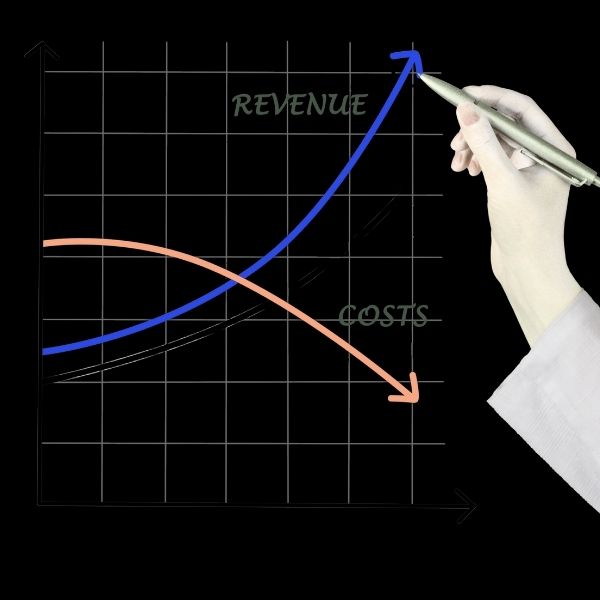
Below break-even, the business generally makes an operating loss under the model. At break-even, revenue equals total costs. Above break-even, additional contribution can generate operating profit if the assumptions remain valid.
But can the startup actually sell 300 units every month?
Consider four questions:
- Customer demand: Are enough customers willing to pay ₹500?
- Capacity: Can you produce and deliver 300 units?
- Sales cycle: How long does it take to acquire a customer?
- Available cash: Can you pay your expenses while sales are building?
For practical guidance on finding and acquiring early customers, read how to get your first 100 customers for a startup.
Also remember that break-even is not the same as cash-flow stability. A business may record enough sales to cover its costs but still experience a cash shortage if customers pay late and suppliers require earlier payment.
Break-Even Analysis for Different Business Types
The basic formula remains the same, but the unit you measure changes with the business model.
| Business type | What counts as a unit? | What to consider |
|---|---|---|
| Product-based business | One product sold | Production, packaging, shipping and sales mix |
| Service business | One project or billable hour | Delivery time, direct labour and available capacity |
| Subscription business | One paying customer per month | Monthly contribution, churn and service costs |
For a service business, estimate how many projects or billable hours you need to cover monthly expenses. Be realistic about the time available for paid work.
For a subscription business, calculate contribution per paying customer per month and consider customer churn, discounts, and the cost of delivering the service.
For a business selling multiple products, break-even depends on the sales mix. If customers increasingly buy lower-margin products, the business may need higher sales volume to cover its fixed costs.
If you are still choosing a business model, explore 15 practical low-investment startup ideas for beginners. Starting with a manageable cost structure may make it easier to test an idea before committing more capital.
Common Break-Even Analysis Mistakes
Avoid these common mistakes when preparing your calculation.
- Forgetting hidden costs. Include relevant software, insurance, maintenance, marketing, payment fees, and other operating expenses. Review your records and supplier quotations to identify overlooked costs.
- Using unrealistic prices or variable costs. Use actual supplier quotes and evidence about what customers are willing to pay.
- Mixing time periods. Compare monthly fixed costs with monthly sales assumptions. Convert annual or quarterly expenses to a consistent period.
- Assuming every cost is strictly fixed or variable. Separate mixed costs where practical and account for expenses that increase in steps.
- Ignoring discounts, refunds, and commissions. Use realistic selling prices and include costs that arise from completing a sale.
- Treating break-even as a guarantee. Run alternative scenarios to see how the result changes when prices, costs, or demand differ from your expectations.
- Ignoring cash flow. Consider when customer payments arrive and when bills must be paid.
A useful improvement is to calculate a base case and a more cautious scenario. If a small increase in variable costs or a modest reduction in selling price makes the sales target unrealistic, you should understand that risk before investing.
How Startups Can Use Break-Even Analysis

Once you know your break-even point, use it to make decisions rather than treating it as just another financial number.
Test Your Pricing
Calculate break-even units at different selling prices. A higher price can increase contribution per unit, but it may also reduce demand. Test whether customers are willing to pay the proposed price.
Set Realistic Sales Targets
Turn monthly break-even units into weekly or daily targets. In the example, 300 units over a 30-day month averages 10 units per day. Adjust for weekends, seasonality, and uneven demand.
Compare Cost Structures
Compare the cost of renting a shop with operating from home, outsourcing production with producing in-house, or hiring employees with using contractors. Consider both fixed and variable costs.
Assess Business Viability
If the required sales volume is far above realistic demand, treat it as a warning. Read Is My Business Idea Worth Pursuing? 7 Signs to Check to examine other aspects of business viability.
Validate Customer Demand
Break-even analysis shows how many sales you need, not whether customers will actually buy. Combine your calculation with customer conversations, small tests, and evidence of willingness to pay.
Our guide on how to validate a startup idea before building it explains how to test demand before committing significant resources.
Calculate the Sales Needed for a Profit Target
You can extend the formula to estimate the units needed to achieve a target operating profit:
Required units = (Fixed costs + Target operating profit) ÷ Contribution per unit
Using the earlier example, suppose the startup wants ₹20,000 in monthly operating profit.
(₹60,000 + ₹20,000) ÷ ₹200 = 400 units
The business would need to sell 400 units per month to reach that target under the same assumptions.
Break-even analysis is one decision-making tool. Combine it with customer validation, cash-flow planning, and realistic demand estimates before making major financial commitments.
Frequently Asked Questions
What is break-even analysis for startups?
It is a financial calculation that estimates how much a startup must sell for total revenue to equal total costs. It helps founders plan prices, sales targets, and budgets.
How do you calculate the break-even point?
Divide fixed costs by contribution per unit. Contribution per unit is the selling price minus the variable cost per unit. Round up to a whole unit when necessary.
What is contribution per unit?
Contribution per unit is the amount remaining from a sale after its variable costs are covered. It helps pay fixed costs and, once those costs are covered, contributes to operating profit.
Can a startup break even without making a profit?
Yes. At break-even, total revenue equals total costs, so operating profit is zero under the model. Sales above break-even can generate operating profit if the assumptions hold.
What happens if variable costs are higher than the selling price?
Each sale creates a negative contribution before fixed costs are considered. Selling more at the same price and cost structure increases the shortfall. The business needs to revise its price, reduce variable costs, or change its offer.
Is break-even analysis enough to decide whether a business idea is viable?
No. It estimates the sales needed to cover costs, but does not prove customer demand, positive cash flow, or long-term profitability. Combine it with market research, customer validation, and cash-flow planning.
Conclusion
Break-even analysis helps you turn a business idea into a measurable financial target. Identify your fixed costs, calculate variable costs and contribution per unit, and determine how much you need to sell to cover expenses.
Your next step is to create a simple break-even worksheet using your own numbers. Calculate your monthly sales target, compare it with realistic customer demand, and test different prices and costs before committing more money.
A business becomes easier to manage when you understand not only how much revenue you hope to earn, but also how much you must sell to cover your costs.
