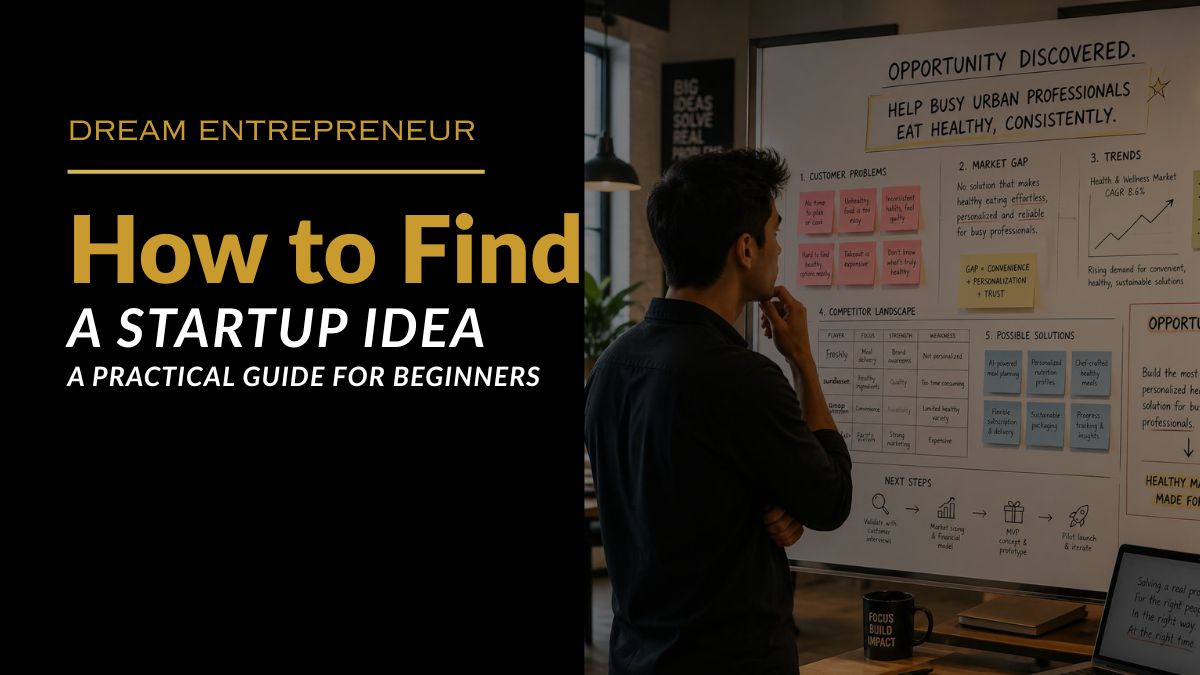
Many aspiring founders think they need a completely original invention before they can start a company. In reality, many useful opportunities begin with something much simpler: a problem that keeps happening, a frustrating process, an underserved customer group, or a better way of doing something that already exists.
Learning how to find a startup idea is therefore less about waiting for inspiration and more about learning how to notice opportunities.
Good startup ideas can emerge from customer complaints, inefficient industries, changing behaviour, new technology, niche markets, or problems you experience yourself. The important part is learning to separate an interesting idea from a problem that may be worth exploring as a business.
Table of Contents
This guide shows you a practical way to discover startup opportunities without turning the process into a random list of business ideas.
How Do You Find a Good Startup Idea?
The practical answer to how to find a startup idea is to start with problems rather than products. Observe recurring frustrations, talk to potential customers, study existing solutions, look for underserved markets, watch meaningful trends, and use your own experience to identify gaps.
Then ask whether the problem has a clearly identifiable customer, existing or potential demand, realistic solutions, accessible customers, and a possible business model.
Finding an idea is only the beginning. A promising opportunity still needs research and validation before you invest significant money or time.
Start With Problems, Not Startup Ideas

If you search endlessly for “the perfect startup idea”, you can easily become focused on products instead of customers.
A better question is:
What problem do people repeatedly struggle with?
Look around your workplace, home, college, neighbourhood and industry. Pay attention to tasks that are slow, expensive, confusing or unnecessarily manual.
For example, a small retailer may spend hours updating stock manually. A student may struggle to find trustworthy career guidance. A local business may receive customer enquiries through several channels but have no simple way to manage them.
Each observation is not automatically a business opportunity. But each can be a useful starting point.
Research on entrepreneurial opportunity recognition suggests that founders often identify opportunities by connecting changes in technology, markets, demographics, behaviour and other external factors. In simple terms, they learn to notice patterns that others may overlook.
So instead of asking, “What should I build?”, start asking:
- What repeatedly frustrates people?
- What takes too much time?
- What is unnecessarily expensive?
- What process is still mostly manual?
- What do customers complain about?
- What solution feels harder than it should?
A problem that people genuinely care about can be a stronger starting point than an idea that simply sounds exciting.
Talk to People and Listen for Recurring Problems
One of the simplest ways to discover startup opportunities is to talk to people who experience problems directly.
Speak with customers, professionals, small business owners, students, parents, service providers, and industry workers.
Do not begin by pitching your idea. Start by understanding their existing behaviour.
Useful questions include:
- What is frustrating about the way you currently do this?
- What takes too much time?
- What do you wish was easier?
- What solution do you currently use?
- What do you dislike about it?
- What have you already tried?
- What does the current solution cost you?
One person’s unusual complaint may not tell you much. But when the same problem appears repeatedly across conversations, it becomes a more interesting signal.
There is an important distinction here. Customer conversations help you discover and understand a problem. They are not the same as full startup validation.
You are still learning what the problem looks like, who experiences it, and how they currently deal with it.
Look for Gaps in Existing Products and Services
You do not have to invent something that has never existed before.
Many good startup opportunities come from improving something customers already use.
You might make an existing solution:
- Simpler
- Faster
- More convenient
- More affordable
- More specialised
- More accessible
- Better suited to a specific customer segment
Start by studying existing products and services.
Read customer reviews. Look at complaints. Compare pricing. Study features. Examine customer support and onboarding. Pay attention to what users say they wish worked differently.
Competition is not automatically a bad sign. It can indicate that customers already recognise the problem and are spending money to solve it.
The opportunity may be to serve a specific group better rather than trying to defeat every competitor.
This approach also aligns with Startup India’s guidance, which highlights customer needs, differentiation, and competitive analysis when considering startup opportunities.
Watch Trends Without Chasing Every Trend
Another way to discover startup opportunities is to watch meaningful changes around you.
These may include:
- Technology changes
- Consumer behaviour
- Demographic shifts
- Workplace changes
- New platforms
- Industry changes
- Regulatory developments
- Changing lifestyles
Tools such as Google Trends can help you explore how search interest changes over time and across locations.
But a trend alone is not a startup opportunity.
A fashionable technology can attract attention without solving a meaningful customer problem. The stronger opportunity is often found at the intersection of:
Changing trend + real problem + identifiable customer + practical solution
For example, artificial intelligence may create new possibilities, but “build an AI startup” is not a problem statement. A better starting point would be identifying a specific customer group whose work could genuinely be improved through AI.
Use trends to notice changes. Do not let trends replace customer understanding.
Use Your Own Experience as an Idea Source
Your own work and life can also help you discover startup ideas.
Think about:
- Repetitive tasks you perform
- Problems you face at work
- Customer complaints you have encountered
- Processes that waste time
- Difficult services you have used
- Skills people regularly ask you for
- Industry knowledge you have developed
Your experience can give you an advantage because you may understand the problem better than an outsider.
But there is a catch.
A problem you personally experience does not automatically mean a large market exists.
Your experience is a signal, not proof.
Once you notice a problem, ask who else experiences it, how often it happens, how people solve it today, and whether they would pay for a better solution.
Explore Niche Markets and Underserved Customers
Beginners often make the mistake of searching for the biggest possible market.
A better approach can be starting with a clearly defined niche.
Instead of:
“Software for businesses”
you might explore:
“Simple inventory software for small independent retailers.”
The second description gives you a much clearer customer group.
A focused niche can make it easier to understand customer behaviour, create a relevant solution, communicate your value proposition, and reach potential users.
You may eventually expand beyond the niche. But starting with a specific customer segment can make the early learning process much easier.
The objective is not to find the smallest possible market. It is to find a customer group with a meaningful problem that you can understand and reach.
Use Online Research to Discover Opportunities

The internet can be a powerful source of startup idea research if you know what to look for.
Useful places include:
- Google Search
- Google Trends
- Online marketplaces
- Product reviews
- Reddit and online communities
- Industry forums
- Social media discussions
- YouTube comments
- App reviews
- Job listings
- Competitor websites
- Industry reports
You are looking for patterns rather than isolated comments.
For example, repeated complaints about an expensive software product may reveal an underserved segment. Job listings that repeatedly mention manual administrative work may point towards an opportunity for automation.
Search behaviour can also reveal questions people repeatedly ask.
However, online attention is not the same as business demand. A topic can receive thousands of searches without supporting a sustainable company.
Market research is useful because it helps entrepreneurs understand customer needs, competitors, and the broader target market before making major decisions.
Turn an Observation Into a Startup Opportunity
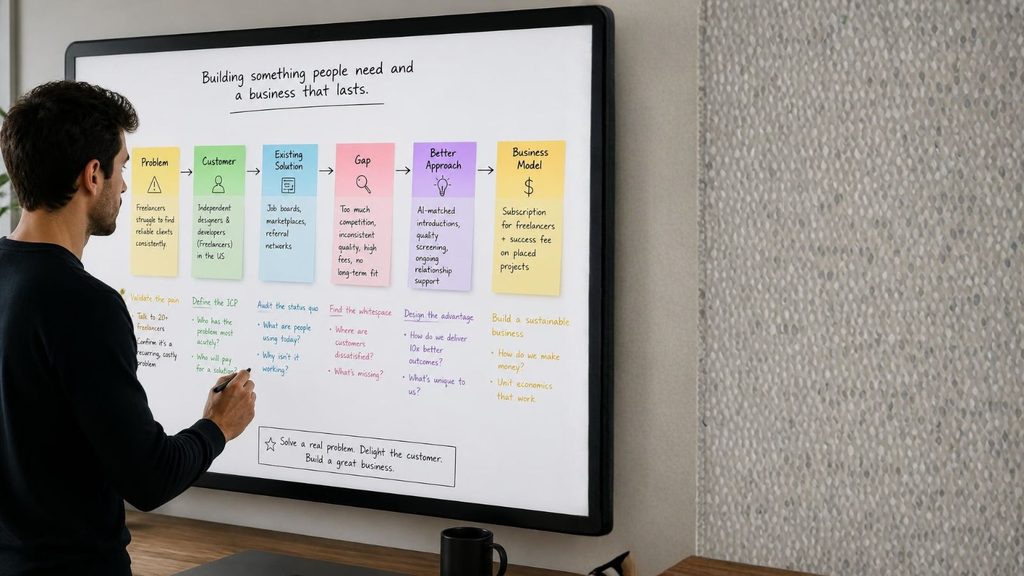
Once you have found an interesting problem, use this simple framework:
Problem → Customer → Existing Solution → Gap → Better Approach → Business Model
Problem
What exactly is difficult, expensive, slow, or frustrating?
Avoid vague statements such as “people need better technology.”
Make the problem specific.
Customer
Who experiences the problem?
A customer segment such as “small retailers with 2-10 employees” is more useful than “businesses”.
Existing Solution
How do people solve the problem today?
They may use competitors, spreadsheets, WhatsApp, employees, agencies, or completely manual processes.
Gap
What is missing from the existing solution?
Perhaps it is too expensive, too complicated, poorly designed, or unsuitable for a particular customer group.
Better Approach
What could you improve?
You might simplify the process, specialise the service, reduce unnecessary steps, or create a better customer experience.
Business Model
How could the solution create and capture value?
Consider who pays, what they pay for, how often they pay, and what it costs you to deliver the solution.
This framework turns startup idea generation into a structured process rather than a brainstorming exercise.
Is Your Startup Idea Worth Exploring?
Finding a startup idea is different from deciding whether it deserves further investment.
Use this initial screening checklist:
Problem
Is the problem meaningful enough for someone to care about solving?
Customer
Can you clearly identify who experiences it?
Frequency
Does the problem happen often enough to matter?
Existing alternatives
Are people already spending time or money to solve it?
Differentiation
Can you provide a meaningful improvement?
Reach
Can you realistically reach the customers who need the solution?
Business potential
Could the solution support a sustainable business model?
A useful startup opportunity does not need to score perfectly on every point. The purpose of this checklist is to decide which opportunities deserve deeper research.
Once you have identified a promising opportunity, the next step is to validate a business idea with real customers and evidence rather than immediately investing heavily.
Common Mistakes When Looking for a Startup Idea
Waiting for a completely original idea
You do not need to invent a category from scratch.
Lesson: Look for existing problems that could be solved better.
Choosing an idea because it sounds exciting
An interesting concept can still have weak customer demand.
Lesson: Study the problem before becoming attached to the solution.
Following every trend
Not every popular technology creates a sustainable opportunity.
Lesson: Look for durable customer problems underneath changing trends.
Building for everyone
A broad audience can make the product and marketing unclear.
Lesson: Start with a specific customer segment.
Ignoring existing solutions
Competition can teach you what customers already value and what they dislike.
Lesson: Study competitors instead of assuming you need an empty market.
Falling in love with your first idea
Your first idea may improve significantly once you speak with customers.
Lesson: Treat your idea as a hypothesis that can evolve.
A 30-Minute Exercise to Find Startup Ideas
If you are still wondering how to find a startup idea, try this exercise today.
First 10 minutes
Write down 10 problems you notice in:
- Work
- Home
- Education
- Shopping
- Healthcare
- Finance
- Transportation
- Local services
- Business processes
Do not judge the ideas yet. Just record the problems.
Next 10 minutes
Choose your three most interesting problems.
For each one, write:
- Who experiences it?
- How often does it happen?
- How is it solved today?
- What is the biggest frustration?
- Does the customer spend money or significant time dealing with it?
Final 10 minutes
Compare the three opportunities.
Ask:
- Is the problem meaningful?
- Is there an identifiable customer?
- Are there existing alternatives?
- Is there a clear gap?
- Could I realistically reach these customers?
- Could I create a better solution?
Choose one opportunity for deeper research, not automatically one business to launch.
That distinction matters. The exercise is designed to help you find startup opportunities worth investigating, not guarantee a successful business.
Key Takeaways
- Start with real customer problems rather than random startup ideas.
- Listen for recurring frustrations and unmet needs.
- Study existing products, reviews, and competitors.
- Use trends to identify change, not to blindly chase fashionable technologies.
- Your own experience can reveal opportunities, but it does not prove demand.
- A focused niche can be easier to understand and serve.
- Use online research to identify patterns, complaints, and workarounds.
- Evaluate an opportunity before committing significant resources.
- Finding an idea comes before validation, and validation comes before building heavily.
How to Find Your Next Startup Idea
You do not need to spend months waiting for inspiration.
Start with these seven actions:
- Write down 10 recurring problems you notice.
- Choose problems experienced by identifiable customers.
- Research how those customers solve them today.
- Study competitors and repeated customer complaints.
- Identify one promising customer segment.
- Develop several possible solutions to the same problem.
- Select one opportunity for deeper customer research and validation.
If you eventually decide to turn that opportunity into a real venture, our guide on what is a startup explains how the idea, validation, MVP, and growth stages fit together.
And when you are ready to test the opportunity with a simple product or service, our guide on how to build an MVP explains how to test important assumptions before investing heavily.
Frequently Asked Questions
Where do good startup ideas come from?
Good startup ideas can come from recurring customer problems, inefficient processes, underserved markets, changing consumer behaviour, technology shifts, industry gaps, and personal experience. The strongest opportunities usually combine a meaningful problem with a clearly identifiable customer and a practical way to create value.
How do I find a startup idea?
Start by observing problems around you, talking to potential customers, studying existing solutions, researching market gaps, and watching meaningful trends. Then shortlist problems based on customer need, frequency, existing alternatives, differentiation, customer reach, and potential business viability.
How do I know if a startup idea is worth exploring?
Look for evidence of a meaningful problem, a specific customer group, existing or potential demand, identifiable alternatives, and a realistic way to provide better value. This is an initial screening step. You still need proper validation before making major investments.
Can I find a startup idea from problems I experience myself?
Yes. Personal experience can help you notice problems and understand them deeply. However, your own experience does not prove that enough other people have the same problem or will pay for a solution. Treat personal experience as a starting signal and research the wider customer segment.
Do startup ideas need to be completely original?
No. A startup does not have to invent something nobody has ever seen. Many opportunities come from improving existing products, serving a specific niche, simplifying a process, reducing friction, or offering a better experience to an underserved customer group.
What should I do after finding a startup idea?
Do not immediately build the full product. First research the customer, market, and competitors, then test your assumptions with potential users. Once the opportunity looks promising, move towards startup validation and eventually a simple MVP before committing significant resources.
Conclusion
You do not need to wait for a magical billion-dollar idea to begin thinking like an entrepreneur.
Good startup opportunities can emerge from a combination of problems you notice, customers you understand, gaps you discover, and solutions you can improve.
The important skill is learning to observe.
Look at how people work, buy, communicate, learn and solve problems. Ask better questions. Study existing alternatives. Pay attention to repeated frustrations and changing behaviour.
Then evaluate the opportunity before investing heavily.
Finding a startup idea is only the beginning. The real work is discovering whether that idea can create meaningful value for a specific customer and support a sustainable business.
Believe • Build • Inspire
