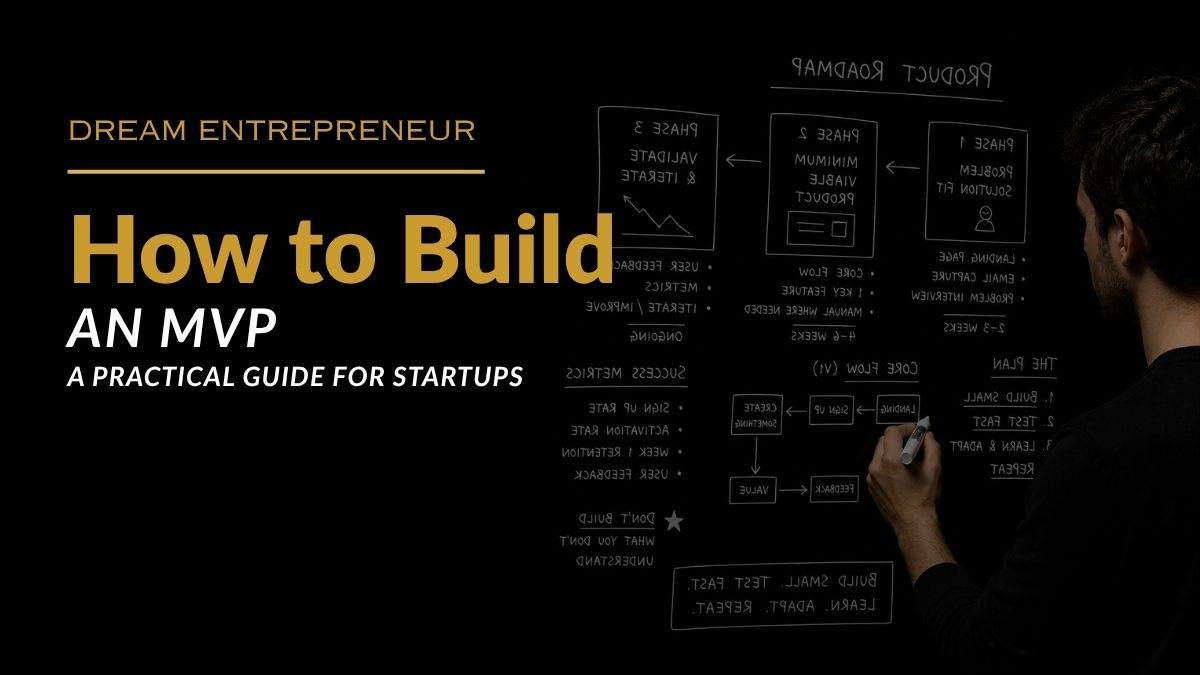
Many founders spend months and a significant amount of money building a full product before they know whether anyone actually wants it. By the time they find out, the budget is gone, and the team is exhausted.
Learning how to build an MVP is really about avoiding that trap. An MVP, or minimum viable product, lets you test your most important assumption with real users before you commit serious time or money to building everything you have in mind.
Table of Contents
This guide walks through the full process: defining the problem, deciding what your MVP actually needs, choosing the simplest way to build it, testing it with real customers, and deciding when the evidence justifies investing more. Nothing here requires a technical background.
How Do You Build an MVP?
The short answer to how to build an MVP is to start by identifying the problem you are solving and the customer who experiences it. Define the one assumption that matters most, the belief your whole business depends on, and decide exactly what you need to test to prove or disprove it.
From there, choose the smallest version of your product that can test that assumption, using the simplest method available, whether that’s a landing page, a manual process, or a basic working prototype. Launch it to real users, measure their actual behaviour rather than their opinions, and use that evidence to improve the product or decide whether further investment is justified.
What Is an MVP?
An MVP is the simplest usable version of a product that allows a founder to test an important assumption with real users. It is not necessarily the smallest thing you could build. It is the version that teaches you the most for the least effort.
It helps to be clear about what an MVP is not. It is not automatically a prototype, since a prototype often exists only to demonstrate an idea rather than to be used by real customers. As Y Combinator explains, MVP stands for minimum viable product, not minimum viable prototype. It is not the final product either, and it does not need every feature you have planned. Most importantly, an MVP is not an excuse for careless or unreliable work. It simply focuses your effort on what actually needs to be tested.
The term MVP became widely associated with the Lean Startup movement, particularly through the work of entrepreneurs and educators such as Steve Blank and Eric Ries.
Why Build an MVP Before Investing Heavily?
Understanding how to build an MVP matters because it helps you learn whether real demand exists before you commit to a large investment. Harvard Business Review frames this well: building an MVP means choosing between experiments that can validate or invalidate your assumptions about a business model, rather than assuming the model is correct from the start. It reduces unnecessary development because you build only what you need to test your assumption, not every feature you can imagine.
It also helps you understand customer behaviour, test pricing, identify which features actually matter, and make better decisions about where to spend money next. An MVP does not eliminate business risk, but it replaces guesswork with evidence.
Before building anything, write down one sentence explaining what the MVP must help you learn. For example: “We want to find out whether local homeowners will pay to get a trusted electrician within 60 minutes.” If a feature does not help answer that question, it probably does not belong in the first version.
Step 1: Start With the Problem, Not the Features
The first real step in how to build an MVP is getting clear on the problem before deciding what to build. A simple framework helps: Customer X has problem Y, and our product solves it through Z.
Identify who experiences this problem, how they currently deal with it, what existing alternatives cost, and why they might switch to something new. This single sentence should guide every decision about what your MVP actually needs to include.
Before deciding what to build, it also helps to understand what is a startup and how an MVP fits into the wider journey of building one.
Step 2: Decide What Your MVP Actually Needs

Once the core assumption is clear, sort potential features into three groups.
Must have: features required to test the core value proposition. Without these, you cannot learn anything meaningful.
Useful later: features that would genuinely help, but are not necessary to validate the idea right now.
Avoid initially: anything that adds complexity without helping you test the assumption.
The goal is to build the smallest product that can generate meaningful learning, not the smallest product possible for its own sake.
Step 3: Choose the Simplest Way to Build Your MVP
A common misconception about how to build an MVP is that it requires custom software development. It usually does not. Depending on what you need to test, options include a no-code or low-code tool, a simple landing page, a basic prototype, a manual or concierge process where you personally deliver the service, a spreadsheet-based workflow, a WhatsApp-based process, or an existing SaaS tool repurposed for your use case.
The right method depends entirely on what you are trying to learn. If you only need to know whether people want something, a landing page or a demo video can be enough. If you need to know whether people will actually use a service repeatedly, a manual concierge version may teach you more than any amount of coding.
Step 4: Build Fast, But Make the MVP Usable
There is a real difference between fast validation and careless development. Your MVP should still be usable, reliable enough that customers can trust it, and simple to understand without lengthy explanation.
Basic analytics to track what users actually do, a clear way for customers to reach you for support, and attention to security or privacy where relevant are not optional extras. They are part of making the MVP credible enough to generate feedback you can actually trust.
Step 5: Test Your MVP With Real Customers
Friends and family are not a reliable test group. They tend to be supportive regardless of whether the product genuinely works, which makes their feedback far less useful than it feels.
Look instead for actual target customers, early adopters willing to try something unfinished, or your first paying customers. Combine direct interviews with observation of what people actually do, since what people say they will do and what they actually do can be very different.
Useful signals include real usage, repeat usage, conversion, retention, purchases, referrals, and the kind of support requests that reveal where the product is confusing or incomplete.
Step 6: Measure What Actually Matters
Vanity metrics like page views or app downloads can feel encouraging without telling you anything useful. Focus instead on metrics tied directly to the assumption you are testing, such as sign-ups that convert into actual usage, activation, retention, repeat purchases, revenue, and direct customer feedback.
The right metric depends entirely on what you are trying to learn. A metric that matters for one MVP may be irrelevant for another.
Step 7: Improve the MVP Based on Evidence
Once real usage data starts coming in, look closely at what users value, what they consistently ignore, where they get stuck, and which requests keep repeating. This evidence often reveals that an initial assumption needs to change, which is a normal and useful part of the process.
Be careful not to implement every customer request blindly. Some requests genuinely reveal what matters. Others simply reflect one person’s preference and would add complexity without real value.
Step 8: Know When to Invest More
Additional investment should follow evidence, not enthusiasm. Positive signals worth watching for include consistent usage over time, a genuine willingness to pay, improving retention, clear customer value, and acquisition channels that seem viable at a reasonable cost.
If the evidence instead shows weak engagement or reluctant customers, that is not a failure. Learning that an assumption needs to change before you have spent heavily is valuable progress, not wasted effort.
Keep building when customers are using the product, returning, and showing willingness to pay.
Change direction when customers have the problem but your proposed solution is not working.
Pause the idea when repeated testing provides little evidence of meaningful demand.
The objective is not to prove that your original idea was right. The objective is to discover what the evidence is telling you before committing more resources.
How Much Does It Cost to Build an MVP?
One of the most common questions about how to build an MVP is what it actually costs. There is no single accurate figure for how much an MVP costs, because it depends heavily on product complexity, the technology involved, your team, design requirements, integrations, security and compliance needs, and geography.
A landing page or a manual concierge test can cost very little beyond your own time. A functioning software product with real infrastructure will naturally cost more, and no-code tools often sit somewhere in between. Rather than asking how much an MVP should cost in general, define exactly what needs to be learned first, then decide how much spending that learning actually justifies.
MVP vs Prototype: What’s the Difference?
Understanding how to build an MVP also means understanding what it isn’t. The table below breaks down the core differences.
| Aspect | MVP | Prototype |
|---|---|---|
| Purpose | Test a real business assumption | Demonstrate or visualise an idea |
| Functionality | Usable by real customers | Often not fully functional |
| User involvement | Real customers use it | Usually shown, not used |
| Business validation | Provides evidence of demand | Provides feedback on the concept |
| Typical stage | Early market testing | Early design or concept testing |
| Expected outcome | Evidence about real behaviour and demand | Feedback on the idea, design or feasibility |
A Practical Example
Here is a hypothetical example showing how to build an MVP in practice. Imagine a founder wants to build a local home services marketplace connecting customers with providers like electricians or cleaners.
Instead of building mobile apps, complex dashboards, automated payments, ratings systems, and multiple service categories all at once, the founder could start with something far smaller: pick one service category, focus on a single local market, create a simple landing page describing the offer, manually match customers with providers by phone or message, use an existing payment method rather than building one, and track demand by hand.
This small MVP would validate whether customers in that market actually want this service, whether providers are willing to participate, and whether the basic matching process works, all before investing in any of the more complex, expensive pieces.
Real-World MVP Examples
A few well-documented examples show how differently this can play out in practice.
Dropbox’s earliest MVP was not a working product at all. Founder Drew Houston created a short demo video showing how the file-syncing experience would work, before the product could reliably do everything shown. Dropbox used this early demonstration video to show how its proposed file-syncing experience would work before the product was fully built. The strong response helped the team validate interest and gave them evidence that the problem was worth pursuing before investing further in the product.
Zappos took a different approach entirely. Founder Nick Swinmurn wanted to test whether people would buy shoes online, so he photographed shoes at local stores, listed them on a simple website, and personally bought and shipped them whenever someone placed an order. There was no inventory and no warehouse. The manual process was not scalable, but it answered the one question that mattered before any serious money was spent.
Both examples reflect the same underlying discipline behind learning how to build an MVP: test the real assumption first, and build the expensive parts only once the evidence supports it.
Key Takeaways
If you remember nothing else about how to build an MVP, remember these points:
- Start with a real problem and a clearly defined customer
- Identify the one assumption your business depends on most
- Build only what is necessary to test that assumption
- Choose the simplest method that can actually validate the idea
- Test with real customers, not friends and family
- Measure behaviour, not vanity metrics
- Learn from evidence before investing further
- Invest more only when the evidence genuinely supports it
How to Build an MVP Without Overspending
Use this checklist as a practical summary of how to build an MVP without overspending on features or infrastructure you don’t yet need.
- Define the problem you are solving in one clear sentence
- Identify your target customer as specifically as possible
- Identify the riskiest assumption your business depends on
- Decide exactly what this MVP needs to prove
- Remove every feature that does not help test that assumption
- Choose the simplest build method available for what you need to learn
- Recruit a small group of real early users
- Measure the behaviour that actually reflects genuine demand
- Learn from the results and improve accordingly
- Decide honestly whether further investment is justified
Once you understand how to build an MVP and validate the core idea, the next step is often to follow a structured roadmap for how to start a startup in India, which covers legal structure, registration, and funding in more depth.
Frequently Asked Questions
What is an MVP?
An MVP, or minimum viable product, is the simplest usable version of a product that lets a founder test an important business assumption with real customers, without building every planned feature first.
How do you build an MVP?
The practical answer for how to build an MVP is to identify the problem and customer, define the riskiest assumption, decide what must be tested, choose the simplest suitable build method, launch to real users, measure their actual behaviour, and use that evidence to improve or decide on further investment.
What should an MVP include?
An MVP should include only the features required to test your core assumption, along with enough usability, reliability and basic support that customers can genuinely trust and use it.
How much does it cost to build an MVP?
Costs vary widely depending on complexity, technology, team size, design and compliance needs. A manual or landing-page MVP can cost very little, while a functioning software product will generally cost more.
How long does it take to build an MVP?
Timelines depend on scope and method. A landing page or manual test can be ready within days, while a basic working product may take several weeks, depending on complexity and available resources.
What is the difference between an MVP and a prototype?
An MVP is usable by real customers and tests genuine business demand, while a prototype is typically used to demonstrate or visualise an idea internally, often without being fully functional.
How do you test an MVP?
Test with real target customers rather than friends and family, combining direct interviews with observation of actual usage, since real behaviour is stronger evidence than opinions or compliments.
When should you invest more money after building an MVP?
Invest further when evidence shows consistent usage, genuine willingness to pay, improving retention, and viable ways to acquire customers, rather than simply because the initial response felt encouraging.
Conclusion
Learning how to build an MVP is not really about spending less money for its own sake. It is about learning faster, validating your assumptions with real evidence, and making better decisions about where your next investment should go.
You do not need a perfect product to start. You need a version small enough to build quickly and honest enough to teach you something real. Believe in the problem worth solving. Build only what proves it. Let the evidence guide what comes next.
