
Running a small business can mean handling customer messages, following up on payments, preparing orders, managing marketing, and planning future growth, often on the same day. You may finish dozens of tasks and still feel that the business has not moved forward.
The problem is not always a lack of time. Sometimes, it is a lack of clear priorities. Prioritizing tasks in business means deciding which activities deserve your attention first based on their impact, urgency, and consequences.
A clear method for prioritizing tasks in business helps you focus on meaningful outcomes instead of reacting to every request.
Table of Contents
Instead of trying to complete everything, learn to identify the work that matters most, schedule important activities, delegate suitable tasks, and stop spending time on work that adds little value.
How Should You Prioritize Tasks in Business?
To prioritize business tasks, first identify the outcome your business needs most. Evaluate each task by its impact on revenue, customers, cash flow, deadlines, dependencies, and the consequences of delay. Complete critical tasks first, schedule important long-term work, delegate suitable responsibilities, and remove unnecessary activities. Then select a realistic set of daily priorities and review them when circumstances change.
Why Prioritisation Matters in a Small Business
Small business owners often have limited time, money, and people to help them. Every hour spent on one activity is an hour unavailable for something else.
Poor prioritisation can affect several parts of the business:
- Revenue and sales: Important leads and sales opportunities may go unanswered while less valuable activities consume the day.
- Customer satisfaction: Delayed deliveries, unresolved complaints, and missed commitments can damage customer trust.
- Cash flow: Overdue invoices and delayed payment follow-ups can create avoidable financial pressure.
- Business growth: Product improvements, customer research, and planning are easily postponed because they rarely demand immediate attention.
- Workload and decision-making: Constantly switching between tasks makes it harder to concentrate and decide what deserves attention.
Consider a local retailer who spends two hours adjusting social media graphics while a qualified bulk-order enquiry remains unanswered. The graphics might improve the business’s appearance, but the sales enquiry could lead to an immediate order. Responding to the potential customer should usually come first.
The lesson is simple: being busy and making meaningful business progress are not the same thing.
Prioritizing Tasks in Business: 7 Practical Steps
1. Identify the Outcome That Matters Most
Before creating a task list, ask yourself what the business needs most right now.
Your answer might be generating more sales, collecting overdue payments, retaining existing customers, improving delivery reliability, or launching a product.
The right priority depends on your current situation. If cash is tight, collecting payments and securing near-term revenue may matter more than redesigning your website. If customers are complaining about delayed orders, improving fulfilment may deserve immediate attention.
Choose one main business outcome for the day or week. Use it to evaluate the tasks competing for your attention.
2. Separate Urgent Tasks From Important Tasks

Urgent tasks need attention soon. Important tasks contribute significantly to business objectives or prevent meaningful problems.
These categories overlap, but they are not identical. A notification may feel urgent without being important, while planning next month’s sales campaign may be important without requiring action this minute.
The Eisenhower Matrix provides a simple way to distinguish between them. Monash University’s guide to time management and the Eisenhower Matrix explains how urgency and importance can help organise competing tasks.
| Task category | What to do | Small business example |
|---|---|---|
| Urgent and important | Do first | Resolve a serious delivery problem before a customer deadline |
| Important but not urgent | Schedule | Develop a customer retention plan |
| Urgent but less important | Delegate where possible | Arrange a routine delivery confirmation |
| Neither urgent nor important | Defer or eliminate | Repeatedly adjusting a design that already works |
When prioritizing tasks in business, use urgency and importance together rather than treating every incoming request as your top priority
Use the matrix as a practical guide, not a rigid rule. A genuinely critical customer, legal, safety, or financial issue can override your planned schedule.
3. Evaluate Business Impact
Next, consider what each task is likely to achieve.
Ask whether it can increase revenue, improve customer satisfaction, reduce risk, protect cash flow, or advance an important business goal.
For example, contacting a qualified sales lead may create a near-term revenue opportunity. Improving a confusing checkout process may reduce friction for many future customers. Reviewing cash flow may reveal a financial problem before it becomes harder to manage.
Not every valuable task produces immediate results. Building a better sales process or improving product quality can create benefits over time.
When comparing competing priorities, focus on the likely outcome rather than how easy, familiar, or enjoyable the task feels. If you need help weighing trade-offs, our guide to decision-making skills for entrepreneurs offers a practical approach to evaluating information and business choices.
4. Consider Deadlines and Dependencies
Some tasks must be completed before other work can begin.
For example, you may need to finish product testing before launching a marketing campaign. You may also need to prepare an accurate invoice before following up on a payment.
Identify these dependencies before arranging your day. Otherwise, you may spend time on a task that cannot progress because a necessary step remains unfinished.
Check actual deadlines and the consequences of missing them. A genuine customer commitment deserves attention, but an email marked urgent or a request for an immediate response should not automatically outrank more consequential work.
5. Choose Your Top Three Priorities
Once you understand the impact, urgency, and dependencies of your tasks, choose three meaningful priorities for the day.
For example, a small business owner might select:
- Follow up with three qualified sales leads.
- Resolve an outstanding customer delivery issue.
- Review overdue invoices and contact the relevant customers.
These priorities address revenue, customer satisfaction, and cash flow. Routine administration can still happen, but it should not automatically push these activities aside.
Three is a practical guideline, not a fixed limit. Your workload will depend on the complexity of your responsibilities and the time available.
Leave some space for unexpected problems. An unrealistic list of fifteen supposedly essential tasks creates pressure without providing clear direction.
6. Decide What to Delegate, Defer, Automate, or Stop
Business owners often hold on to tasks simply because they have always done them personally. Over time, routine work can consume the attention needed for decisions that genuinely require the owner’s judgement.
Use four options:
- Delegate: Ask a capable team member or suitable service provider to handle routine order updates, data entry, or standard customer enquiries.
- Defer: Move low-priority work to a specific future date rather than allowing it to interrupt more important activities.
- Automate: Use simple templates, spreadsheet formulas, scheduled reminders, or existing free tools for repetitive work where appropriate.
- Stop: Remove unnecessary meetings, repeated manual checks, and activities that no longer produce enough value.
You do not need employees or expensive software to apply this principle. A reusable email template or a basic payment reminder spreadsheet can reduce repetitive effort.
Before delegating, explain the expected result, deadline, and any rules that must be followed. Keep responsibility for sensitive decisions that require your expertise.
7. Review and Reprioritise
Priorities are not permanent. A new customer issue, an unexpected cash-flow problem, or a change in delivery timing may require you to adjust your plan.
Review progress at the end of each day. Identify completed work, unfinished commitments, and tasks that no longer deserve attention. At the end of the week, check whether your time supported the business outcome you originally chose.
Avoid changing priorities every time a new message arrives. Reprioritise when there is a meaningful reason, such as new evidence, a real deadline, or a significant change in business risk.
Consistency matters because a good plan only creates value when you follow it long enough to make progress. Our guide to consistency in business explains how to maintain useful routines when results take time.
A Simple Priority-Scoring Method
If several tasks appear equally important, use a simple scoring method to compare them. You can do this on paper or in a spreadsheet.
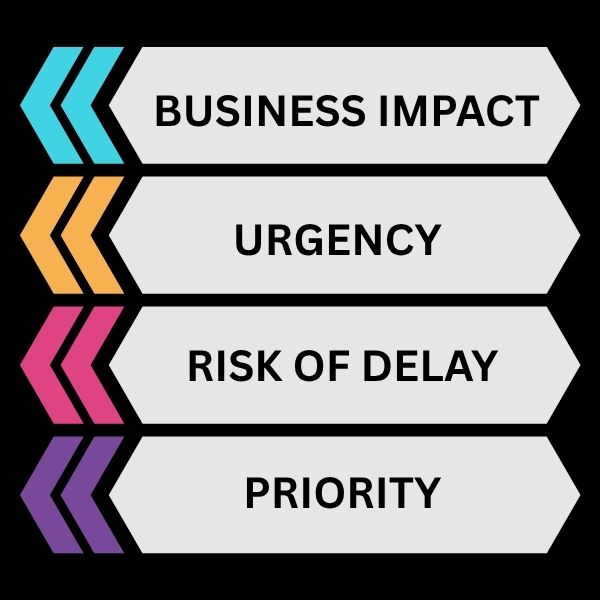
This prioritizing tasks in business method gives you a consistent way to compare competing responsibilities and choose what deserves attention first.
Give each task a score from 1 to 3 for three factors:
- Business impact: 1 means low impact, 2 means moderate impact, and 3 means high impact.
- Urgency: 1 means it can wait, 2 means it needs attention soon, and 3 means it requires attention very soon.
- Risk of delay: 1 means little consequence if delayed, 2 means a meaningful disadvantage, and 3 means a serious consequence.
Add the three scores. The maximum is 9. A higher total suggests that a task deserves earlier attention.
This is a practical heuristic, not a scientifically validated formula. It supports judgement rather than replacing it. Critical legal, safety, financial, and customer commitments may require immediate attention regardless of their total score.
Consider this illustrative example:
| Task | Impact | Urgency | Delay risk | Total |
|---|---|---|---|---|
| Follow up on a qualified sales lead | 3 | 3 | 2 | 8 |
| Resolve a customer delivery issue | 3 | 3 | 3 | 9 |
| Redesign a low-traffic website section | 1 | 1 | 1 | 3 |
The delivery issue ranks first because delaying it could harm the customer relationship. The sales follow-up comes next because the opportunity may be time-sensitive. The website redesign can be scheduled for later.
Reassess the scores whenever circumstances change. A task that appears minor today may become important if a deadline approaches or new information emerges.
Common Prioritisation Mistakes to Avoid
Even a good planning system can fail when everyday habits undermine it.
- Treating every task equally: Connect each task to a business outcome before deciding when to do it.
- Responding to every notification: Turn off non-essential alerts and check routine messages at planned intervals.
- Choosing easy tasks first: Begin with a meaningful task when your energy and schedule allow, rather than using small tasks to avoid difficult work.
- Ignoring sales and cash collection: Reserve regular time for customer follow-ups, payment reminders, and retention activities.
- Overloading the day: Estimate the time required and leave room for operational interruptions.
- Postponing strategic work: Give important long-term activities a specific place on your calendar.
- Changing direction too frequently: Require a clear reason before replacing an existing priority.
- Refusing to delegate: Identify tasks that can be handled reliably by someone else or simplified with a basic system.
The goal is not to eliminate every interruption. It is to prevent avoidable distractions from controlling your working day.
A Simple Daily Prioritisation Routine
Use this repeatable routine to make your daily business priorities clearer:
- Review commitments: Check deadlines, customer promises, payments, and operational issues that cannot safely wait.
- Choose the main outcome: Decide what result would make the day worthwhile for your business.
- Select your top three priorities: Choose tasks that contribute directly to that outcome or protect essential operations.
- Protect focused time: Start with the highest-impact task when practical and give it an uninterrupted block.
- Batch routine work: Group messages, administration, and similar activities where your business allows it.
- Review the day: Record progress, carry forward genuine unfinished priorities, and prepare tomorrow’s list.
A practical time management routine for entrepreneurs can help you turn these choices into a workable schedule. Prioritisation determines what deserves attention; time management helps you decide when and how to give it that attention.
A Realistic Example: A Local Retailer
Imagine a local retailer starting the day with three unfinished tasks: a qualified bulk-order enquiry, social media graphics for next week, and an internal spreadsheet that needs reorganising.
The retailer checks the order deadline, responds to the potential buyer, and confirms the next steps. They then handle an urgent customer delivery issue before scheduling the graphics and spreadsheet work for a quieter period.
This hypothetical example shows how to rank tasks by their business consequences instead of their convenience. The retailer is not abandoning marketing or administration. They are completing the work with the greatest immediate impact first.
The same approach can work for freelancers, online sellers, service providers, and solo founders. The exact priorities differ, but the decision process remains useful.
Key Takeaways
- Prioritise outcomes, not activity: A full task list does not guarantee meaningful progress.
- Separate urgency from importance: Immediate requests are not always the most valuable work.
- Consider business impact: Revenue, customers, cash flow, risk, and strategic goals all matter.
- Respect genuine deadlines: Check dependencies and consequences before choosing the order.
- Keep daily priorities realistic: Three meaningful priorities provide a useful starting point.
- Remove low-value work: Delegate, defer, automate, or stop tasks where appropriate.
- Review and adapt: Change your plan when new evidence or genuine business needs justify it.
Conclusion
Effective prioritisation is a business skill, not just a productivity technique. When you choose tasks based on their impact, deadlines, and consequences, you give your limited time and resources a clearer purpose.
You will not complete everything every day, and you do not need to. Focus on the work that supports customers, protects cash flow, creates sales opportunities, and builds a stronger business. Schedule important long-term work before it becomes urgent, and stop giving low-value activities more attention than they deserve.
Start tomorrow by identifying your most important business outcome, selecting three priorities, and reviewing what you achieved. Small, deliberate choices can make your working day more focused and your business decisions more practical.
Believe • Build • Inspire
