Studying successful founders is easy. Understanding the decisions that made their businesses work is much more useful.
India’s startup ecosystem has produced founders across fintech, consumer businesses, food technology, biotechnology, SaaS, e-commerce, and financial services. Their journeys are very different, but some patterns appear repeatedly. They identify real problems, understand customers, manage resources carefully, build capabilities and change direction when evidence demands it.
The most useful lessons from Indian startup founders are therefore not about copying Zerodha, Nykaa, Zoho or any other successful company. They are about understanding the principles behind important decisions and adapting those principles to your own market, resources and circumstances.
For a first-time entrepreneur, that distinction matters. Your starting point may be a small service business, a side project, or an early startup. You can still learn from founders who built much larger companies.
What Can First-Time Entrepreneurs Learn From Indian Startup Founders?
First-time entrepreneurs can learn to solve real customer problems, use their existing strengths, validate ideas before investing heavily, manage cash carefully, build useful products, strengthen operations, earn customer trust, and think long-term. Just as importantly, they can learn to adapt when evidence changes instead of becoming attached to their original plan.
Table of Contents
Why Study Indian Startup Founders?
There is no single Indian startup formula.
Nithin Kamath built Zerodha after experiencing problems in traditional broking. Falguni Nayar brought investment banking experience into a consumer beauty business. Kiran Mazumdar-Shaw built Biocon in a specialised and highly regulated industry. Sridhar Vembu developed Zoho around a long-term, bootstrapped approach.
Deepinder Goyal started Zomato by solving a very practical information problem around restaurant menus. Swiggy developed its business around urban convenience and continued expanding its service model.
These founders operated in different industries, periods, capital environments, and customer segments.
These lessons from Indian startup founders are valuable because they come from very different business environments.
That is why their stories are worth studying together.
The objective is not to find one founder to imitate. It is to identify decisions that can improve your own decision-making.
8 Lessons From Indian Startup Founders
The following lessons from Indian startup founders focus on decisions that a first-time entrepreneur can adapt to a smaller business.
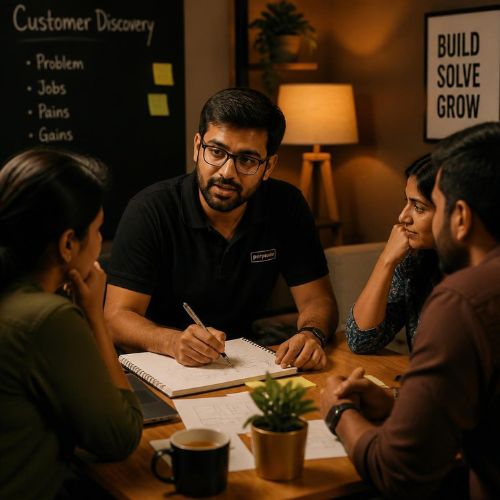
1. Start With a Real Customer Problem
Founder Example
Deepinder Goyal’s early Zomato journey provides a useful example. While working at Bain & Company, he noticed colleagues struggling to access restaurant menus. Instead of beginning with a complicated technology product, he and Pankaj Chaddah started by scanning menus and putting them online.
What They Did
The initial solution was simple. It addressed an observable problem before becoming a much broader platform.
The important lesson is that the original version of a business does not need to look like the final company.
What First-Time Entrepreneurs Can Learn
A startup idea becomes more useful when it is connected to a specific problem experienced by identifiable customers.
Instead of asking, “What business should I start?”, ask:
“What problem do people repeatedly face, and how are they solving it today?”
How to Apply It
- Write down three recurring problems you have personally observed.
- Identify exactly who experiences each problem.
- Study how customers solve it today.
- Look for complaints, workarounds, and unmet needs.
- Test whether people would actually pay for a better solution.
If you are still searching for an opportunity, start with our guide on how to find a startup idea.
Real-Life Example
Zomato began with restaurant menus and discovery rather than the much broader food ecosystem it later became. Deepinder Goyal has explained that the company initially used scanned menus before expanding into online ordering and other services. The significance is simple: start by solving one useful problem, then let evidence guide what comes next.
2. Use Your Existing Experience as an Advantage
Founder Example
Falguni Nayar did not enter entrepreneurship without professional experience. Before founding Nykaa, she spent 18 years at Kotak Mahindra Capital Company, including serving as a managing director.
Kiran Mazumdar-Shaw provides another example from a completely different field. Her biotechnology background became closely connected with the business she built at Biocon.
What They Did
Both examples show that previous experience can become an entrepreneurial asset.
It does not mean you must start a business in exactly the same industry. Financial analysis, sales, marketing, technology, operations, or industry knowledge can transfer into a new venture.
What First-Time Entrepreneurs Can Learn
Your previous career may have already given you skills that another founder would need years to develop.
How to Apply It
- List your strongest professional skills.
- Identify industries where those skills are valuable.
- Look for customer problems you understand better than outsiders.
- Use your existing network for early research.
- Identify the skills you still need to learn or outsource.
The goal is not to stay inside your comfort zone. It is to recognise the assets you already have.
Real-Life Example
Nykaa’s own company profile identifies Falguni Nayar as its founder and notes her extensive experience in e-commerce, investment banking, and broking. Her entrepreneurial journey shows how existing professional capabilities can become useful when entering a new business category.
3. Validate Before Scaling
Founder Example
Deepinder Goyal’s early experience also demonstrates why timing and validation matter. His first food-ordering venture was attempted before the market was ready. Later, the business restarted with a simpler restaurant discovery model.
Zomato’s evolution illustrates an important principle: an entrepreneur can change the product when the original approach does not provide enough evidence.
What They Did
The founders moved from an early concept toward a simpler model that customers could actually use.
What First-Time Entrepreneurs Can Learn
Do not confuse enthusiasm with validation.
Before investing heavily in technology, employees, inventory, or advertising, build evidence that the problem matters and that customers are willing to act.
One of the most practical lessons from Indian startup founders is to build evidence before making large commitments.
How to Apply It
- Identify your riskiest assumption.
- Talk to potential customers.
- Test demand with the smallest practical experiment.
- Measure actual behaviour, not just compliments.
- Change the idea if the evidence challenges your assumptions.
Our guide on how to validate a startup idea before building it covers this process in greater detail.
You can then use how to build an MVP when you are ready to test a practical version of the solution.
Real-Life Example
Zomato’s early transition from food ordering to restaurant menus and discovery shows the value of changing direction when circumstances demand it. The lesson is not that one particular model is correct. It is that founders should remain willing to test, learn, and adapt.
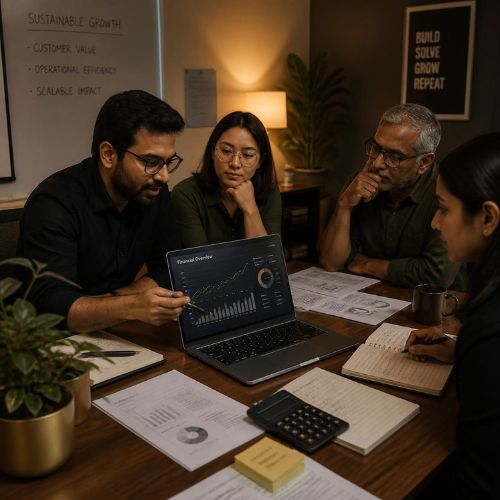
4. Treat Money as a Strategic Resource
Founder Example
Nithin Kamath and Sridhar Vembu offer two strong examples of financial discipline.
Zerodha was bootstrapped, while Zoho has also described itself as bootstrapped and privately held.
What They Did
Both businesses developed with a strong focus on generating value from customers rather than treating outside capital as the automatic starting point.
However, this does not mean bootstrapping is always better.
Some businesses require substantial capital because of technology, infrastructure, research, regulation, or market timing.
What First-Time Entrepreneurs Can Learn
Money gives you options, but poor financial discipline can reduce those options quickly.
The objective is not simply to spend less. It is to understand what each major expense is expected to achieve.
How to Apply It
- Separate essential spending from optional spending.
- Track monthly cash flow.
- Know how much it costs to serve each customer.
- Avoid hiring before the workload justifies it.
- Decide what milestone each major investment should produce.
If you are evaluating financing options, read our guides on bootstrapping a startup and bootstrapping vs funding.
Financial discipline is another important part of the lessons from Indian startup founders.
Real-Life Example
Zerodha’s official company profile says Nithin Kamath bootstrapped the company after experiencing problems during his years as a trader. Zoho has also publicly explained why it chose to remain bootstrapped. These examples demonstrate that financial independence can be a strategic choice, not simply a limitation.
5. Build the Simplest Product That Solves the Problem
Founder Example
Zomato’s early use of scanned restaurant menus is useful here, but the broader principle applies far beyond food technology.
The first version of a product does not need every feature that might eventually exist.
What They Did
The early product focused on providing useful information. More complex services came later.
What First-Time Entrepreneurs Can Learn
Many beginners try to build the complete business before proving that the core problem is worth solving.
That can lead to unnecessary development, higher costs, and slower learning.
How to Apply It
Ask:
- What is the one problem my first version must solve?
- Which feature is essential?
- Which feature can wait?
- What can be done manually at first?
- What customer behaviour would prove that the solution is useful?
Your MVP should help you learn something important.
For a practical framework, see how to build an MVP.
Real-Life Example
Zomato’s early restaurant discovery product was far simpler than the broader platform that followed. The lesson for a beginner is not to copy the product. It is to identify the smallest useful solution that can generate real customer learning.
6. Build Operations Before Chasing Growth
Founder Example
Falguni Nayar and Nykaa provide a useful lesson in the relationship between customer demand and operational capability.
A business can generate strong demand and still struggle if inventory, fulfilment, customer service, or other processes cannot support that demand.
What They Did
Nykaa built a consumer business where product authenticity, customer experience, fulfilment and retail operations were important parts of the overall proposition.
What First-Time Entrepreneurs Can Learn
Growth exposes weaknesses.
If your business gets ten times more customers tomorrow, the processes that worked with ten customers may not work with one hundred.
How to Apply It
Before accelerating marketing:
- Document your important processes.
- Identify the first point that would break under higher demand.
- Improve delivery and customer support.
- Track recurring operational errors.
- Create simple systems before adding complexity.
Our guide on how to scale a small business covers this transition from early traction to repeatable operations.
Real-Life Example
Nykaa’s focus on authenticity and its product onboarding and warehouse processes show that trust and operations are part of the customer proposition, not separate back-office concerns.
7. Earn Trust Before Chasing Scale
Founder Example
Nithin Kamath and Falguni Nayar both demonstrate why trust can become part of a business model.
Zerodha’s customer-focused approach and Nykaa’s emphasis on product authenticity show two different ways of building confidence in a customer’s decision.
What They Did
Zerodha built around simplifying the customer experience in broking. Nykaa has publicly emphasised product authenticity and sourcing through brands or authorised distributors.
What First-Time Entrepreneurs Can Learn
A customer does not only buy the product.
They also buy the confidence that the product will work, the company will deliver what it promised, and problems will be handled responsibly.
How to Apply It
- Make clear promises.
- Do not hide important limitations.
- Respond quickly when something goes wrong.
- Ask customers what makes them hesitant to buy.
- Make reliability part of your product strategy.
You can also explore Nithin Kamath business lessons for a deeper look at customer focus, financial discipline, and sustainable growth.
Real-Life Example
Nykaa’s published authenticity guarantee states that products are sourced directly from brands or authorised distributors. That is a concrete example of turning customer confidence into an operating principle rather than treating trust as just a marketing message.
8. Think Long Term, But Adapt
Founder Example
Sridhar Vembu’s Zoho journey and Azim Premji’s transformation of Wipro demonstrate two different forms of long-term thinking.
Long-term thinking is not about keeping the same plan forever.
What They Did
Zoho has maintained a long-term, privately held, and bootstrapped approach. Wipro, meanwhile, evolved significantly under Azim Premji as the business moved from its earlier operations into technology services.
What First-Time Entrepreneurs Can Learn
A long-term objective gives you direction. Adaptability helps you reach that objective when circumstances change.
The two are not opposites.
How to Apply It
- Define where you want the business to be in three to five years.
- Review your assumptions regularly.
- Change tactics when evidence changes.
- Protect important values while changing methods.
- Avoid abandoning a good business simply because progress is slower than expected.
For another perspective on long-term thinking, see Azim Premji business lessons and our guide to leadership principles for entrepreneurs.
Real-Life Example
Zoho’s own account of its journey describes a business built over decades without outside venture capital. Wipro’s history shows a different path, involving major changes in business direction. Together, they demonstrate that long-term thinking can coexist with strategic adaptation.
What First-Time Entrepreneurs Should Not Copy
This is one of the most important lessons from Indian startup founders: understand the context behind a decision before applying it.
Successful founders are useful teachers, but their timelines are not templates.
Do not automatically:
- Copy a founder’s business model without understanding your market.
- Raise funding because another founder raised it.
- Expand into multiple cities before proving one market.
- Hire a large team before the workload requires it.
- Copy another company’s marketing strategy.
- Assume a famous founder’s timeline is normal.
- Chase valuation instead of business fundamentals.
- Treat one founder’s unusual circumstances as a universal formula.
The most useful principle is simple:
Copy principles, not timelines.
Zerodha’s capital strategy may not suit a biotech startup. Nykaa’s retail model may not suit a software company. Zoho’s long bootstrapped journey may not be practical for every capital-intensive business.
Your job is to understand why a decision worked in its original context and then decide whether the underlying principle fits yours.
Founder Comparison
| Founder | Company | Lesson | What a Beginner Can Apply |
|---|---|---|---|
| Nithin Kamath | Zerodha | Customer focus and financial discipline | Solve a real problem and manage cash carefully |
| Falguni Nayar | Nykaa | Experience, customer understanding and operations | Use existing skills and build operational strength |
| Kiran Mazumdar-Shaw | Biocon | Technical knowledge and capability building | Turn expertise into a differentiated business |
| Sridhar Vembu | Zoho | Long-term thinking and financial independence | Build patiently and avoid unnecessary capital dependence |
| Deepinder Goyal | Zomato | Problem discovery and iteration | Start simple and adapt based on evidence |
| Sriharsha Majety | Swiggy | Customer convenience and execution | Focus on the customer experience behind the product |
| Azim Premji | Wipro | Adaptability and capability building | Change direction when markets change |
| Ratan Tata | Tata Group | Calculated risk and long-term leadership | Take thoughtful risks without ignoring fundamentals |
How to Apply These Lessons to Your Own Business
The best way to turn these lessons from Indian startup founders into useful business decisions is to convert them into a simple process.

Step 1: Identify One Problem
What specific customer problem are you solving?
Avoid starting with a broad statement such as “I want to build a successful startup.”
Define the problem clearly.
Step 2: Talk to Customers
Ask potential customers how they solve the problem today.
Listen for repeated frustrations, existing alternatives, and willingness to pay.
Step 3: Start Small
Build the smallest practical version you can test.
Do not invest heavily simply because you are excited about the idea.
Step 4: Get Early Customers
Try to get your first few paying customers through direct conversations, referrals, communities or founder-led sales.
Our guide on how to get your first 10 customers can help you structure this stage.
Step 5: Track the Economics
Know what it costs to acquire and serve a customer.
Revenue alone does not tell you whether the business is healthy.
Step 6: Improve
Use customer feedback to improve the product, offer, pricing, or process.
Do not defend every original decision simply because it was yours.
Step 7: Decide Whether to Scale
Scale when the evidence supports it.
If customers are returning, the economics are improving, and your operations can handle additional demand, growth becomes a more informed decision.
For the next stage, see how to get your first 100 customers for a startup and how to scale a small business.
Key Takeaways
- Start with a real customer problem, not just an interesting idea.
- Use your existing experience as an entrepreneurial advantage.
- Validate important assumptions before making large commitments.
- Treat cash flow and capital allocation as strategic decisions.
- Build the simplest useful product before adding complexity.
- Strengthen operations before accelerating growth.
- Earn trust through reliable products and clear promises.
- Think long-term while remaining willing to adapt.
- Study founder decisions rather than copying founder timelines.
Frequently Asked Questions
What can first-time entrepreneurs learn from Indian startup founders?
The most useful lessons from Indian startup founders include customer discovery, validation, financial discipline, product development, operations, and long-term thinking. The important point is to adapt these principles to their own business rather than copying a successful founder’s exact strategy.
Who are some Indian startup founders worth studying?
Nithin Kamath, Falguni Nayar, Kiran Mazumdar-Shaw, Sridhar Vembu, Deepinder Goyal, and Sriharsha Majety offer different entrepreneurial perspectives. Founders such as Azim Premji and Ratan Tata can also provide useful lessons in long-term business building and leadership.
What is the most important lesson from successful startup founders?
One of the most important lessons is to build around a real customer problem and learn from evidence. Successful founders often change products, strategies, or processes as they learn more about their customers and markets.
Should first-time entrepreneurs copy successful founders?
No. Entrepreneurs should copy principles, not timelines. A founder’s decision was made within a particular market, financial situation, industry, and period. What worked there may not work for another business.
How can a beginner apply lessons from Indian startup founders?
Start with one problem, speak with potential customers, test a small solution, get early customers, track the economics, and improve based on evidence. These actions turn founder lessons into practical business decisions.
Do Indian startup founders usually bootstrap or raise funding?
There is no single pattern. Some Indian founders, including Nithin Kamath and Sridhar Vembu, built businesses through bootstrapping. Other startups have raised significant external capital because their business models required it. The right financing strategy depends on the business.
Conclusion
Successful founders are useful teachers when we study the decisions behind their businesses rather than simply admiring the outcomes.
A first-time entrepreneur does not need to reproduce Zerodha, Nykaa, Zoho, or any other successful company. The more useful goal is to understand why founders solved particular problems, managed constraints, tested assumptions, built trust, and changed their strategies when circumstances demanded it.
The real value of these lessons from Indian startup founders is not in copying their companies, but in understanding how they made decisions.
Your business may be much smaller. Your market may be different. Your resources may be limited. That does not prevent you from applying the same discipline of thinking.
Study the decisions. Adapt the principles. Build according to your own reality.
Believe • Build • Inspire

Loved this topic!
A useful and inspiring read for aspiring entrepreneurs. Consistency, adaptability, and customer focus are key to building a successful startup.