
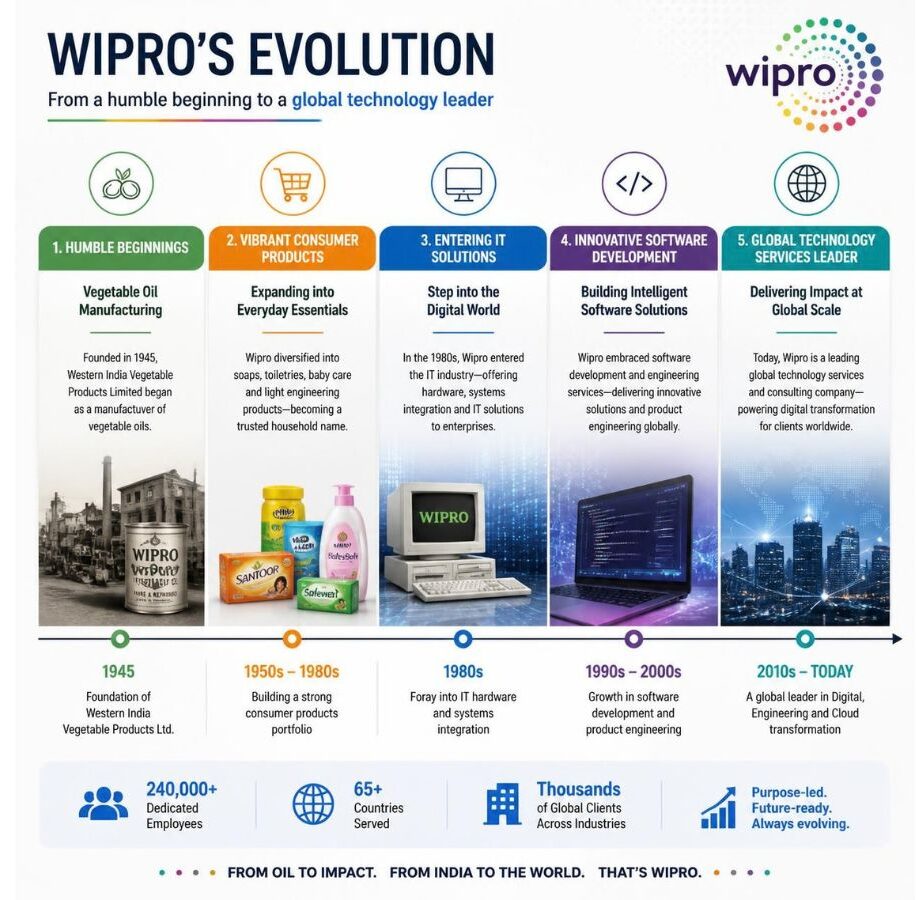
Most people know Wipro as a global technology company. Fewer remember that it began in 1945 as a vegetable oil business. The distance between that starting point and today’s Wipro is one reason Azim Premji business lessons are worth studying.
The useful part is not simply the size of the company. It is the thinking behind the journey: recognising new opportunities, adapting as markets changed, developing capabilities, and keeping values at the centre of business decisions.
This article looks at seven lessons drawn from documented decisions and practices associated with Wipro under Premji. Where a lesson is an interpretation rather than a stated Premji principle, it is presented as an entrepreneurial application rather than a direct quote or personal teaching.
Table of Contents
What Can Entrepreneurs Learn From Azim Premji?
Wipro’s evolution under Premji offers seven practical lessons: look beyond the business you started, build for the long term, make ethics part of the business, adapt when markets change, invest in people and capability, connect business with purpose, and stay grounded as you grow. Together, these Azim Premji business lessons show how strategy, values, and patience can shape a business over time.
Key Takeaways
- A first product can be a starting point, not a permanent limit.
- Long-term building requires patience and deliberate investment.
- Ethics affects trust, and trust affects business relationships.
- Adapting does not mean abandoning every existing strength.
- Strong companies build capability beyond the founder.
- Purpose can provide direction when difficult trade-offs arise.
- Values become increasingly important as a business grows.
Who Is Azim Premji?
Azim Premji took charge of his family’s business in the 1960s and went on to lead Wipro for more than five decades. In 2019, he stepped back as Executive Chairman after 53 years at the helm and continued as Founder Chairman.
Wipro began as a vegetable oil manufacturer in 1945. Under Premji’s leadership, it expanded into consumer products and entered India’s IT industry in the early 1980s. In the 1990s, Wipro began offering software services to global clients. The company later demerged its non-IT diversified businesses and became focused on global IT services.
Today, Wipro describes itself as a global technology services and consulting company, with FY2026 revenue of about $10.5 billion and operations across 65 countries.
Wipro’s history of transformation provides the context. The lessons come from examining the decisions and principles behind it.
1. Look Beyond the Business You Started
The business example.
Wipro began as a cooking oil manufacturer. During the late 1970s and early 1980s, under Premji’s leadership, the company expanded into India’s IT industry. It later used its hardware and software capabilities to offer services to global clients.
This was not simply a change in product. It represented a much broader change in the type of business Wipro was building.
The entrepreneurial lesson.
Wipro’s transformation suggests that entrepreneurs can remain committed to building a lasting company without becoming permanently attached to the first product or business model they created.
That does not mean abandoning a business whenever something new appears. It means paying attention when customers, technology, or market conditions reveal a credible adjacent opportunity.
How to apply it.
- Keep a record of customer requests you cannot currently fulfil.
- Note which related problems appear repeatedly.
- Identify opportunities that match capabilities you already have.
- Test one adjacent offer as a small pilot before making a major investment.
For example, a tailor who repeatedly receives requests for school uniforms could test one small uniform order before deciding whether that should become a new business line.
2. Build for the Long Term
The business example.
Wipro’s transformation from a vegetable oil business into a global technology company did not happen through one launch or one short-term strategy. It developed through decades of diversification, technology investment, capability building, and organisational change.
Premji’s long tenure also meant that major business decisions could be viewed across a much longer period than a single financial quarter.
The entrepreneurial lesson.
Long-term thinking allows entrepreneurs to make investments that may not produce immediate returns but can strengthen the business later.
Skills, reputation, systems, customer relationships, and organisational capability often take time to develop. A founder focused only on the next sale can overlook these foundations.
How to apply it.
- Write a three-year direction and break it into 90-day actions.
- Before a major decision, ask what it does to trust and capability over the next three years.
- Reinvest part of early profits into skills, systems, or customer experience.
- Avoid sacrificing long-term trust simply to improve a short-term number.
This way of thinking also connects with the broader entrepreneur mindset required to operate under uncertainty.
3. Make Ethics Part of the Business
The business example.
Wipro’s stated values include passionate commitment to client success, respect for each person, global responsibility and unyielding integrity. Wipro describes integrity as including honesty, fairness, and delivering on commitments.
Wipro has also publicly connected its purpose-driven approach with Premji’s belief that sustainable economic value should be created on a foundation of ethics and responsibility.
The entrepreneurial lesson.
Ethics is not simply a statement on a company website. It affects how customers, employees, suppliers, and partners experience the business.
A company can lose trust through exaggerated claims, hidden conditions, unreliable delivery promises, or unfair treatment. Once trust is damaged, repairing it can take much longer than creating it.
How to apply it.
- Write three business rules you will not compromise on.
- Avoid making claims that you cannot substantiate.
- Be transparent when a problem affects a customer.
- Decide in advance how you will respond when a profitable opportunity conflicts with your values.
Good decision-making skills for entrepreneurs can help founders consider both immediate benefits and longer-term consequences.
4. Adapt When the Market Changes
The business example.
Wipro entered IT when the industry was still developing in India. The company’s transformation continued through hardware, software development, and global IT services.
At the same time, Wipro’s broader business history included businesses outside IT. The company later demerged its non-IT diversified businesses in 2013, creating a more focused IT services organisation.
This history shows that business adaptation can involve both expansion and later simplification.
The entrepreneurial lesson.
Adapting does not mean abandoning every strength you already have.
A business can carry existing customer knowledge, operational discipline, relationships, brand trust and other capabilities into a new opportunity. At other times, it may need to simplify or exit activities that no longer fit its direction.
The important question is not whether you should change. It is what the evidence says you should change and what you should preserve.
How to apply it.
- Review sales and customer questions regularly for patterns.
- Before changing direction, list the strengths you can carry forward.
- Test a new direction through a small experiment.
- Review whether an existing product still fits your long-term strategy.
If your original idea is struggling, first examine the evidence before deciding whether to improve, pivot, or pause. Your guide on what to do when your business idea isn’t working provides a useful next step.

5. Invest in People and Capability
The business example.
Wipro’s stated values include treating each person with respect and creating an environment where people can learn, share, and grow. Its current strategy also continues to emphasise talent and differentiated capabilities.
Leadership continuity provides another useful example. Rishad Premji became Executive Chairman in 2019, while Srinivas Pallia became CEO and Managing Director in 2024 after a long career with Wipro.
These facts do not prove that any single internal people strategy caused Wipro’s growth. They do, however, illustrate the importance of leadership depth and organisational capability in a large company.
The entrepreneurial lesson.
A business becomes less dependent on its founder when knowledge, skills, responsibilities, and decision-making capability are distributed across the organisation.
This matters even in a five-person business. If every important decision depends on the founder, growth can quickly create a bottleneck.
How to apply it.
- List the three skills your business depends on most.
- Identify who currently holds each critical capability.
- Train at least one backup person for important tasks.
- Document one recurring process every week.
- Give capable team members responsibility for measurable outcomes.
If you are still developing your own foundation, start with these essential skills for entrepreneurs.
6. Connect Business With Purpose
The business example.
The Azim Premji Foundation was established in 2001. Wipro states that Premji and the promoter group have pledged 66% of Wipro’s economic ownership to the Foundation for philanthropic purposes.
Wipro also describes itself as a purpose-driven company and connects its business approach with wider responsibilities toward communities and the environment.
These are documented facts. The entrepreneurial lesson that follows is an application, not a claim that Premji expects every entrepreneur to follow the same model.
The entrepreneurial lesson.
Purpose does not require a founder to copy Premji’s philanthropic structure.
For a small business, purpose can simply mean being clear about the problem you exist to solve, the people you serve, and the values you will not compromise.
Purpose can become particularly useful when two commercially attractive options have different consequences for customers, employees or the wider community.
How to apply it.
- Write one sentence describing your business purpose beyond profit.
- Define who benefits from solving the problem.
- Choose one measurable responsibility you can realistically maintain.
- Make sure your stated values influence actual decisions.
7. Stay Grounded While Building at Scale
The business example.
Wipro describes its Spirit of Wipro as a consistent set of values that has remained central while the company has transformed over time. Its current materials continue to emphasise values such as respect, responsibility, integrity and trust.
Premji’s transition from Executive Chairman in 2019 also illustrates an important aspect of organisational continuity: leadership roles can change while the organisation continues operating around established structures and values.
The entrepreneurial lesson.
This lesson is an inference from the documented history, rather than a direct statement from Premji.
Growth becomes easier to manage when decision rights, processes, values, and leadership responsibilities are not left entirely to informal founder control.
This applies to a five-person business as much as a large company.
How to apply it.
- Decide who approves spending, pricing, and hiring.
- Review cash, customers, and quality every month.
- Document responsibilities as the team grows.
- Ask what would happen if you were unavailable for two weeks.
- Review whether your business still operates according to the values you established at the beginning.
If you are preparing to grow beyond the founder-led stage, see how to scale a small business for practical systems and growth considerations.
Key Takeaways From These Azim Premji Business Lessons
- Track repeated customer requests and test adjacent opportunities.
- Think in long-term directions while working through short-term actions.
- Write down your non-negotiable business rules.
- Preserve useful strengths when changing direction.
- Build backups for important skills and processes.
- Define a purpose that your business can actually deliver.
- Put systems and decision responsibilities in place before growth makes them urgent.

Frequently Asked Questions
What Can Entrepreneurs Learn From Azim Premji?
Entrepreneurs can learn about adaptability, long-term thinking, ethical business practices, capability building, leadership development, and responsible value creation. Wipro’s transformation provides documented examples of these themes. The practical takeaway is to adapt the underlying principles to your own business rather than attempt to copy Wipro’s scale or strategy.
What Made Azim Premji Successful?
Premji led Wipro through a transformation from a vegetable oil business into a diversified group and eventually a global technology services company. The documented history spans more than five decades and includes diversification, entry into IT, technology capability development, global expansion, and organisational change. No single factor explains the entire journey.
How Did Azim Premji Transform Wipro?
Wipro began as a vegetable oil manufacturer in 1945, expanded into consumer products, entered the Indian IT industry in the early 1980s, and began offering software services to global clients in the 1990s. It later demerged its non-IT diversified businesses and focused on global IT services.
What Leadership Principles Is Azim Premji Known For?
Wipro’s documented values associated with its leadership culture include client success, respect for each person, global responsibility, and unyielding integrity. Wipro also connects its purpose-driven approach with ethics, responsibility, and wider stakeholder value.
What Can Small-Business Owners Learn From Azim Premji?
Small-business owners can borrow the principles rather than the scale. Test adjacent opportunities, protect trust, develop people, document important processes, and think beyond immediate sales. These practices can help make a small business less dependent on the founder and better prepared for future growth.
How Can Entrepreneurs Apply Premji’s Business Lessons Today?
Choose one principle that matches your current business challenge and turn it into a specific action. For example, track repeated customer requests, document one important process or review a major decision from a long-term perspective. Treat these lessons as prompts for your own judgement, not guarantees of success.
Conclusion
Studying successful entrepreneurs is most useful when it goes beyond admiration. The real value lies in understanding the decisions, principles and habits that can be adapted to circumstances very different from those of a large global company.
The Azim Premji business lessons discussed here show how entrepreneurs can remain open to change, build capabilities, protect trust, develop people and think about the wider purpose of their work.
You do not need Wipro’s resources to apply these ideas. Start with the problem you can understand, the customer you can reach, and the capability you can build next.
That is the practical spirit behind Dream Entrepreneur:
Believe in a meaningful opportunity, Build with discipline and responsibility, and Inspire through the value your business creates.
No lesson guarantees success. Start with one principle, apply it to your business, and let evidence guide what you do next.
Ashutosh Keshari
Founder • Dream Entrepreneur
