Starting a startup is exciting, but building one is rarely straightforward. Founders can have a strong idea, a capable team, and even early customers, yet still struggle because important business fundamentals were misunderstood or addressed too late.
If you are wondering why startups fail, the answer is usually more complicated than one bad decision. Problems with customer demand, product-market fit, cash flow, execution, team alignment, business economics, or timing can interact and eventually put pressure on the entire business.
Understanding why startups fail requires looking at what happens before the final crisis.
The useful question is not only why a startup failed. It is whether you can recognise the warning signs early enough to make a better decision.
Table of Contents
Why Do Startups Fail?
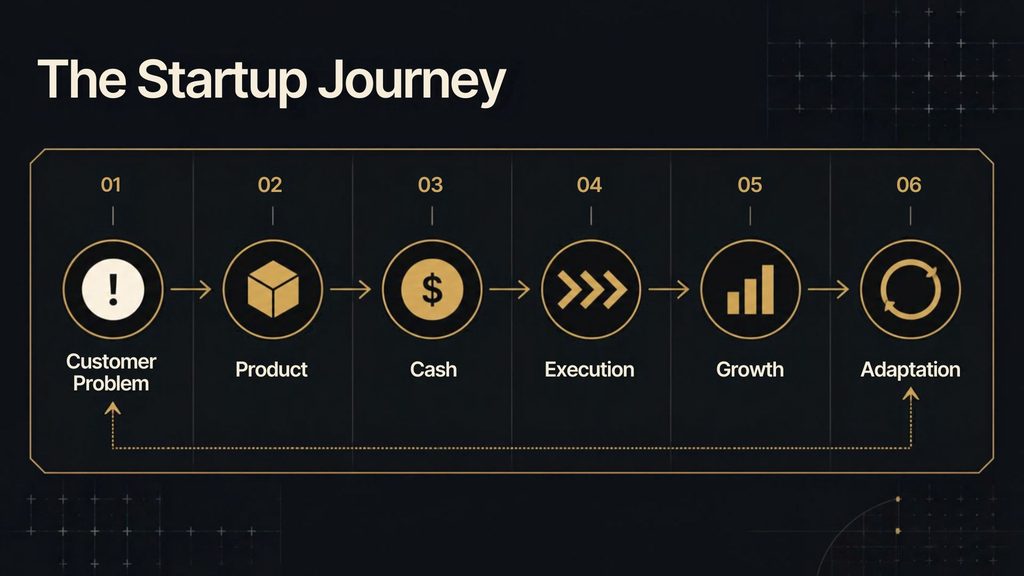
Startups fail when important business fundamentals do not work well enough to support the company. Common reasons include solving a weak customer problem, poor product-market fit, misunderstanding the target customer, running out of cash, scaling too early, weak execution, ignoring customer feedback, founder or team problems, poor unit economics, and failing to adapt. Often, several problems occur together rather than one isolated mistake causing failure.
The goal is therefore not to avoid every mistake. It is to identify important problems early, test your assumptions, and fix the highest-impact issue before it becomes more expensive.
1. Solving a Problem Customers Do Not Care Enough About
One of the most important reasons startups fail is that the founder solves a problem that exists but is not painful enough for customers to act on.
There is a difference between:
- “This would be useful.”
- “I would probably try it.”
- “I need this solved.”
Only the last response shows strong urgency.
Warning signs
You may have a weak problem-solution foundation if:
- Customers are interested but do not buy.
- People compliment the idea but do not use it.
- You cannot identify a specific customer group with the problem.
- Customers already have an acceptable alternative.
- The problem happens rarely.
Lesson
Do not confuse interest with demand.
Ask potential customers:
- How do you solve this problem today?
- How often does it happen?
- What does the problem currently cost you?
- Have you already paid for a solution?
- What would make you switch?
Before building heavily, research the opportunity. Your guide on how to find a startup idea can help you begin with real customer problems rather than random ideas.
Practical action: Identify your biggest assumption about the customer problem and test it with real conversations or a small experiment.
2. Poor Product-Market Fit
A startup may have a real problem to solve but still fail to create a product that customers consistently want.
Product-market fit means, in simple terms, that a product solves an important problem well enough for a defined group of customers to keep using or buying it.
Downloads, website traffic, social media attention, or investor interest do not automatically prove product-market fit.
Warning signs
Look for patterns such as:
- Customers try the product but do not return.
- Retention remains weak.
- Conversion is consistently poor.
- Users need heavy discounts to buy.
- Customers do not consider the product important enough to keep using.
Recent analysis of startup post-mortems by CB Insights found poor product-market fit among the major causes cited by failed companies.
Lesson
Do not measure only how many people arrive. Measure what they do afterwards.
Practical action: Track activation, repeat usage, retention, conversion, and customer feedback. If the evidence remains weak, improve the product or reconsider the target market before spending more on growth.
3. Not Understanding the Target Customer
“Everyone” is not a customer segment.
When a startup tries to serve everyone, its messaging, product priorities, pricing, and marketing often become unclear.
A founder should understand:
- Who experiences the problem?
- What alternatives do they use?
- What matters most to them?
- How much are they willing to pay?
- Where do they discover solutions?
- What might stop them from buying?
A useful customer definition might be much narrower than expected.
For example, “small businesses” is broad. “Independent Indian retailers with two to five stores that struggle to track inventory across locations” gives you a much clearer starting point.
Lesson
Specificity improves decision-making.
Our guide on how to research a business idea before you start covers customer research, competitors, demand, pricing, costs, and testing in more detail.
Practical action: Write down your ideal first customer in one sentence. Then speak to people who actually fit that description.
4. Running Out of Cash
A startup can have customers and still run into trouble if its cash position is poorly managed.
Four terms are especially important:
- Revenue: Money generated from customers.
- Profit: Revenue remaining after expenses.
- Burn rate: How quickly the company is spending cash.
- Runway: How long the available cash can support the business at its current burn rate.
Revenue does not mean you have enough cash to survive.
A startup can increase sales while still losing money because costs are growing faster than revenue.
Warning signs
- Monthly expenses keep increasing.
- Cash runway is shrinking rapidly.
- Hiring happens before revenue justifies it.
- Marketing spending is difficult to connect to results.
- The company depends on raising money simply to continue operating.
CB Insights’ 2026 analysis of 431 VC-backed shutdowns found that running out of capital was the most frequently cited final cause, while poor product-market fit and unsustainable economics often appeared earlier in the chain of problems.
Lesson
Cash is not a substitute for a working business model.
Practical action: Review your monthly burn, available cash, expected revenue, and realistic runway. Separate essential spending from spending that can wait.
For deeper context, see Startup Funding Explained, Bootstrapping a Startup Without Funding, and Bootstrapping vs Funding.
5. Scaling Too Early
Growth feels like success, but scaling an unproven business can make existing problems much bigger.
Hiring more people, increasing advertising, entering new markets, or building complex systems before demand is validated can increase costs without fixing the underlying problem.
A better progression is:
Validate → Repeat → Scale
Harvard Business School research on startup scale-ups highlights that confirmed product-market fit is an important starting point for the scaling phase, while businesses can still struggle to achieve profitability and operational alignment as they grow.
Lesson
Do not scale a process simply because it exists. Scale something that already works.
Practical action: Before expanding, ask whether you can repeatedly acquire customers, deliver the product, retain customers, and understand the economics.
Once the foundation is stronger, how to scale a small business provides a practical next step.
6. Weak Execution
A good idea still needs disciplined execution.
Some startups struggle because priorities constantly change. Others have too many projects, unclear ownership, slow decisions, or a habit of starting things without finishing them.
Warning signs
- The team has too many priorities.
- Nobody clearly owns important tasks.
- Decisions are repeatedly postponed.
- Projects remain unfinished.
- Strategy changes every few weeks without new evidence.
Lesson
Execution is not about doing everything quickly. It is about doing the right things consistently.
Practical action: Choose the one or two priorities that matter most for the current stage. Assign clear ownership, set deadlines, and review results regularly.
A startup does not need perfect execution. It needs enough discipline to learn and improve.
7. Ignoring Customer Feedback
Founders can become emotionally attached to what they built.
When customers complain, some founders immediately defend the product instead of asking what the feedback reveals.
Not every customer request should become a feature. A single unusual complaint may not represent the wider market.
But repeated patterns deserve attention.
Look for:
- The same complaint from multiple customers.
- The same feature request appearing repeatedly.
- Customers abandoning the product for the same reason.
- A consistent difference between what customers expected and what they received.
Lesson
Customer feedback is evidence, not an instruction sheet.
The goal is to identify patterns in behaviour, complaints, retention, and purchasing decisions.
Practical action: Review customer feedback regularly and group similar comments together. Then decide which recurring problem has the greatest effect on retention, conversion, or satisfaction.
8. Founder or Team Problems
A startup can have a good market and still struggle because the people building it cannot work effectively together.
Common problems include:
- Unclear roles.
- Conflicting priorities.
- Ownership disputes.
- Poor communication.
- Weak accountability.
- Important decisions being avoided.
These problems become more serious as the company grows.
A founder may be able to manage everything personally with three people, but that approach becomes difficult with 30 or 300.
Lesson
The team must understand who owns what, what the company is trying to achieve, and how important decisions will be made.
Practical action: Clarify responsibilities, decision rights, priorities, and expectations. Address recurring conflicts before they become organisational problems.
For a broader look at founder leadership, see Leadership Principles for Entrepreneurs.
9. Weak Business Model or Poor Unit Economics
Revenue growth does not automatically mean a healthy business.
A startup needs to understand how money flows through each customer relationship.
Important concepts include:
- Revenue model: How the business earns money.
- Customer acquisition cost (CAC): What it costs to acquire a customer.
- Customer lifetime value (LTV): The economic value a customer can generate over the relationship.
- Gross margin: How much remains after direct costs associated with delivering the product or service.
If acquiring customers costs more than the economic value they generate, increasing sales can actually increase losses.
Example
Suppose a business spends ₹1,500 to acquire a customer who generates only ₹1,000 in contribution over the relationship.
More customers do not solve the problem. They increase the gap.
Lesson
Understand the economics before chasing growth.
Practical action: Calculate the basic economics of your customer journey. Ask whether each additional customer improves the business or makes the underlying problem larger.
10. Failing to Adapt
Commitment is valuable. Stubbornness is not.
A founder should remain committed to the mission while being willing to change the strategy, product, pricing, customer segment, or distribution method when evidence shows that the current approach is not working.
This distinction matters:
Mission: What you ultimately want to achieve.
Strategy: How you currently plan to achieve it.
Your strategy can change without abandoning your mission.
Lesson
Adaptation is not automatically a sign that the original idea was bad. It can be a sign that the founder is learning.
Practical action: Review important assumptions regularly. When new evidence contradicts an assumption, change the decision rather than protecting the assumption.
Real-World Examples: What Founders Can Learn
Real businesses provide useful lessons when the example directly connects to the principle.
Nithin Kamath and Zerodha
Zerodha’s own description of its business philosophy emphasises customer interest over growth, product quality, transparency, and a bootstrapped and profitable approach. It also says word-of-mouth has been an important driver of its growth.
Lesson: Growth should follow a business model and customer value proposition that can genuinely support it.
Falguni Nayar and Nykaa
Falguni Nayar founded Nykaa in 2012 after a long career in investment banking. Nykaa’s own company profile describes its development from a digital-first beauty platform into a broader beauty, fashion, and lifestyle business.
Lesson: A founder can enter an established market by understanding a specific customer opportunity and building a focused business around it.
These examples should not be treated as formulas for success. Their value is in examining the decisions behind the businesses and identifying principles that can be adapted to different situations.
How to Tell If Your Startup Is in Trouble
Understanding why startups fail doesn’t mean assuming every warning sign leads to failure. The key question is whether several indicators appear together or worsen over time.
Use this checklist:
- Weak customer retention
- Unclear customer problem
- Rapidly shrinking cash runway
- Growing revenue with worsening economics
- Constantly changing priorities
- Repeated customer complaints
- Heavy dependence on discounts
- Scaling before validating demand
- Increasing team conflict
- Falling conversion rates
- Customers showing interest but not taking action
Treat these as signals to investigate, not as a reason to panic.
What to Do If Your Startup Is Struggling
Instead of trying to fix everything simultaneously, use a simple five-step process.
1. Revisit the customer problem
Make sure the problem is real, specific, and important enough for customers to act.
2. Review actual evidence
Look at sales, retention, customer behaviour, cash flow, complaints, and conversion rather than relying on assumptions.
3. Identify the biggest constraint
Ask: What single problem is currently limiting the business the most?
4. Fix the highest-impact problem first
Do not spread the team across ten improvements. Focus resources where they can change the outcome.
5. Measure whether the change works
Set a clear metric and review the result. If the evidence does not improve, learn from it and test another approach.
The objective is not to make the startup look busy. It is to make the business healthier.

Startup Failure Diagnostic Table
| Startup Problem | Warning Sign | Lesson | Action |
|---|---|---|---|
| Weak customer problem | Interest without purchases | Solve an urgent problem | Talk to target customers |
| Poor product-market fit | Low retention | Attention is not demand | Measure repeat usage |
| Wrong customer | “Everyone” is the target | Specific customers improve focus | Define a narrow segment |
| Cash problems | Runway shrinking | Revenue is not the same as cash | Control burn and monitor runway |
| Scaling too early | Costs rise faster than demand | Validate before expanding | Repeat before scaling |
| Weak execution | Priorities constantly change | Ideas need follow-through | Set clear ownership |
| Ignored feedback | Repeated complaints | Patterns matter | Analyse recurring feedback |
| Team problems | Conflict and unclear roles | Alignment supports growth | Clarify responsibility |
| Poor economics | Growth increases losses | Revenue alone is insufficient | Track unit economics |
| Failure to adapt | Evidence is ignored | Strategy must evolve | Review assumptions regularly |
FAQs About Why Startups Fail
Why do startups fail?
Why startups fail is usually connected to several business problems rather than one isolated mistake. Startups fail for many interconnected reasons, including weak customer demand, poor product-market fit, cash problems, premature scaling, weak execution, team issues, poor business economics, and failure to adapt. The immediate cause may be running out of money, but earlier business problems often contribute to that outcome.
What is the biggest reason startups fail?
There is no single universal reason. Recent CB Insights analysis found running out of capital was the most frequently cited final cause among its analysed shutdowns, while poor product-market fit and unsustainable economics were important underlying problems.
Do startups fail because of lack of funding?
Sometimes, but lack of funding is not always the root problem. A startup can raise significant capital and still fail if customers do not want the product or the business economics do not work. Funding can provide time and resources, but it cannot create genuine customer demand.
How can founders prevent startup failure?
Founders can reduce risk by validating the customer problem, understanding their target market, monitoring cash flow, measuring product usage and retention, listening to customers, controlling spending, and adapting when evidence changes. The aim is to discover major problems early rather than wait until they become expensive.
Can a struggling startup recover?
Yes, some struggling startups can recover if the founders identify the real constraint and make meaningful changes. Recovery may involve changing the customer segment, product, pricing, business model, cost structure, or growth strategy. The first step is to replace assumptions with evidence.
When should a startup change its business model?
A startup should seriously reconsider its business model when repeated evidence shows that customers are not willing to pay enough, acquisition costs are unsustainable, margins remain weak, or the current model cannot support the required growth. Change should be based on evidence rather than frustration alone.
Key Takeaways
- Start with a customer problem, not just an exciting idea.
- Validate demand before investing heavily.
- Product-market fit requires more than downloads or attention.
- Know exactly who your target customer is.
- Monitor cash flow and runway before cash becomes a crisis.
- Follow Validate → Repeat → Scale.
- Treat recurring customer feedback as valuable evidence.
- Clarify founder and team responsibilities early.
- Revenue growth is not enough if unit economics remain weak.
- Stay committed to the mission while remaining flexible about strategy.
Conclusion
Understanding why startups fail is useful because failure often leaves warning signs before the final outcome.
A weak customer problem, poor product-market fit, cash pressure, premature scaling, weak execution, team problems, or poor economics can all create problems. The good news for founders is that these signals can often be investigated before the situation becomes irreversible.
Do not treat every setback as failure. Treat it as information.
Go back to the customer. Review the evidence. Find the biggest constraint. Fix it, measure the result, and adapt when necessary.
A startup does not need to get everything right from day one. It needs to keep learning faster than its problems grow.
Believe • Build • Inspire
