
Table of Contents
An idea can feel brilliant when it lives only in your head. It solves a problem you care about, it looks simple, and you can already picture the customers. But excitement is not evidence of demand.
Many first-time founders spend months and significant money on an idea, only to discover that customers do not see the problem the same way, already use another solution, or will not pay enough to make the business work. Good business idea research helps you discover these issues early, while changing direction is still relatively inexpensive.
If you are still deciding what to build, start with our guide on how to find a startup idea. Once you have a promising opportunity, research is the next step before committing significant money, time, or resources.
This guide shows you how to research a business idea step by step. The goal is not to prove your idea is perfect. It is to learn whether enough evidence exists to justify testing it further.
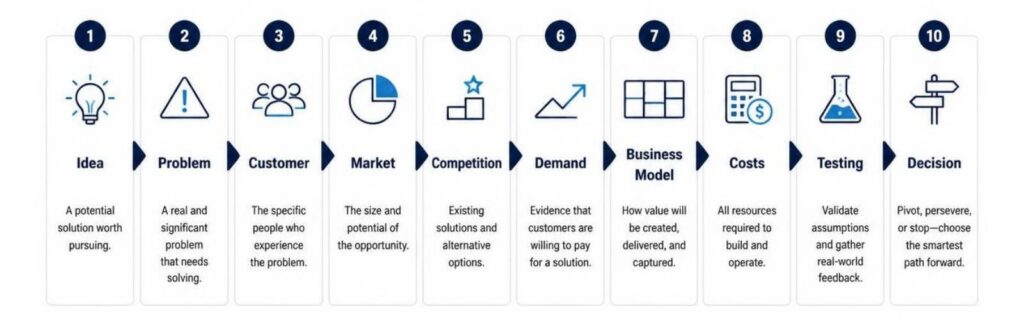
The research journey in one line: Idea → Problem → Customer → Market → Competition → Demand → Solution → Business Model → Costs → Testing → Decision
What Is Business Idea Research?
Business idea research is the process of gathering and evaluating evidence about customers, problems, competitors, demand, pricing, costs, and feasibility to determine whether a business idea deserves further testing or investment.
It covers the customer, the problem, the market, the competition, demand, pricing, and the basic economics of the idea.
This is different from searching Google for a few articles. Casual searching can easily confirm what you already believe. Proper research is structured. You identify your assumptions, look for evidence that supports or challenges them, and record what you learn.
In simple terms, business idea research answers one important question:
What do we actually know, and what are we only guessing?
Why Should You Research a Business Idea Before Starting?
Research will not remove risk. Every business carries some. What it can do is reduce uncertainty so you understand the risks you are taking.
Good research can help you:
- Learn whether a real problem exists
- Identify who has the problem and how often
- Discover what people already use to solve it
- Understand whether there is meaningful demand
- Learn what customers expect and what frustrates them
- Understand how competitors price, position, and sell
- Identify assumptions that could materially affect the business
- Avoid spending heavily on the wrong product or market
- Improve the original idea
Sometimes research supports moving forward. Sometimes it suggests changing the customer, price, positioning, or solution. It can also show that an idea is not worth pursuing.
All three outcomes can be useful because they help you make a better decision before committing substantial resources.
How to Research a Business Idea Before You Start
How do you research a business idea?
Define the idea clearly, study the problem and customer, talk to potential customers, examine competitors, look for demand signals, research pricing, estimate market potential, understand the business model and costs, check relevant requirements, and then test the most important assumptions with a small real-world experiment.
Here is the process in detail.
Step 1: Clearly Define the Business Idea
Before you research anything, explain your idea in one or two sentences. If you cannot, the research will quickly become unfocused.
Use this simple format:
I want to offer [what] to [who] who struggle with [problem], so that [benefit].
Here is an example created only for illustration:
I want to offer a weekday healthy lunch subscription to office workers in a mid-sized city who struggle to find affordable, nutritious food near their workplace, so that they save time and eat better.
This immediately gives you several things to research: office workers, nearby food options, current alternatives, price sensitivity, and how people currently solve the lunch problem.
Step 2: Identify the Problem You Are Trying to Solve
Founders often become attached to a solution before checking whether the underlying problem is important enough.
Research the problem first.
A problem is what the customer struggles with. A solution is what you plan to offer. Your product is only one possible solution, and customers may already be using another.
Ask:
- What exactly is the problem?
- Who experiences it?
- How often does it happen?
- How serious is it?
- What do people do about it today?
- Are they already spending money or time solving it?
The last two questions are especially useful. A problem people already spend money or significant effort solving gives you stronger evidence than a problem people merely say sounds annoying.
Step 3: Define Your Target Customer
“Everyone” is rarely a useful target market.
A clear customer definition makes every later step easier, from interviews and competitor research to pricing and marketing.
Depending on your business, describe the customer using details such as:
- Age or life stage, where relevant
- Location, where relevant
- Profession or type of business
- Interests and behaviour
- Buying habits
- Specific problem
- Ability to pay
- Willingness to pay
For the lunch example, “office workers within two kilometres of three business parks who currently buy lunch at least three days a week” is far more useful than “people who eat lunch.”
You may eventually develop a customer persona, but keep it grounded in evidence from real customers rather than assumptions about what your ideal buyer is like.
Step 4: Talk to Potential Customers
Customer interviews are one of the most useful research methods, and one that beginners often skip.
Talk to people who genuinely fit your target customer profile.
Instead of immediately pitching your idea, ask about their existing behaviour.
Useful questions include:
- How do you currently solve this problem?
- What is frustrating about your current solution?
- How often do you face this problem?
- What have you already tried?
- What does this problem cost you in time or money?
- What would make you switch to another solution?
Avoid leading questions such as:
“Would you buy my product?”
People can sincerely like an idea without ever purchasing it.
Ask about what they actually did recently rather than what they might do in the future. Behaviour is generally more useful evidence than hypothetical enthusiasm.
Take notes and look for repeated patterns. Several relevant customers describing the same frustration can be a meaningful signal. One person’s strong opinion is still only one person’s opinion.
Step 5: Study Existing Competitors
Competitor research is not simply about finding businesses to defeat.
It helps you understand what customers already accept, what they complain about, and where gaps may exist.
Look at three types of alternatives:
- Direct competitors: Businesses offering a similar product or service to a similar customer
- Indirect competitors: Businesses solving the same underlying problem differently
- Substitutes: Workarounds such as doing it yourself, using another process, or doing nothing
For the lunch example, direct competitors might be meal-subscription businesses. Indirect competitors could include canteens, tiffin services, and food delivery platforms. A substitute could be bringing lunch from home.
For each relevant competitor, research:
- Products or services
- Pricing
- Positioning and marketing messages
- Target customers
- Customer reviews and complaints
- Strengths and weaknesses
- How customers find and purchase from them
A simple matrix can keep this information organised:
| Competitor | Target Customer | Offer | Price | Strength | Weakness | Opportunity |
|---|---|---|---|---|---|---|
| Competitor A | Office workers | Daily meal delivery | Higher | Wide menu | Slow delivery | Faster, fixed-time service |
| Competitor B | Students | Budget tiffin | Lower | Low price | Limited variety | Healthier options |
| Competitor C | Families | Home-style meals | Medium | Trusted taste | No office delivery | Office-focused plans |
This table is an illustrative example, not real market data.

Competition can actually provide useful evidence. If customers are already paying for solutions in a category, you know the problem has at least some commercial activity.
However, an empty market is not automatically a better opportunity. It may mean customers have little interest in paying for a solution.
Step 6: Research Market Demand
How do you know whether people want your business idea?
Look for multiple signals showing that people are already searching for, discussing, using or paying for solutions to the problem.
Useful demand signals include:
- Search behaviour: What people search for around the problem
- Online communities: Questions and complaints in relevant forums and groups
- Customer discussions: Conversations on social platforms
- Product reviews: What buyers praise or complain about
- Marketplace activity: Evidence that similar products or services are being purchased
- Industry reports: Relevant research from credible organisations
- Competitor activity: Visible evidence of customers or commercial activity where reliable information is available
Treat each signal as one piece of evidence, not as proof.
High search volume shows interest or information demand. It does not prove that people will buy your product, buy from you, or generate enough revenue to support the business.
Low search volume does not automatically mean low demand either, particularly for local, specialised, or offline businesses.
Look for multiple signals pointing in the same direction.
Step 7: Look for Customer Pain Points and Gaps
Once you understand customers and competitors, look for the gap between what customers need and what existing solutions provide.
Common gaps include:
- High price
- Poor convenience
- Complicated processes
- Slow service
- Limited availability
- Weak customer support
- Limited customisation
- Poor experience for a specific customer group
A business opportunity often comes from solving an existing problem better, differently, or for a more specific audience rather than inventing something completely new.
Customer interviews and competitor reviews are particularly useful here because they show what people actually dislike about existing solutions.
Step 8: Research Pricing and Willingness to Pay
Pricing research is different from asking, “What price would you like?”
Most customers naturally prefer lower prices.
Instead, investigate:
- Competitor pricing
- What customers spend on current alternatives
- The cost of the problem in time or money
- The value your solution could create
- Different pricing models such as one-time, subscription, or pay-per-use
Then separate interest from willingness to pay.
Interest means:
“That sounds useful.”
Willingness to pay is stronger evidence:
“I am prepared to pay for this.”
A person can genuinely like your idea and still never become a customer.
You can discuss realistic pricing during interviews, but actual behaviour can provide stronger evidence. Depending on the business, that might come from a pre-order, deposit, paid pilot or trial.
Step 9: Estimate the Market and Business Potential
Market size research can help you understand whether the opportunity is large enough for the business you want to build.
Three common terms are:
- Total Addressable Market (TAM): Everyone who could theoretically buy this type of product or service
- Serviceable Available Market (SAM): The part of that market your business can realistically serve based on factors such as location, customer type, and product scope
- Serviceable Obtainable Market (SOM): The portion you could realistically reach and capture given your resources, competition, and distribution
Use realistic assumptions.
For example, suppose 50,000 office workers are in your broader city market. Perhaps only 10,000 work in areas your delivery operation can currently serve. Your realistic first-year customer base would be a much smaller subset of that group.
Avoid inflated market-size calculations designed only to make an idea look attractive.
A large market is not automatically a strong opportunity if you cannot reach the customers. A smaller market can still be meaningful if the customers have a real problem and the business economics work.
Step 10: Research the Business Model
A good idea and a viable business are not necessarily the same thing.
Your business model explains how the idea creates value and generates revenue.
Research:
- Who pays?
- What exactly do customers pay for?
- What is the revenue model?
- What are the major costs?
- How will customers find you?
- What will customer acquisition cost?
- How will the product or service be delivered?
- Will customers buy once or repeatedly?
- What could affect profit margins?
Even rough calculations can expose major problems.
If acquiring a customer costs more than the revenue and margin you can reasonably generate from that customer, the model needs to change.
Step 11: Research Startup Costs and Risks
List what it could actually cost to start and operate the business.
Depending on the idea, this may include:
- Product development
- Inventory
- Equipment
- Technology
- Marketing
- Staff
- Legal and compliance costs
- Packaging
- Logistics
- Customer acquisition
Get current quotes and prices relevant to your location and industry.
Do not blindly copy startup-cost estimates from an article about a different business or country.
Then identify the assumptions that could materially affect your economics.
For example:
“Customers will order four times a week.”
Or:
“Delivery will cost less than ₹50 per order.”
These are assumptions that can be tested.
Step 12: Check Legal, Regulatory and Operational Requirements
Some businesses require much more regulatory research than others.
Depending on the business and location, investigate:
- Licences and registrations
- Taxes
- Industry regulations
- Product standards
- Data and privacy requirements
- Sector-specific rules
- Intellectual property
- Insurance
- Employment requirements
- Food, health or financial regulations where applicable
Requirements vary by location and industry, so always check the rules that apply to your specific situation.
If your business may qualify as an MSME in India, check the official Udyam Registration portal to understand the current registration process and eligibility requirements.
India-Specific Considerations
For entrepreneurs in India, official government sources can provide useful starting points.
Udyam Registration: The official Udyam Registration portal states that MSME registration is free, paperless, and based on self-declaration. Use the government portal rather than private sites that charge a fee for the registration process.
Food businesses: FSSAI states that food businesses are required to be licensed or registered under the applicable food-safety framework. The official FoSCoS system is used for food licensing and registration, with requirements depending on the type and scale of the business.
For food-related businesses, review the applicable FSSAI registration and licensing requirements before investing in the business model.
Data and privacy: If your business collects personal data, review the Digital Personal Data Protection Act and the current DPDP Rules and implementation timeline. The Ministry of Electronics and Information Technology publishes the official rules and enforcement information.
GST and taxes: GST registration requirements depend on the nature of supplies, turnover, and other circumstances. Do not assume that one threshold applies to every business. Check the current GST rules and official guidance relevant to your business.
These are general research starting points, not legal or tax advice. Rules can change, so verify current requirements before launching.
Step 13: Test the Idea Before Building the Full Business
Research tells you what you know about the opportunity.
Testing tells you how people respond to your proposed solution.
Depending on the business, low-cost tests can include:
- Landing pages
- Prototypes
- Demonstrations
- Minimum viable products
- Small pilot programmes
- Pre-orders where appropriate
- Small paid tests
- Waitlists
- Manual or concierge versions of a service
For the lunch example, you could serve a small group of office workers for two weeks, charge a realistic price, and measure who reorders.
That can teach you more about actual behaviour than weeks of speculation.
An MVP can be one practical way to test an important assumption with real users. Our guide on how to build an MVP explains how to approach this without building everything at once.
Research and validation are related, but they are not identical.
- Research gathers evidence about customers, markets, competitors, and the business environment.
- Validation tests whether your proposed solution receives meaningful real-world response.
Research helps you understand the opportunity. Validation helps you test the solution.
For a deeper look at validation, see our guide on how to validate your business idea.
You can also explore our more startup-specific guide on how to validate a startup idea before building.
Business Idea Research Checklist
Use this checklist before committing significant resources:
- ☐ I can clearly explain the problem.
- ☐ I know who experiences it.
- ☐ I have spoken with potential customers.
- ☐ I understand how customers solve the problem today.
- ☐ I have researched direct and indirect competitors.
- ☐ I found meaningful evidence of demand.
- ☐ I understand likely pricing.
- ☐ I have considered willingness to pay.
- ☐ I have identified major costs.
- ☐ I understand the basic business model.
- ☐ I have checked relevant legal requirements.
- ☐ I have identified major assumptions and risks.
- ☐ I know what I need to test next.
You do not need perfect answers to every question.
You need enough evidence to identify the most important remaining uncertainty.
How Long Should Business Idea Research Take?
There is no universal number of days that every entrepreneur should spend researching an idea.
The appropriate amount depends on:
- Complexity of the business
- Industry
- Cost of launching
- Regulatory requirements
- Type of customer
- Sales cycle
- Amount of uncertainty
A simple local service may require less research than a manufacturing business that needs equipment, inventory, and regulatory approvals.
The higher the cost of being wrong, the more carefully you should research before committing resources.
The goal is to research enough to make your next decision, not to research forever.
If the remaining questions can only be answered by real customers, move from research to testing.
Common Business Idea Research Mistakes
Researching Only Information That Confirms the Idea
If you only look for evidence supporting your idea, you are not really testing it.
Actively look for reasons the idea might not work.
Treating Friends and Family as the Market
Friends and family can provide useful feedback, but they may not behave like your target customers.
Relevant customer conversations are more useful for understanding actual market needs.
Relying Entirely on Search Volume
Search data can reveal interest, but it does not prove that people will purchase your solution.
Combine search behaviour with customer conversations, competitor evidence, and real-world testing.
Ignoring Competitors
No obvious competitors does not automatically mean you found an undiscovered opportunity.
It may mean the market is small, difficult, or already served through another type of solution.
Assuming a Large Market Guarantees Success
A large market can still be difficult to enter.
Customer access, competition, pricing, distribution, and acquisition costs all matter.
Asking Only Hypothetical Buying Questions
“Would you buy this?” can provide a clue, but actual behaviour is stronger evidence.
Ignoring Pricing
Customers may like a product but still reject the price required for a sustainable business.
Ignoring Costs
Revenue alone does not make a business viable.
Research the cost of creating, delivering, and selling the product.
Spending Too Much Before Testing
Do not spend heavily simply because you have completed a lot of research.
Use the simplest reasonable experiment that can answer your most important remaining question.
Continuing Research Without Taking Action
Research should help you make decisions.
If you continue collecting information without testing important assumptions, research can become a form of procrastination.
Treating Research as Proof
Research produces evidence, not certainty.
Markets change, customers behave unpredictably, and new information can appear after launch.
How Do You Know When You Have Researched Enough?
You have reached a useful decision point when you can answer the key questions with reasonable evidence and know what should happen next.
Ask yourself:
- Is there a meaningful problem?
- Who experiences it?
- How are they solving it today?
- Is there evidence of demand?
- What alternatives already exist?
- Why might customers choose this solution?
- Can customers realistically pay?
- Can the business potentially make money?
- What are the biggest risks?
- What should be tested next?
If one unanswered question could significantly change your decision, make that question your next research or validation priority.
Research also does not necessarily stop after launch. Customer behaviour, competitors, and market conditions continue to provide new information.
If results later suggest that your original idea is not working as expected, our guide on when a business idea isn’t working can help you examine the problem and decide what to investigate next.
Research vs Validation vs Launch
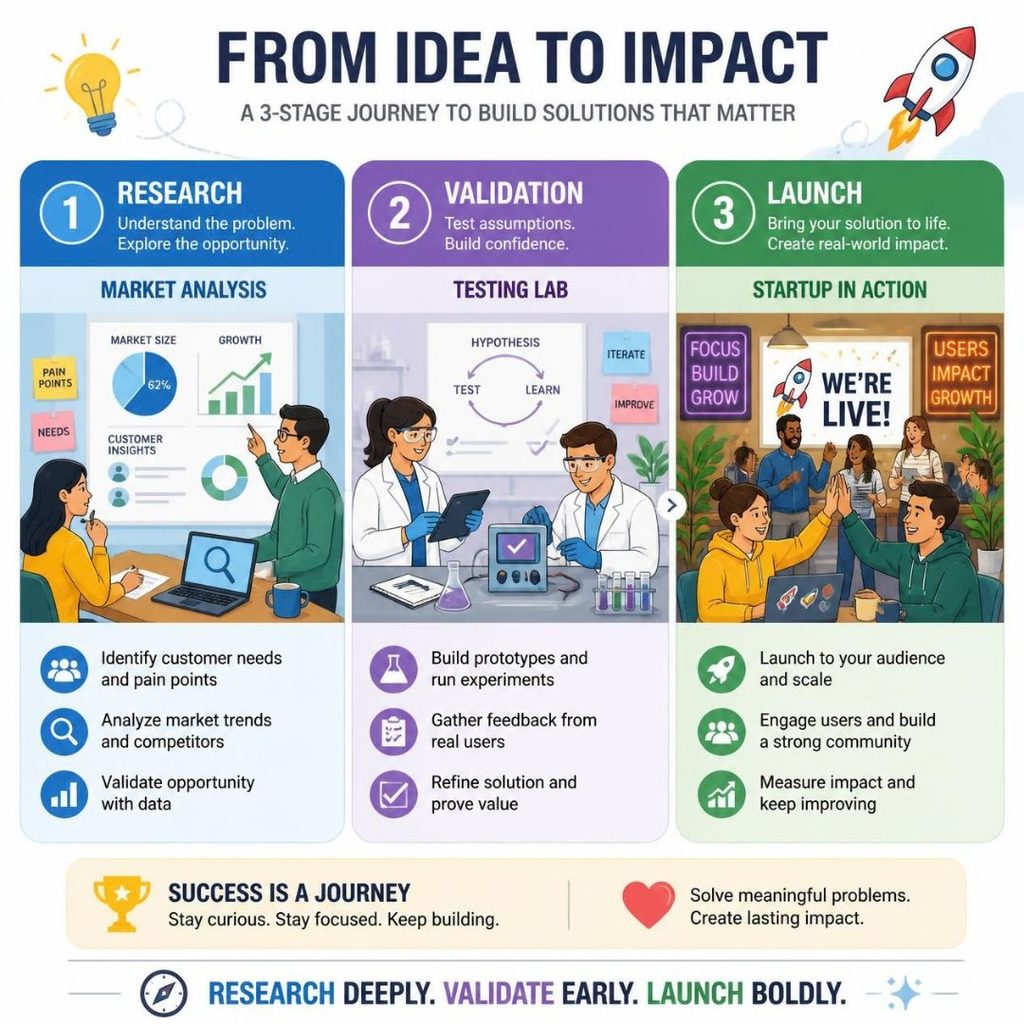
Research, validation, and launch are connected, but they answer different questions.
| Stage | Main Question | Typical Activities |
|---|---|---|
| Research | What do we know? | Market, customer and competitor research |
| Validation | Does the proposed solution work in the real world? | Interviews, MVP, pilot and paid tests |
| Launch | Can we operate and sell consistently? | Product or service launch and customer acquisition |
Research builds understanding.
Validation tests assumptions.
Launch puts the tested business into operation.
The stages can overlap. A pilot may reveal a new pricing question, sending you back to research. That is normal.
Frequently Asked Questions
How do I research a business idea?
Define the problem and target customer first. Then research customers, competitors, market demand, pricing, costs, the business model and relevant legal requirements. Talk to potential customers and finish with a small test of your most important assumptions.
What should I research before starting a business?
Research the problem, target customer, existing alternatives, market demand, competition, pricing, willingness to pay, business model, startup costs, risks and relevant legal requirements.
What is business idea research?
Business idea research is the process of gathering and evaluating evidence about customers, problems, markets, competitors, demand, pricing, costs and feasibility before committing significant resources to a business idea.
How do I know if there is demand for my business idea?
Look for multiple signals, including customer discussions, search behaviour, reviews, existing purchases, competitor activity, sign-ups, pilot participation or other meaningful actions. No single signal proves demand.
How do I research my competitors?
Identify direct competitors, indirect competitors and substitutes. Compare their customers, products, pricing, positioning, reviews, strengths, weaknesses and distribution. Pay particular attention to repeated customer complaints and unmet needs.
How do I validate a business idea?
Validation involves testing whether people respond meaningfully to your proposed solution. Depending on the business, this can include interviews, prototypes, landing pages, MVPs, pilots, pre-orders or paid tests.
How much research should I do before starting a business?
Do enough research to understand the major risks and decide what to do next. Complex, expensive or regulated businesses generally require more research than simple, low-cost ideas.
What is the difference between market research and business idea validation?
Market research gathers information about customers, competitors, demand and market conditions. Business idea validation tests whether people respond to your specific proposed solution. Research helps you understand the opportunity, while validation tests important assumptions about the solution.
Conclusion
Strong business idea research follows a practical path:
Define the idea → Understand the problem → Research customers → Study competitors → Check demand → Research pricing → Examine the business model → Identify risks → Test the idea
The purpose is not to prove that your idea is perfect.
It is to replace assumptions with evidence and identify what needs to be tested next.
Once you understand the opportunity well enough, take the next step with a small experiment rather than immediately making a large investment.
Research before you build. Test before you scale. Learn before you commit heavily.
