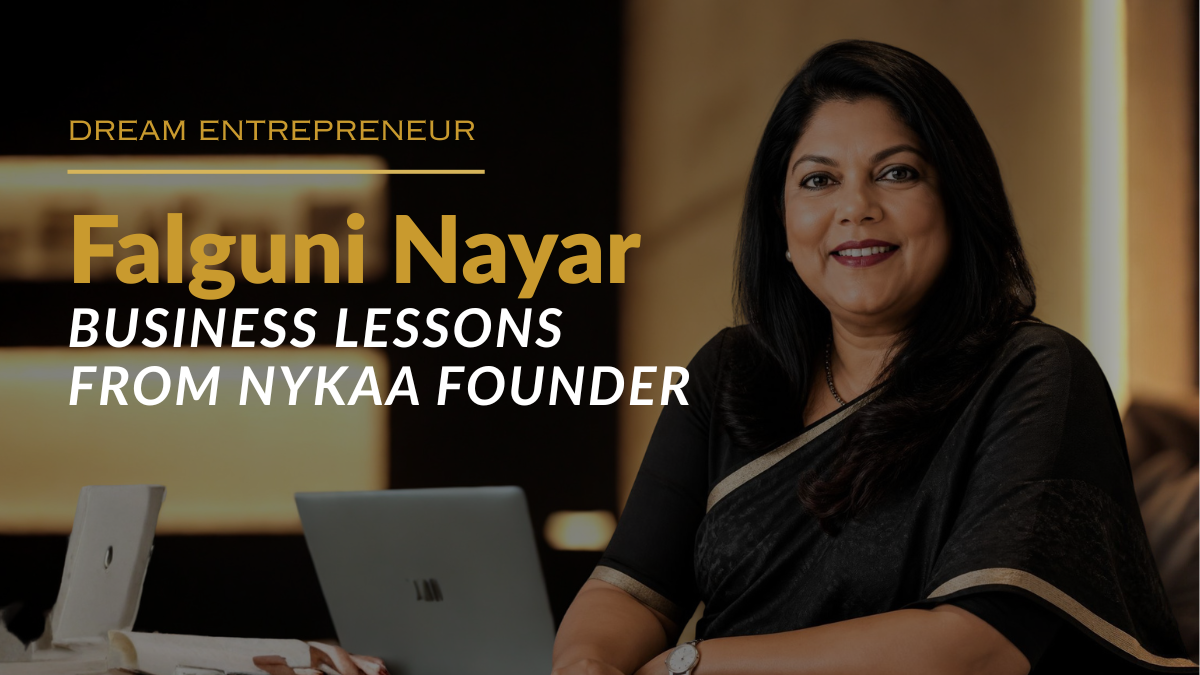
Falguni Nayar business lessons offer more than a story about building a successful beauty company. They provide practical insights into customer understanding, financial discipline, operational readiness, content, leadership, and long-term business thinking.
Table of Contents
Falguni Nayar offers a different example. After spending years in investment banking, she founded Nykaa in 2012 and built a beauty-focused consumer business around product authenticity, customer experience, content, and retail, as outlined in Nykaa’s official company profile. Nykaa’s own company profile describes Nayar as its founder, Executive Chairperson, Managing Director, and CEO.
The interesting part of her story is not simply that Nykaa became successful. The real value of these Falguni Nayar business lessons is understanding how the business was built.
From being careful with capital to temporarily slowing marketing when operations could not handle demand, several decisions behind Nykaa provide useful lessons for entrepreneurs.
In this article, we will examine seven practical lessons from Falguni Nayar and Nykaa, along with the mistakes entrepreneurs should avoid and simple ways to apply these ideas to their own businesses.
What Can Entrepreneurs Learn from Falguni Nayar?
The biggest lessons from Falguni Nayar’s entrepreneurial journey are to understand the customer deeply, protect business economics, build operational capability before chasing rapid growth, use content to educate customers, and think beyond short-term funding or valuation.
Her experience also shows that a founder’s previous career can become an advantage when its skills are applied to a new industry.
Let’s look at these lessons in detail.
1. Use Your Previous Experience Instead of Starting From Zero
Before founding Nykaa, Falguni Nayar spent around 18 years with Kotak Mahindra Capital Company and served as a managing director. Her background included investment banking and broking.
She did not have to become an expert in everything before starting a business. Instead, she brought skills from her previous career into entrepreneurship.
Financial analysis, understanding businesses, evaluating investments, and thinking about capital allocation can all be valuable when running a startup.
What entrepreneurs can learn
Your previous experience does not have to be directly related to your startup.
A finance professional can build a consumer business. A marketer can build a software company. A teacher can create an education business.
The useful question is not, “Am I from the right industry?”
Ask instead:
“Which skills have I already developed that can give my business an advantage?”
Your existing knowledge can reduce some of the learning curve.
2. Solve a Real Customer Problem, Not Just a Market Opportunity

Nykaa was built around beauty and personal care, but the opportunity was not simply about selling products online.
Trust was an important part of the model.
Beauty products can be difficult to choose without information. Customers may want guidance about ingredients, usage, brands, and product suitability. Nykaa combined commerce with content and education, helping customers discover products rather than treating the website only as a catalogue.
Nykaa itself describes its mission around a curated and authentic assortment, while its authenticity policy states that products are sourced directly from brands or authorised distributors.
What entrepreneurs can learn
Do not ask only:
“What product can I sell?”
Ask:
“What uncertainty or frustration does my customer have before buying?”
If you can reduce that uncertainty, your business becomes more valuable.
For a small business, this could mean product demonstrations, comparison guides, tutorials, FAQs, consultations, or better after-sales support.
The lesson from Nykaa is that customer experience can become part of the business model itself.
3. Be Careful With Capital

One of the strongest Falguni Nayar business lessons is financial discipline.
According to The Economic Times, Nykaa operated with family funding during its first two years while Nayar wanted to establish business metrics before raising external capital. She also described being careful about how much capital the company put to work.
This does not mean every startup should avoid investors.
For founders starting with limited resources, bootstrapping a startup can also be a practical way to test an idea, control expenses, and build the business before seeking external funding.
It means founders should understand what additional capital is supposed to accomplish.
If ₹10 lakh is raised, the founder should be able to explain what that money will improve.
Will it increase production capacity?
Improve technology?
Acquire customers?
Hire critical employees?
Build inventory?
If the answer is simply “growth”, the funding plan may not be clear enough.
What entrepreneurs can learn
Capital should solve a business problem, not hide one.
A small founder can apply this lesson even without outside funding by separating:
- essential expenses
- growth expenses
- experimental expenses
- unnecessary expenses
Revenue and cash flow may not look as exciting as fundraising, but they determine how long a business can survive.
4. Do Not Confuse Demand With Readiness

One of the most useful Nykaa startup lessons came from an operational problem.
In an interview with The Economic Times, Nayar explained that Nykaa initially experienced strong demand but was not operationally ready to handle it. The company did not have the necessary ERP capability, customer complaints increased, and marketing was temporarily reduced. Once the operational side improved, marketing was restarted.
This is an important lesson because entrepreneurs often think more sales are always good news.
They are not if the business cannot fulfil those sales properly.
A sudden increase in orders can expose weaknesses in:
- inventory management
- customer support
- delivery
- technology
- billing
- hiring
- quality control
What entrepreneurs can learn
Growth should not move much faster than your ability to deliver.
Before running an aggressive marketing campaign, ask whether your business can handle twice the current demand.
If not, improve the system first.
For a small online business, that might mean creating standard operating procedures, finding backup suppliers, improving order tracking, or automating repetitive tasks.
5. Build Content That Helps Customers Make Decisions
Nykaa’s approach to content is another useful part of its business model.
The company has historically combined beauty commerce with editorial content, advice, and education. Falguni Nayar has also discussed content as an important part of what differentiated the company, particularly through the creative talent working on the brand.
This creates an important distinction.
Content does not have to exist simply to attract website traffic.
Good business content can help customers decide what to buy.
For example:
A skincare company can publish an ingredient guide.
A financial advisor can explain loan eligibility.
A clothing business can create size and styling guides.
A software company can publish tutorials.
What entrepreneurs can learn
Think of content as part of your sales process.
Instead of asking:
“What can I post today?”
Ask:
“What question is stopping my customer from buying?”
Then create content that answers that question.
This is especially useful for small businesses because educational content can continue attracting customers without requiring a salesperson to explain the same thing repeatedly.
6. Think Long Term, But Scale Carefully
Nykaa’s growth was not built only around an online marketplace.
The company developed an omnichannel approach and expanded into additional categories and businesses, including Nykaa Fashion and SuperStore by Nykaa. Its recent company materials describe this broader consumer technology and retail ecosystem.
But expansion creates risk.
Every new category, location, product line, or technology investment requires money, people, and management attention.
This is why long-term thinking should not be confused with expanding everywhere.
What entrepreneurs can learn
Long-term thinking means knowing what business you want to build five or ten years from now, while making today’s decisions carefully.
A small founder could apply this by asking:
- What should my business become?
- Which capability must I build first?
- What should I deliberately avoid for now?
- Which expansion can wait?
The goal is not to become bigger as quickly as possible.
This is one reason many aspiring founders struggle before their businesses get a real chance to grow. Understanding why most aspiring entrepreneurs fail before they start can help founders identify weak assumptions before committing too much time or money.
The goal is to build something that can remain useful and economically sustainable as it grows.
7. Do Not Let Other People’s Expectations Define Your Business
Falguni Nayar’s career also challenges a common assumption about entrepreneurship: that founders must follow a standard path.
She moved from a senior investment-banking career into consumer entrepreneurship and built Nykaa in an industry that was different from her professional background. Nykaa was founded in 2012, and the company later became a publicly listed business.
Her story is useful because many aspiring entrepreneurs delay starting because they believe they are too old, too inexperienced, from the wrong industry, or lacking the “right” background.
But the opposite lesson is also important.
Changing careers does not automatically create entrepreneurial success.
Nayar’s experience, financial knowledge, and professional network were useful resources. A beginner should not copy the visible outcome without understanding the underlying capabilities that supported it.
What entrepreneurs can learn
Do not copy another founder’s timeline.
Copy useful principles.
Your starting point may be completely different, so your strategy should be different too. This connects closely with the idea of developing an entrepreneur mindset, where you learn to think about opportunities, risks, customers, and decisions differently.
What Makes Falguni Nayar’s Leadership Approach Interesting?
Falguni Nayar’s leadership can be understood through the combination of financial discipline, customer focus, and willingness to invest when the business required it.
Her story is not simply about being conservative.
The company also invested in warehouses, inventory, people and marketing as it prepared for growth. In one interview, Nayar described investing ahead in these areas while dealing with questions about the company’s strategy.
That creates an important distinction:
Financial discipline does not mean refusing to spend.
It means understanding why you are spending.
A founder may need to spend aggressively on technology when the existing system cannot support customers. At another stage, spending more money may simply increase costs without improving the business.
Good leadership requires knowing the difference.
What Can Small Entrepreneurs Apply From the Nykaa Story?
You do not need a large team or significant funding to apply these Falguni Nayar business lessons.
Start with five practical exercises.
1. Identify your customer’s biggest uncertainty
Write down the five questions customers ask before buying from you.
Create useful answers for those questions.
2. Review every major expense
For each expense, ask whether it improves revenue, customer experience, efficiency or business capability.
If it does none of these, reconsider it.
3. Test your operational capacity
If your orders doubled next month, what would break first?
Fix that weakness before increasing marketing.
4. Create education-led content
Publish content that helps customers understand your product or service.
Do not focus only on promotional posts.
5. Define your long-term business direction
Write down where you want the business to be in three years.
Then identify what you need to build this year.
This prevents entrepreneurs from chasing every new opportunity.
Common Mistakes Entrepreneurs Should Avoid
The Nykaa story can also be misunderstood.
Mistake 1: Thinking bootstrapping is always better
Bootstrapping can provide control, but it can also limit how quickly a business can invest.
The right choice depends on the business model and capital requirements.
Mistake 2: Copying Nykaa’s business model
Beauty retail has specific economics, customer behaviour and operational requirements.
A founder should copy the principles, not the exact model.
Mistake 3: Scaling before fixing operations
More customers are not helpful if poor delivery, stock problems or customer service damage the brand.
Mistake 4: Treating content as decoration
Content should answer customer questions or create meaningful discovery.
Posting regularly without a purpose is not a content strategy.
Mistake 5: Believing every successful founder had a perfect plan
Successful businesses usually involve adjustments, difficult decisions, and unexpected problems.
Nykaa’s early operational challenges are a useful reminder that growth itself can expose weaknesses.
Key Takeaways
The most practical Falguni Nayar business lessons are:
- Use your existing professional skills as entrepreneurial assets.
- Solve customer problems rather than simply selling products.
- Treat capital as a resource that needs disciplined allocation.
- Build operations before pushing aggressive growth.
- Use content to educate customers and support purchasing decisions.
- Think long term without expanding recklessly.
- Build according to your own business situation rather than copying another founder’s journey.
Falguni Nayar’s story is particularly useful because it shows that entrepreneurship does not have one fixed starting point. Her transition from investment banking to building Nykaa demonstrates how professional experience, customer understanding, financial discipline, and execution can come together in a new business.
The practical lesson for an aspiring entrepreneur is simple: study the decisions behind the success, not just the success itself. That is what makes these Falguni Nayar business lessons useful beyond the Nykaa story.
Frequently Asked Questions
What is Falguni Nayar best known for?
Falguni Nayar is best known as the founder of Nykaa, the beauty and lifestyle retail company operated by FSN E-Commerce Ventures. Before founding Nykaa in 2012, she spent around 18 years at Kotak Mahindra Capital Company, where she served as a managing director.
What can entrepreneurs learn from Falguni Nayar?
Entrepreneurs can learn about customer focus, financial discipline, operational readiness, content-led commerce and long-term business thinking. Her experience also shows the value of using skills developed in a previous career when entering entrepreneurship.
How did Falguni Nayar approach startup funding?
Nayar has spoken about being financially prudent and making business metrics work before raising significant external capital. The Economic Times reported that Nykaa operated with family funds during its first two years before seeking outside investment.
What was one important early challenge faced by Nykaa?
Nykaa experienced a period when customer demand grew faster than its operational capabilities. Nayar explained that the company temporarily reduced marketing after customer complaints increased and then resumed growth after strengthening its operations.
Why is Falguni Nayar’s story relevant to women entrepreneurs in India?
Her story provides an example of a woman moving from a senior professional career into entrepreneurship and building a major consumer business. However, the broader lesson applies to entrepreneurs generally: professional experience can become a strong foundation for building a new venture when combined with customer understanding and execution.
