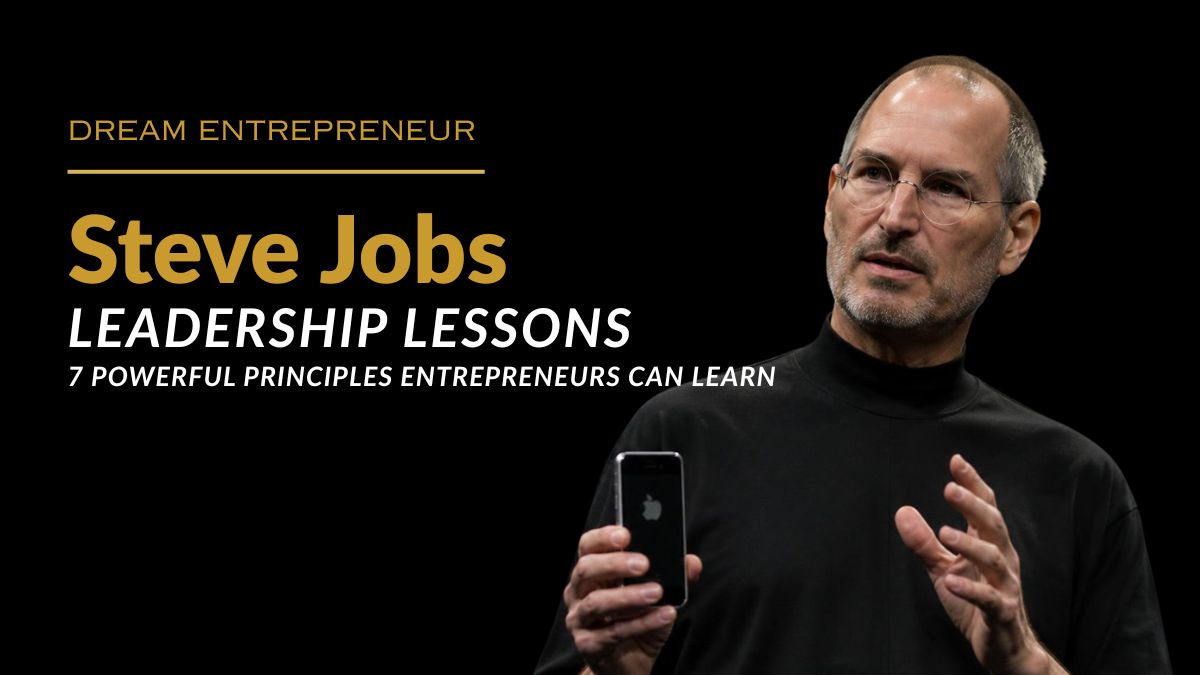
Steve Jobs was not successful simply because he created innovative technology. His bigger contribution was connecting product vision, design, customer experience, and business strategy into one clear direction.
Table of Contents
When he returned to Apple in 1997, the company had a wide and confusing product range. Jobs responded by narrowing the focus and putting resources behind fewer products. That decision became an important part of Apple’s turnaround.
This is why Steve Jobs leadership lessons remain relevant beyond the technology industry. A founder running a small business faces similar questions: What should we build? Who are we serving? Which opportunities should we ignore? How can we make our offer easier to understand? How do we maintain quality while working with limited resources?
The goal is not to copy Steve Jobs or recreate Apple. The useful approach is to study the principles behind his decisions and adapt them to your own business.
Quick Answer: What Are the Most Important Steve Jobs Leadership Lessons?
The most practical Steve Jobs leadership lessons are to build around a clear vision, focus on fewer priorities, simplify the customer experience, care about the complete product journey, learn to say no, communicate ideas clearly, and maintain high standards for execution.
These principles can help founders make better decisions, build stronger products, and create a business that customers can understand and value.
1. Build Around a Clear Product Vision

One of the strongest Steve Jobs leadership lessons is the importance of having a clear product vision.
When Jobs returned to Apple in 1997, he worked to simplify the company’s product priorities. Instead of allowing teams to spread their efforts across too many products, Apple focused on a smaller number of core products.
The lesson is simple: a business needs to know what it wants to be known for.
A clear vision makes decisions easier. It helps a founder decide which customers to serve, which features deserve investment, and which opportunities are distractions.
For a startup, the vision does not need to be complicated. It can be one clear statement about the problem you want to solve and the value you want to create.
How to apply this principle
- Define the main problem your business exists to solve.
- Identify the customer you want to serve best.
- Write down what you want your product or business to be known for.
- Use that statement when evaluating new ideas.
A strong vision becomes a decision-making filter, not just a sentence on a website.
2. Focus on What Matters Most
Another important lesson is strategic focus.
Every business has limited time, money, people, and attention. Trying to pursue ten priorities at the same time often means none receives enough attention.
Jobs understood the value of reducing complexity. After returning to Apple, he pushed the company toward a much smaller product focus. This allowed teams to concentrate their resources on products that mattered most.
For a first-time founder, this principle is especially useful. You may have many ideas for products, marketing channels, features, and partnerships. That does not mean you should pursue all of them now.
Choose the few priorities that can make the biggest difference.
A practical approach is to select three major priorities for the next 90 days. Everything else should either support those priorities or wait.
This kind of focus is useful in startup planning, product development, and business growth.
A useful decision rule
Before adding another priority, ask:
Will this make a meaningful difference to our customers or business goals right now?
If the answer is no, it may belong on a future list rather than today’s task list.
3. Make Simplicity a Competitive Advantage

Steve Jobs leadership lessons also show why simplicity can become a business advantage.
Simplicity does not mean making something basic. It means removing unnecessary complexity so that customers can understand and use the product more easily.
Apple’s introduction of the iPod in 2001 is a good example. Apple presented the product around a simple customer benefit: carrying a large music library in a small device. The experience was connected with iTunes, making the overall process easier for users.
The broader lesson applies to almost every business.
A complicated offer can make customers hesitate. A complicated website can make visitors leave. A complicated onboarding process can reduce conversions. Too many choices can make decision-making harder.
How to simplify your business
- Remove unnecessary features from your offer.
- Explain your main benefit in one sentence.
- Reduce the number of steps required to buy or use your product.
- Review your website from a first-time customer’s perspective.
- Remove information that does not help the customer make a decision.
When customers understand your value quickly, your business becomes easier to choose.
4. Put Customer Experience at the Centre
Product quality is important, but the complete customer experience matters too.
One of the most useful Steve Jobs leadership lessons is to think beyond individual features. Consider how the customer discovers the product, evaluates it, buys it, uses it, and decides whether to return.
Apple’s 2007 iPhone launch demonstrated this broader product thinking. The iPhone was presented not simply as another mobile phone, but as a combination of a phone, a widescreen iPod and an internet communications device.
The lesson for business owners is to look at the complete customer journey.
A great product can still struggle if the website is confusing, the buying process is difficult, or customer support is poor.
For startup leaders, customer experience should therefore be part of product strategy rather than an afterthought.
Review the customer journey
Ask yourself:
- Is the problem clear before the customer buys?
- Is the buying process simple?
- Does the product deliver the promised value?
- What happens when the customer needs help?
- Would the customer recommend the experience?
Improving these small points can create a stronger business without requiring a completely new product.
5. Learn to Say No
A good strategy is not only about deciding what to do. It is also about deciding what not to do.
This is one of the most practical Steve Jobs leadership lessons for founders because small businesses are constantly presented with new opportunities.
A new feature sounds useful. A new social platform looks promising. A potential partnership appears attractive. A new customer segment seems interesting.
But every yes consumes resources.
Jobs’ return to Apple illustrates the value of reducing competing priorities. The company needed greater focus rather than more initiatives.
Use a simple decision filter
Before committing resources, ask:
- Does this support our main customer?
- Does it strengthen our core offer?
- Does it help one of our current priorities?
- Do we have the resources to execute it properly?
If the answer is no, the idea may need to wait.
Saying no is not rejecting growth. It is protecting the capacity to execute the right opportunities well.
6. Communicate Ideas Through Storytelling
A strong idea can fail if people do not understand it.
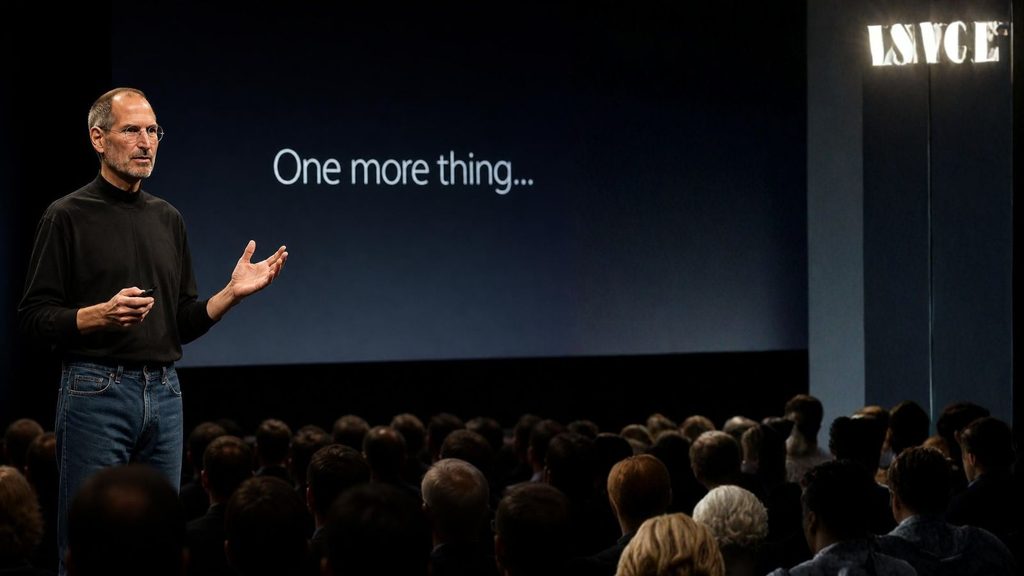
Steve Jobs became well known for presenting products through simple narratives. Instead of overwhelming audiences with technical specifications, his presentations often started with the customer problem, introduced the product, and demonstrated why it mattered.
The 2007 iPhone launch is a useful example. Jobs framed the product around three familiar functions before revealing that they were combined into one device.
The communication principle is valuable for founders, sales teams, and business leaders.
When explaining your product, do not start with everything it can do. Start with the problem and the outcome.
A useful structure is:
Problem → Solution → Benefit → Proof
For example, instead of listing ten software features, explain the business problem, show how your product solves it, describe the result, and provide evidence.
Clear communication improves sales conversations, presentations, websites, and team alignment.
Make your message easier to remember
Before presenting your product, try to answer three questions:
- What problem does it solve?
- Who benefits from the solution?
- Why should they care?
If your audience can understand those answers quickly, your communication is already stronger.
7. Set High Standards and Execute
Having a vision is only the beginning. Strong leadership also requires disciplined execution.
Jobs was known for paying close attention to product quality and the details of the user experience. Apple’s products brought together hardware, software, design, and customer experience into a connected system.
The lesson is not that every founder should chase perfection.
Perfectionism can slow a business down. High standards are different. They mean deciding what quality looks like and consistently meeting that standard.
For a small business, this could mean:
- Delivering work when promised.
- Checking important details before publishing.
- Making the product easy to use.
- Responding professionally to customers.
- Fixing recurring problems instead of repeatedly working around them.
High standards create trust. Consistent execution turns that trust into reputation.
Why Steve Jobs Leadership Lessons Still Matter
The lasting value of Steve Jobs leadership lessons is not that every entrepreneur should imitate his personality or management style.
Jobs was also a complex leader. His demanding approach produced exceptional results in some situations, but not every aspect of his behaviour is suitable for every organisation.
The better approach is to separate the principle from the personality.
Study the focus, product thinking, customer orientation, communication and commitment to quality. Then adapt those ideas to your own leadership style.
This becomes even more useful when you compare Jobs with other Real-Life Leaders.
Satya Nadella offers lessons in empathy, culture, and organisational transformation. Ratan Tata demonstrates values-driven leadership and long-term thinking. Falguni Nayar provides an example of building a major business after starting a new entrepreneurial chapter later in her career.
Different leaders use different methods. The goal is to learn the principle that fits your situation.
How to Apply Steve Jobs’ Leadership Lessons to Your Business
You do not need to run a technology company to use these ideas. Start with a simple review of your business.
1. Define what you want to be known for
Write one clear sentence describing the value your business provides.
2. Choose three priorities for the next 90 days
Avoid treating every task as equally important. Decide which activities can create the greatest impact.
3. Remove one unnecessary product, feature or process
Look for something that creates effort without creating enough value.
4. Review the customer journey
Experience your own website, buying process, or service as a new customer.
5. Simplify your offer
If customers need a long explanation to understand what you sell, make the message clearer.
6. Rewrite your value proposition
Explain the problem you solve, who you solve it for, and why your solution is useful.
7. Define your quality standard
Decide what must be done exceptionally well and create a repeatable process for maintaining it.
These actions can also strengthen startup validation and MVP development because they force you to focus on the customer problem before expanding the product.
Key Takeaways
- A clear vision gives a business direction.
- Focus helps limited resources create greater impact.
- Simplicity can make products and offers easier to understand.
- Customer experience extends beyond the product itself.
- Strategic leaders know when to say no.
- Clear storytelling makes complex ideas easier to communicate.
- High standards matter when they are supported by consistent execution.
- The best leadership lessons should be adapted, not blindly copied.
FAQs About Steve Jobs Leadership Lessons
What are the most important Steve Jobs leadership lessons?
The most important lessons include having a clear vision, focusing on fewer priorities, simplifying products and communication, understanding customer experience, saying no to distractions and maintaining high standards.
What was Steve Jobs’ leadership style?
Jobs had a highly demanding and product-focused leadership style. He placed strong emphasis on vision, design, quality and execution. However, his personality and management behaviour should not be copied without considering the needs of a particular organisation.
What can entrepreneurs learn from Steve Jobs?
Entrepreneurs can learn how to make clearer decisions, focus limited resources, simplify their offers, communicate value and maintain quality. These principles can apply to startups, small businesses and established companies.
How did Steve Jobs approach innovation?
Jobs often approached innovation by combining technology with design, usability and customer experience. The iPod and iPhone demonstrate how Apple packaged multiple capabilities into products designed around a clear user experience.
Why was focus important to Steve Jobs?
Focus helped Apple reduce competing priorities and direct resources toward a smaller number of important products. For founders, focus can prevent limited time and money from being spread across too many projects.
Can small business owners apply Steve Jobs’ leadership lessons?
Yes. Small businesses can apply these principles without copying Apple’s scale or technology. Clarifying the offer, reducing unnecessary complexity, improving customer experience and setting quality standards can benefit almost any business.
Conclusion
The lasting value of Steve Jobs leadership lessons is not that every entrepreneur should build the next Apple. It is that businesses become clearer when leaders know what to prioritise and what to leave out.
Vision gives direction. Focus protects resources. Simplicity makes value easier to understand. Customer experience builds trust. Storytelling creates clarity. High standards build confidence, while disciplined execution turns ideas into something customers can use.
Study Steve Jobs alongside other Real-Life Leaders, but do not try to copy any one person completely. Take the principle. Test it in your own business. Keep what works and adapt what does not.
Believe in the value you want to create. Build it with discipline. Inspire people through the quality of the work.
