Entrepreneurship in India is no longer limited to opening a shop, factory, or family business. A person can build a local service, digital business, D2C brand, specialised consultancy, software product, or technology startup.
Digital payments, online commerce, and cloud tools have changed how many entrepreneurs can test ideas and reach customers. Customers still need trust, the numbers still need to work, and compliance still matters.
This guide explains what entrepreneurship in India looks like, where practical opportunities exist, the challenges beginners should prepare for, and a realistic path from identifying a problem to getting early customers.
Table of Contents
What Is Entrepreneurship in India?
Entrepreneurship in India means identifying an opportunity or customer problem, creating value through a product or service, organising resources and taking calculated risks to build a sustainable venture.
It can include a one-person service business, local enterprise, manufacturing unit, online business or high-growth startup. Entrepreneurship is therefore broader than starting a startup.
Self-employment may focus on income through your own work, while small business ownership usually serves a defined market. Startup entrepreneurship often involves testing a repeatable and potentially scalable model under uncertainty. These categories can overlap. The common thread is value creation through initiative, customer understanding, and execution.
If you want a broader foundation, see our guide on what is entrepreneurship.
What Is Driving Entrepreneurship in India?
Several structural changes are making it easier to start and operate certain businesses.
Digital payments are one example. NPCI reports that UPI processed more than 22.7 billion transactions in June 2026, showing the scale of infrastructure available to businesses and consumers.
Internet access, e-commerce and cloud software can also lower barriers to reaching customers.
India’s diversity creates another opportunity. Entrepreneurs can serve metro customers, Tier 2 and Tier 3 markets, regional-language audiences, rural customers, specialised B2B segments or global clients from India.
The startup ecosystem is also more structured. Eligible ventures can seek DPIIT recognition through Startup India. Under the current 2026 framework, eligible non-DeepTech startups can generally qualify for recognition for up to 10 years with a ₹200 crore turnover ceiling, while eligible DeepTech startups can qualify for up to 20 years with a ₹300 crore ceiling. These are recognition rules, not requirements that every new business must satisfy.
There is also an important India-specific reality: there is no single Indian customer. A metro professional, Tier 2 retailer, rural consumer and small manufacturing company can have very different needs, budgets, languages and buying behaviour.
That is why “the Indian market” is often too broad a starting point. Choose a specific segment first.
Entrepreneurship Opportunities in India
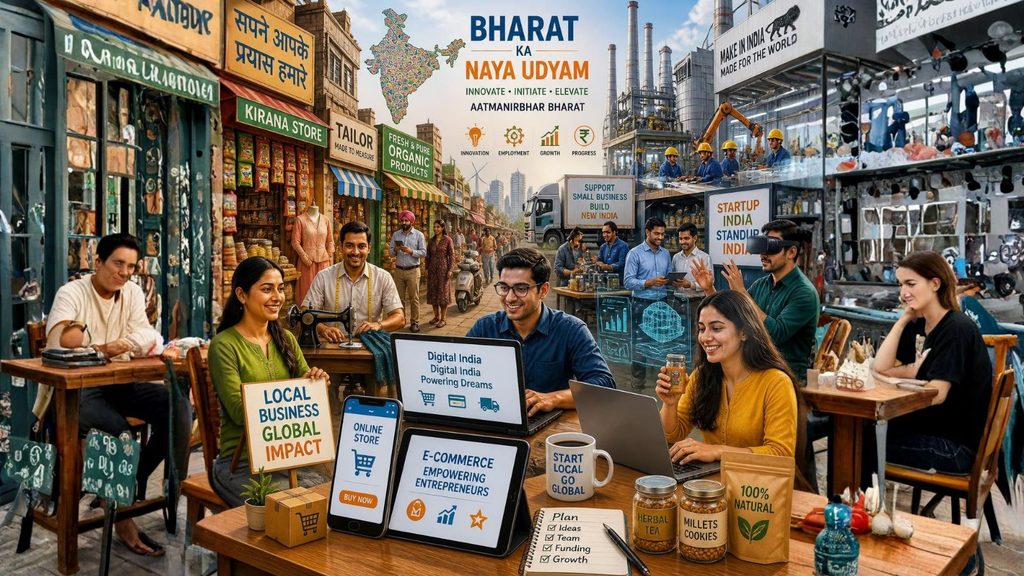
The strongest opportunity is usually not the trendiest sector. It is a specific problem faced by customers you can understand and reach.
Digital and online services: Digital marketing, content, design, software, consulting, and online education can begin with limited infrastructure.
D2C and e-commerce: Focused products, regional brands and niche segments can be easier to position than broad catalogues.
Technology and SaaS: Solve a specific business problem instead of simply deciding to build an app.
Fintech, health and education: These sectors offer opportunities, but applicable rules, safety and responsible execution matter.
Manufacturing and agribusiness: Specialised production, packaging, processing, logistics, storage and agricultural value chains can support businesses beyond the venture-capital model.
Local and regional businesses: Home services, repair, training, food, logistics and professional practices are also genuine entrepreneurial ventures.
The better question is not “Which sector will definitely grow?” It is “Which customer problem can I solve better, and can the economics support the business?”
What Are the Biggest Challenges for Entrepreneurs in India?

Finding the right problem: An idea may sound useful without being painful enough for customers to pay for.
Competition: Customers already have alternatives, including competitors, manual processes, and doing nothing.
Capital: Not every business needs external funding. Many are better suited to bootstrapping, provided cash needs are understood.
Customer acquisition: A good product does not automatically create awareness or trust. Outreach, referrals, partnerships and content may all matter.
Compliance: Registration, taxation, labour, licences and sector-specific rules vary. Understand what applies to your model.
Hiring and cash flow: Suitable skills can be difficult to find, while expenses may arrive before revenue. Regional differences in language, purchasing power and behaviour also matter.
What Mindset Does an Entrepreneur in India Need?
Start with problem-solving. Ask what is wrong, who experiences it, and what evidence shows that it matters.
Think customer-first and track revenue, costs, margins, and cash flow from the beginning. Be patient and adaptable because the first version of an idea may change after customer feedback.
Develop execution discipline and ethical, long-term thinking. Confidence should come from learning and action, not from assuming success is guaranteed.
How to Start Your Entrepreneurial Journey in India
If you are wondering how to start entrepreneurship in India, do not begin by trying to build the perfect company. Begin with a problem you can investigate.
- Identify a real problem. Start with something customers genuinely struggle with.
- Define the customer. Be specific about who experiences it most strongly.
- Research the market. Study competitors, alternatives, demand, pricing, and behaviour.
- Validate the idea. Speak with potential customers and test important assumptions before spending heavily. See our guide on how to validate a business idea.
- Choose a business model. Decide who pays, what they pay for, and how you deliver value.
- Start small. Use a simple offer, pilot or MVP where appropriate.
- Get early customers. Direct conversations, outreach, referrals, and relevant communities can be more useful initially than chasing large audiences. See our guide on how to get your first 10 customers.
- Formalise when appropriate. Choose the suitable structure and understand relevant registration, tax, and compliance requirements.
- Improve before scaling. Use customer feedback and financial results to decide what deserves more investment.
For a startup-specific path, see how to start a startup in India.
Startup India and Government Support
Government support can help, but it should not become the business plan.
Startup India provides a route for eligible entities to seek DPIIT recognition. The current framework covers eligible private limited companies, registered partnerships, LLPs and cooperative societies that meet applicable age, turnover, innovation or improvement, and scalability conditions. DPIIT recognition is different from ordinary business registration.
Recognised startups may access self-certification in specified areas, IPR facilitation, easier public procurement norms, and other support, subject to conditions.
Understand the business first, then check the relevant government framework and current official rules.
Entrepreneurship vs Startup: What Is the Difference?
Entrepreneurship is the broader activity of identifying opportunities, creating value, and building a venture.
A startup is generally a venture working under uncertainty to find a repeatable and potentially scalable business model, often with a strong growth orientation.
Every startup involves entrepreneurship, but not every entrepreneur is building a startup.
A profitable local business can be a successful entrepreneurial venture. You do not need venture capital, rapid expansion, or a technology product to be a real entrepreneur.
A Simple 90-Day Entrepreneurship Roadmap
Days 1-30: Choose a problem, identify the customer, study competitors, and test assumptions.
Days 31-60: Create a simple offer, build an MVP where appropriate, start outreach and get early customers.
Days 61-90: Review revenue and costs, improve the offer, strengthen customer acquisition, document processes, and decide whether to continue, change direction, or scale.
Common Mistakes New Entrepreneurs in India Should Avoid
- Starting because a business is trending: Follow customer problems, not fashion.
- Copying blindly: Understand why the model works before adapting it.
- Spending heavily early: Test important assumptions first.
- Assuming funding is necessary: Consider bootstrapping where suitable.
- Ignoring cash flow: Track money from the beginning.
- Trying to serve everyone: Start with a focused segment.
- Confusing attention with demand: Measure enquiries and sales.
- Ignoring compliance: Understand the rules relevant to your business.
Frequently Asked Questions
What is entrepreneurship in India?
It involves identifying opportunities or customer problems, creating value, and building sustainable ventures across traditional businesses, services, manufacturing, digital commerce, and technology.
Why is entrepreneurship important in India?
Entrepreneurship creates products, services and new ways of solving customer problems while helping businesses respond to changing technology and consumer needs.
What are the best opportunities for entrepreneurship in India?
There is no single best opportunity. Digital services, D2C, SaaS, manufacturing, agribusiness, education, health, fintech, and local services can all offer possibilities. The right choice depends on demand and business economics.
How can I start entrepreneurship in India?
Start with a specific problem, research the market, speak with customers, validate demand, create a simple offer, and get early customers. Formalise when appropriate and improve using evidence.
What are the biggest challenges faced by entrepreneurs in India?
Common challenges include demand, competition, customer acquisition, cash flow, capital, hiring, and compliance. Preparation and discipline can help manage them.
Do I need a lot of money to become an entrepreneur in India?
Not necessarily. Some businesses can begin with skills, existing resources, a simple service or a small pilot. Capital needs depend on the model, so focus first on the cost of testing and delivering the first version.
Key Takeaways
- Entrepreneurship is broader than startups.
- Start with a real customer problem.
- India offers opportunities across many sectors.
- Choose a specific customer segment.
- Validate before investing heavily.
- Build financial discipline.
- Learn relevant regulations.
- Start small, improve, and scale only after finding what works.
How to Start Your Entrepreneurship Journey in India
Entrepreneurship becomes clearer through action and learning, not endless planning. Pick one problem, speak to the people who experience it, test your assumptions, and let evidence guide the next decision.
You do not need to know everything before starting. Learn what matters, make disciplined decisions, and keep improving.
India offers room for local businesses, services, manufacturing, digital ventures and startups. Sustainable entrepreneurship comes from solving meaningful problems rather than simply chasing opportunity.
Conclusion
Entrepreneurship in India offers many paths, from a specialised local business to a digital service, manufacturing venture or scalable startup. But opportunity alone is not enough.
Sustainable entrepreneurs learn to understand customers, solve meaningful problems, manage money carefully, execute consistently, and adapt when evidence changes their assumptions.
Do not measure your beginning against someone else’s scale. Start with the problem you can understand, the customer you can reach, and the smallest useful solution you can test.
Believe • Build • Inspire
