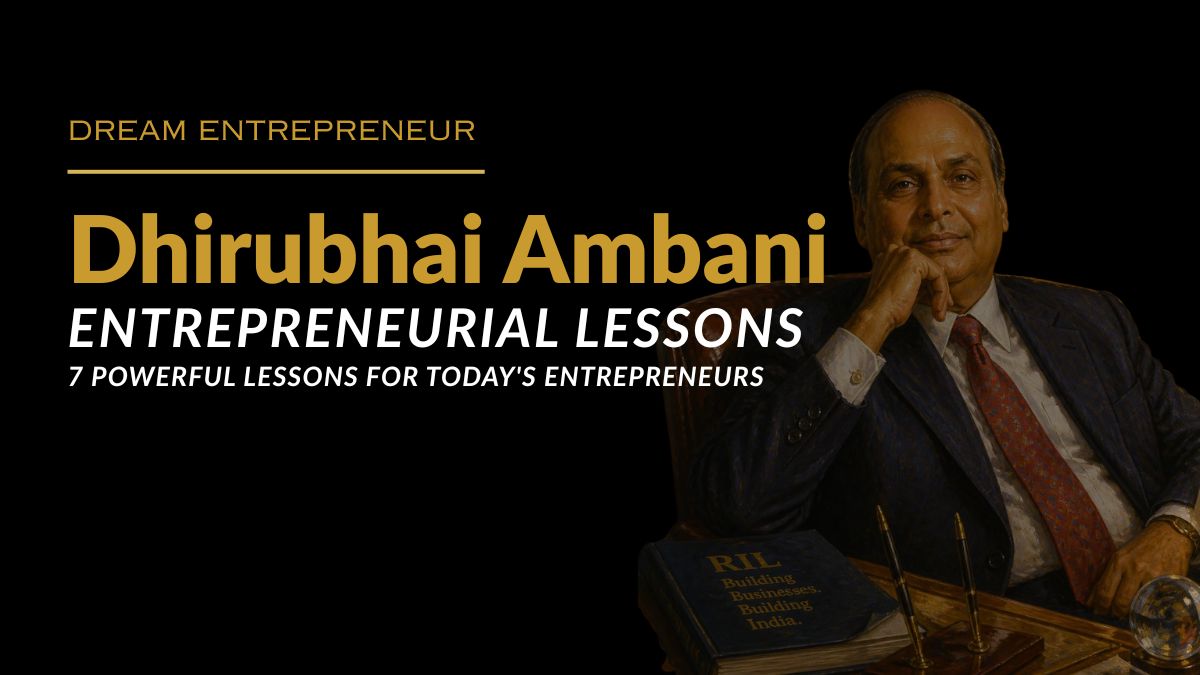
In 1958, a young man named Dhirubhai Ambani (Dhirajlal Hirachand Ambani) walked into a 350 square foot office in Mumbai’s Masjid Bunder with one table, three chairs, a telephone, and a plan to trade yarn and spices, a modest start for a man later remembered as one of India’s most influential industrialists. That small trading firm, Reliance Commercial Corporation, eventually grew into Reliance Industries, one of India’s largest companies.
It’s tempting to read a story like this as a highlight reel. But the more useful way to read it is as a set of decisions, some that paid off, some that were pure grind, and a few that could easily have gone the other way. That’s what the Dhirubhai Ambani entrepreneurial lessons in this article are really about: not the size of what he built, but the thinking that got him there.
“The goal is to turn these Dhirubhai Ambani entrepreneurial lessons into practical decisions that a founder can use today.”
Table of Contents
This isn’t a biography. It’s a look at how he thought, what he decided, and what any founder building something today can actually take from it.
What Can Entrepreneurs Learn From Dhirubhai Ambani?
The most useful Dhirubhai Ambani entrepreneurial lessons come down to seven ideas: think big while starting small, spot opportunities early, understand your customer and your reach, take calculated risks instead of blind ones, build for scale rather than a single win, execute with discipline, and think long term while building stakeholder trust. None of these need his exact resources or his era. They need the same habits of thinking, applied to whatever you’re building right now.
Lesson 1: Think Big, Even When You Start Small

Dhirubhai Ambani came back to India from Aden in the late 1950s and started Reliance Commercial Corporation with modest capital and no industrial background, working out of a small trading office rather than a factory. And yet, from very early on, those who worked with him describe someone already talking in terms of a much larger company.
What actually mattered wasn’t the ambition itself. It was that he kept operating at a scale he could genuinely manage while making decisions that kept a bigger future open, building trading relationships and reinvesting his earnings instead of overextending early.
Starting small doesn’t require thinking small. You can run a modest operation today while still choosing systems and pricing that won’t need to be torn up and rebuilt the moment the business grows. It’s the same thinking behind bootstrapping a startup without external funding: resourcefulness now, ambition for later.
How to Think Big While Starting Small
- Set a long-term direction even if your current operation is tiny.
- Choose tools and processes that can scale later, not just work for today.
- Review your bigger goal every few months so daily tasks don’t quietly replace it.
Lesson 2: Identify Opportunities Before They Become Obvious
One of the clearer lessons from Dhirubhai Ambani’s journey is about timing. He moved from general trading into synthetic textiles in 1966, setting up his first mill at Naroda near Ahmedabad and launching the Vimal brand when synthetic fabrics were still a growing, underexplored category compared to traditional Indian textiles.
He wasn’t the only trader in Mumbai at the time. What set him apart was paying attention to where demand was shifting and moving before the opportunity got crowded. Later, when Reliance went public in 1977 (the issue was reportedly oversubscribed around seven times), he was early to a different kind of shift: how ordinary Indians could actually own a piece of a company.
Spotting an opportunity early isn’t about guessing well. It’s about paying close attention to changing customer needs and testing a direction before your competitors treat it as obvious.
How to Spot Business Opportunities Early
- Track shifts in customer behaviour, not just what competitors are doing.
- Talk to potential customers before building a full product.
- Test a smaller version of an idea before committing major resources.
Lesson 3: Understand Customers and Build Market Reach

A product is only as good as its reach. Dhirubhai Ambani built an extensive distribution network for the Vimal brand, combining company-owned stores, franchised outlets, and a large base of retail counters to reach customers well beyond India’s major cities and into smaller towns.
This mattered because Reliance wasn’t just selling fabric; it was selling trust in a new brand, and trust needed a wide, consistent presence. He also opened dealerships to people outside the traditional textile trade, building reach faster than relying only on established agents.
For a founder today, the equivalent might be an online store, a delivery network, or better customer support. The principle hasn’t changed: a good product with poor reach loses to an average product that customers can actually find and trust.
How to Improve Customer Understanding and Reach
- Map out exactly how customers discover, buy, and receive your product.
- Ask existing customers what almost stopped them from buying.
- Build feedback loops so your reach improves with real data, not guesses.
Lesson 4: Take Calculated Risks
Dhirubhai Ambani is often remembered for bold moves, but the more accurate lesson is about calculated risk, not blind risk. When he built the Patalganga polyester filament yarn plant in the early 1980s, he set it up with a licensed capacity of around 10,000 tonnes a year, well above the roughly 6,000 tonnes of annual demand that existed at the time, betting that demand would grow into that capacity as the sector expanded. It was a real bet, made ahead of the market rather than in response to it.
He also took Reliance public in 1977 after finding conventional bank financing difficult to secure, a decision with genuine uncertainty attached since public shareholding at this scale wasn’t common practice in India yet.
The entrepreneurs who last are rarely the ones who avoid risk completely or the ones who chase it recklessly. They do the homework, understand the downside, and then act once the opportunity is strong enough.
How to Take Calculated Risks in Business
- Base risk decisions on information you’ve actually gathered, not just instinct.
- Understand the worst-case outcome before committing, and have a plan for it.
- Time major decisions around real signals in your market, not general optimism.
Lesson 5: Build for Scale

From the 1980s onward, Dhirubhai Ambani pursued backward integration, moving from finished textiles into producing the raw materials behind them, first at Patalganga and later at the large Hazira petrochemical complex commissioned in 1991. Each step reduced dependence on imports and gave Reliance more control over its own cost and supply. Reliance’s own account of this backward integration journey lays out the full timeline, plant by plant.
You don’t need industrial plants to apply this. For most small businesses, building for scale simply means setting up systems and repeatable processes early, so growth doesn’t mean starting over every time volume goes up. If you’ve ever tried to scale a small business that was still being run out of spreadsheets and group chats, you already know what happens when the systems aren’t ready before the demand is.
How to Build a Business for Scale
- Document your core processes so they don’t live only in one person’s head.
- Choose suppliers and partners who can support higher volume later.
- Fix your biggest bottleneck to growth before you add new products.
Lesson 6: Focus on Execution, Not Just Ideas
The Patalganga plant itself is often cited as an example of Reliance’s execution speed, built and commissioned in a timeframe that stood out against the industry norms of the period. That reputation for fast, disciplined project execution followed Reliance through its later petrochemical and refinery projects as well.
An idea only becomes a business once someone executes it consistently: tracking progress, controlling cost, and adjusting the plan based on what the market is actually showing you, not what you hoped it would show. Execution discipline is one of the Dhirubhai Ambani entrepreneurial lessons that’s easy to nod along to and hard to actually practise.
“That discipline is another of the most practical Dhirubhai Ambani entrepreneurial lessons for founders: ideas matter only when they are turned into consistent action.”
How to Execute With Discipline
- Break big goals into weekly, measurable actions instead of vague targets.
- Review actual results against your plan on a fixed schedule.
- Prioritise finishing one thing well over starting several things at once.
Lesson 7: Think Long Term and Build Stakeholder Trust
Dhirubhai Ambani built Reliance’s shareholder base into one of the largest in India, at a time when stock market investing was unfamiliar to most middle-class households. He leaned on regular dividends and direct communication to build trust with small investors, turning many of them into long-term supporters rather than short-term traders looking for a quick exit. That same instinct for building trust over time extended into how Reliance approached employees, distributors, and business partners.
The lesson here isn’t about networking for personal gain. It’s about treating trust with shareholders, customers, employees, and partners alike as a business asset that compounds over years rather than something to spend down for a quick win.
How to Build Long-Term Business Relationships
- Communicate clearly and regularly with the people who back your business.
- Keep commitments even when a relationship isn’t immediately profitable.
- Review your key business relationships every year, not just when something goes wrong.
What Today’s Entrepreneurs Can Take From Dhirubhai Ambani’s Approach
Some parts of Dhirubhai Ambani’s playbook remain directly useful, and this is really where the Dhirubhai Ambani entrepreneurial lessons in this article earn their keep. Customer understanding, calculated risk, disciplined execution, long-term thinking, and building for scale are principles that don’t really expire, whatever industry you’re in.
Other parts need real adaptation. He built physical distribution networks across thousands of retail points; today, digital distribution and online customer acquisition often do that same job faster and cheaper. He also operated inside India’s regulatory environment of the 1970s and 1980s, while today’s founders deal with different rules, far more global competition, and a lot more data about their customers than he ever had access to.
The historical facts of his journey belong to that period. The thinking behind them is what actually carries forward, and it’s worth reading alongside how other Indian business leaders approached the same problems, like the discipline behind Ratan Tata’s leadership lessons.
How to Apply Dhirubhai Ambani’s Entrepreneurial Lessons Today
A practical way to use these Dhirubhai Ambani entrepreneurial lessons is to work through them as a sequence, rather than as seven separate ideas sitting on their own.
- Find a real opportunity. Base it on an actual gap you’ve observed, not just personal interest.
- Understand the customer. Talk to people who would actually buy before building extensively.
- Start with a manageable version. Test the idea at a scale you can afford to be wrong at.
- Take calculated risks. Move once you have enough information, not once you feel certain.
- Build repeatable systems. Document what works so growth doesn’t mean starting over.
- Focus on execution. Track progress against a plan, and adjust based on results.
- Think beyond the first milestone. Treat your first success as a starting point, not an end point.
This works whether you’re a solo founder testing a small idea or a growing business planning its next phase, because it’s really the entrepreneur mindset behind it that matters more than the size of the business. To understand the broader idea behind these principles, it helps to start with what is entrepreneurship in the first place, and then translate that into practical decisions about how to start a business and test your own ideas.
“Several Dhirubhai Ambani entrepreneurial lessons remain directly useful today, even though the tools and markets have changed.”
Frequently Asked Questions
Who was Dhirubhai Ambani?
Dhirubhai Ambani, born Dhirajlal Hirachand Ambani, was an Indian businessman who founded Reliance Commercial Corporation in Mumbai in 1958 and built it into Reliance Industries, one of India’s largest private sector companies, before he died in 2002.
What are the most important Dhirubhai Ambani entrepreneurial lessons?
The core lessons include thinking big while starting small, spotting opportunities early, understanding customers and distribution, taking calculated risks, building for scale, executing with discipline, and building long-term stakeholder trust.
What made Dhirubhai Ambani a successful entrepreneur?
He combined bold long-term vision with disciplined execution, moving early into growing markets, building wide distribution reach, and earning lasting trust with shareholders, employees, and partners over decades.
What can startups learn from Dhirubhai Ambani?
Startups can learn to validate opportunities before committing heavily, build systems that support growth rather than just today’s needs, and treat risk-taking as a disciplined process rather than a gamble.
What can small business owners learn from Dhirubhai Ambani?
Starting with limited resources doesn’t limit long-term ambition. Consistent customer focus, reliable distribution, and steady execution matter more than having large capital at the start.
Is Dhirubhai Ambani’s business approach still relevant today?
The underlying principles- customer focus, calculated risk, execution discipline, and long-term trust, remain relevant. Specific methods, like physical distribution networks, need adapting to today’s digital environment.
Key Takeaways
These Dhirubhai Ambani entrepreneurial lessons come down to a few core ideas worth keeping close:
- Ambition and a small starting point aren’t in conflict with each other.
- Spotting a shift in customer needs early is often more valuable than reacting to a proven trend.
- A great product still needs strong, well-understood distribution to succeed.
- Calculated risks, backed by information and timing, beat both blind risk and excessive caution.
- Building systems and infrastructure early makes future growth far less disruptive.
- Consistent execution turns a promising idea into an actual business.
- Long-term trust with customers, employees, and partners compounds in value over time.
Conclusion
Dhirubhai Ambani’s journey, from a small trading office in Masjid Bunder to building one of India’s largest industrial groups, stays useful not because his exact path can be copied, but because his thinking can be. The Dhirubhai Ambani entrepreneurial lessons in this article don’t need his resources, his era, or his industry to work.
What carries forward is simpler: think clearly, identify real opportunities, execute consistently, build for scale, and stay focused on long-term value over quick wins. Every entrepreneur builds under different conditions, but that sequence holds up across most of them.
Believe in the opportunity you see. Build it with discipline. Let the results inspire the next step.
