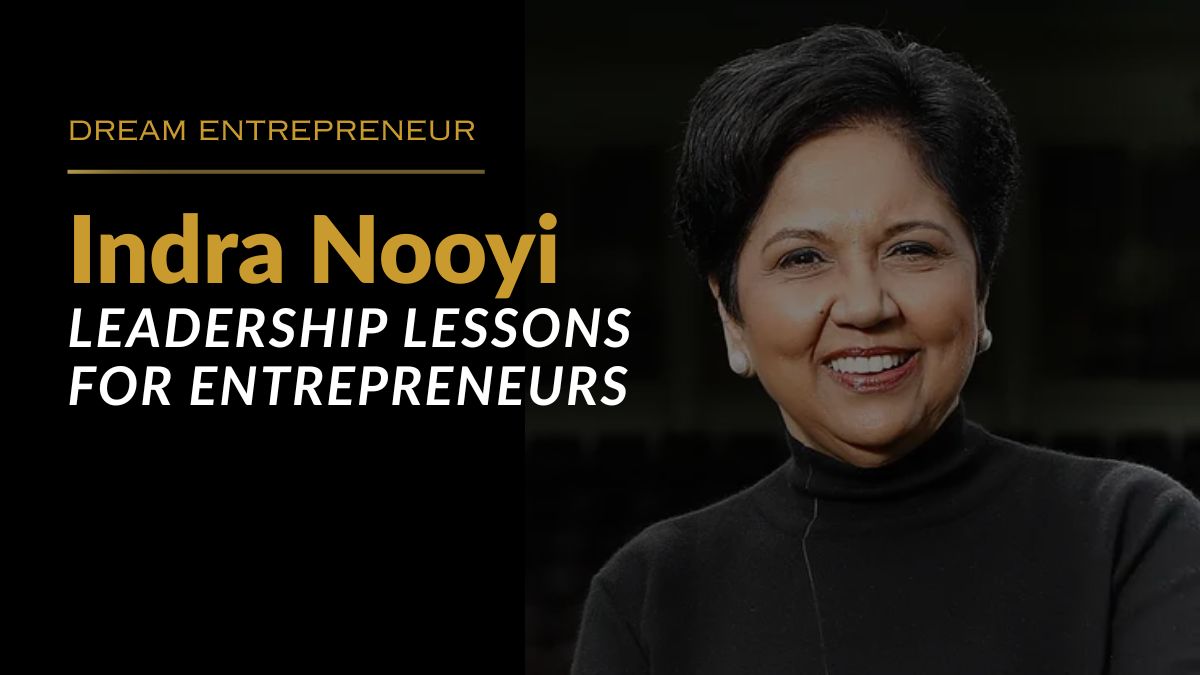
Many entrepreneurs think leadership means having all the answers, making fast decisions, and being the person everyone follows.
Indra Nooyi’s career presents a different picture.
Table of Contents
As the former Chairman and CEO of PepsiCo, Nooyi spent years making decisions that involved competing priorities: financial performance, changing consumer preferences, talent, sustainability, innovation, and long-term growth.
She became PepsiCo’s CEO in 2006 and stepped down as CEO in October 2018 after 12 years in the role, as confirmed in PepsiCo’s announcement about her succession. PepsiCo reported that during her CEO tenure, revenue grew from $35 billion in 2006 to $63.5 billion in 2017, while the company continued investing in its Performance with Purpose strategy.
The useful question for an entrepreneur is not simply, “How successful was Indra Nooyi?”
It is: What decisions and leadership principles helped her manage a complex global business, and which of those principles can a smaller business use today?
Here are seven practical Indra Nooyi leadership lessons entrepreneurs can learn from her career.
What Is Indra Nooyi’s Leadership Approach?
Indra Nooyi’s leadership approach can be broadly understood as a combination of long-term thinking, strategic transformation, stakeholder awareness, talent development, and disciplined execution.
The Indra Nooyi leadership lessons discussed in this article focus on these practical aspects of leadership rather than simply summarising her career.
One of the clearest examples was PepsiCo’s Performance with Purpose philosophy, which connected financial performance with longer-term priorities around products, the environment, and people. PepsiCo’s Performance with Purpose strategy.
The idea was to pursue financial performance while also addressing products, environmental impact, and people. PepsiCo introduced the initiative under Nooyi’s leadership in 2006.
This did not mean ignoring profits.
Instead, the strategy attempted to connect long-term business performance with changing consumer expectations and broader business responsibilities.
For an entrepreneur, the lesson is straightforward: a business strategy becomes stronger when it considers where the market is going, not only where it is today.
Why Do Indra Nooyi Leadership Lessons Matter for Entrepreneurs?
These Indra Nooyi leadership lessons are particularly useful for entrepreneurs because they show how strategic thinking, people management, adaptability, and long-term decision-making work in a complex business environment.
A startup founder or small-business owner may never manage a company the size of PepsiCo. But the leadership problems are surprisingly similar.
Nooyi’s career is useful because it shows how leadership decisions can involve trade-offs rather than simple right-or-wrong answers. This requires an entrepreneur mindset that focuses on learning, adapting, and making better decisions instead of simply reacting to problems.
Her experience also demonstrates that strategic leadership is not limited to founders. Her career also illustrates how strategic thinking can develop over decades rather than appearing suddenly at the CEO level. Yale School of Management’s profile of Nooyi’s leadership journey. Entrepreneurs, managers, and future business leaders can develop these skills long before they run a large company.
7 Indra Nooyi Leadership Lessons Every Entrepreneur Can Learn
1. Think Beyond Short-Term Results
One of the strongest themes in Nooyi’s leadership was the balance between immediate performance and long-term growth.
PepsiCo described Performance with Purpose as an approach that considered both short-term priorities and long-term goals.
This is especially relevant for entrepreneurs.
A new business often faces pressure to generate revenue quickly. That pressure is real. But decisions made only for this month’s revenue can create problems later.
For example, a founder may accept every customer even when some customers are unprofitable. Another may reduce product quality to save a small amount of money. A third may avoid investing in systems because manual work appears cheaper. Entrepreneurs working with limited resources can also learn from the principles of bootstrapping a startup, where careful spending and prioritisation become essential for long-term survival.
These decisions can produce short-term benefits but create long-term costs.
Practical lesson: Divide business decisions into two categories:
- What improves the business today?
- What makes the business stronger one or two years from now?
You need both.
2. Prepare for Change Before It Becomes a Crisis
Nooyi’s PepsiCo faced a changing food and beverage environment, including growing attention to nutrition and changing consumer preferences.
The company responded by working on its portfolio and expanding healthier options while continuing to operate major established brands. PepsiCo’s own reports describe efforts to reduce sugar, sodium, and saturated fat and increase more positive ingredients.
This is a useful entrepreneurship lesson.
A business should not wait until customers completely abandon a product before adapting.
Imagine a local food business noticing that customers are increasingly asking for healthier options. A weak response would be to ignore the trend until sales decline. A better response could be testing a small healthier product range and measuring customer response.
The same principle applies to technology, marketing, payment methods, customer service, and distribution.
Practical lesson: Watch customer behaviour continuously and experiment before change becomes urgent.
3. Build a Purpose That Supports the Business

“Purpose” can easily become a marketing slogan.
Nooyi’s approach is more useful when viewed as a business strategy.
Performance with Purpose was designed around financial performance alongside product, environmental, and people-related priorities. PepsiCo continued to describe the philosophy as a cornerstone of its strategy after Nooyi’s departure.
For a small entrepreneur, purpose does not need to mean creating a massive sustainability programme.
It could mean building a business around a clear customer problem.
For example, a small education company might focus on affordable practical learning. A local food business might build its reputation around consistent quality and transparent ingredients. A software startup might focus on making a complicated business process easier for small companies.
The purpose should influence decisions, not merely appear on the website.
Practical lesson: Ask, “What problem are we genuinely trying to solve?” Then make your product, customer experience, and business decisions support that answer.
4. Develop People, Not Just Products
Leadership becomes difficult when the business grows because one person cannot make every decision.
Nooyi’s tenure involved building a strong management team and moving experienced executives into important leadership positions. PepsiCo repeatedly highlighted its management depth and succession planning during her tenure.
This is another valuable Indra Nooyi leadership lesson: founders need to build people and systems, not become the centre of every decision.
Many small-business owners become the biggest bottleneck in their own company.
Every customer complaint comes to the founder. Every purchase needs approval. Every marketing decision needs permission. Every employee waits for instructions.
This may work with three people. It becomes difficult with 20 or 50.
Practical lesson: Give people responsibility along with authority.
Instead of saying, “Do exactly what I tell you,” define the outcome, boundaries, and resources. Then allow capable people to make decisions.
A founder’s job should gradually shift from doing everything to building a team that can do important things without constant supervision.
5. Make Difficult Strategic Decisions When the Business Needs Them

Leadership is not only about inspiring people. It also involves changing the structure of a business when the existing model no longer makes sense.
A good example came in PepsiCo’s North American beverage operations. In 2009, the company announced plans to acquire the outstanding shares of its two largest bottlers, arguing that the changing industry required a more flexible and efficient model.
This is one of the most practical Indra Nooyi leadership lessons for entrepreneurs: successful leaders must be willing to rethink their strategy when business conditions change.
The lesson is not that every entrepreneur should acquire another company.
The lesson is that leaders need to examine whether their current business structure still supports their objectives.
A startup may discover that its sales process is too dependent on one founder. A retailer may discover that its physical location limits growth. A service business may realise that charging only by the hour prevents it from scaling.
Practical lesson: Do not become emotionally attached to a business model simply because it worked in the past.
Review your structure regularly.
6. Combine Ambition With Execution
A strategy means very little if the organisation cannot execute it.
Nooyi’s leadership involved strategic priorities, organisational changes, portfolio decisions, and investments designed to support PepsiCo’s long-term direction. For entrepreneurs, this is closely connected to building discipline when motivation fails because consistent execution requires systems and routines, not motivation alone.
PepsiCo’s leadership announcements during her tenure frequently connected organisational changes with specific growth, innovation, efficiency, and consumer objectives.
For entrepreneurs, this distinction is critical.
Many founders have excellent ideas but weak execution systems. This is one reason aspiring entrepreneurs fail before they start, especially when they focus heavily on ideas but do not build the habits, systems, and discipline required to execute them.
They create a business plan but do not establish weekly targets. They launch social media pages but do not measure results. They develop products but do not systematically collect customer feedback.
A practical leadership system could be as simple as:
- Set three important goals for the quarter.
- Assign one person responsible for each goal.
- Define measurable outcomes.
- Review progress every week.
- Change tactics when evidence shows they are not working.
Practical lesson: Strategy tells you where to go. Execution determines whether you actually get there.
7. Lead With a Wider View of Stakeholders
A business does not operate in isolation.
Customers, employees, suppliers, investors, communities, regulators, and business partners can all affect its success.
Nooyi’s Performance with Purpose philosophy explicitly reflected this broader stakeholder view. PepsiCo described the strategy as balancing financial returns with products, environmental responsibility, and people.
For a small business, this does not mean sacrificing profitability.
It means understanding that reputation, employee trust, customer loyalty, and supplier relationships can become competitive advantages.
For example, a small manufacturer that consistently pays suppliers on time may receive better cooperation during difficult periods. A business that treats employees fairly may find it easier to retain experienced staff.
Practical lesson: Profit keeps a business alive, but strong relationships can make it more resilient.
What Does Indra Nooyi’s Success Story Teach About Strategic Leadership?
One of the most useful Indra Nooyi leadership lessons is that strategic leadership requires balancing current business performance with the changes that may shape future growth.
The most useful part of Indra Nooyi’s success story is not that she became the CEO of a global company.
It is how she approached a business that was already enormous and still tried to prepare it for changing conditions.
During her tenure, PepsiCo continued to deliver strong financial results while pursuing its broader Performance with Purpose agenda. When she stepped down in 2018, PepsiCo said net revenue had increased from $35 billion in 2006 to $63.5 billion in 2017.
However, entrepreneurs should avoid interpreting this as proof that every purpose-led decision automatically produces financial success.
Large corporations have enormous resources, established brands, global distribution, and professional management teams. A startup cannot simply copy their strategy.
The transferable lesson is the thinking process:
Changing market → strategic response → investment → execution → measurement → adjustment
That process works for businesses of almost any size.
What Can Entrepreneurs Learn From Indra Nooyi’s Leadership Style?
Nooyi’s leadership style can be particularly useful for entrepreneurs who are moving from individual contributor to business leader.
The biggest shift is learning to think beyond personal productivity.
An entrepreneur might initially ask:
“How can I work harder?”
A leader eventually needs to ask:
“How can I build a business that performs well even when I am not doing every task?”
That requires delegation, systems, talent development, clear communication, strategic planning, and accountability.
It also requires accepting that leadership decisions may involve competing priorities.
For example, hiring another employee increases costs today but may create capacity for growth tomorrow.
Similarly, improving a product may reduce short-term margins but strengthen customer retention.
Good leadership does not eliminate these trade-offs. It makes them visible and helps the business choose deliberately.
Common Leadership Mistakes Entrepreneurs Should Avoid
Studying successful leaders can create another problem: copying the visible behaviour without understanding the underlying principle.
Here are some mistakes to avoid.
Copying the strategy instead of the thinking: A small startup does not need PepsiCo’s corporate structure. It needs disciplined strategic thinking appropriate to its own scale.
Focusing only on vision: A big vision without measurable execution becomes a presentation rather than a business strategy.
Ignoring short-term cash flow: Long-term thinking does not mean ignoring today’s finances. Entrepreneurs still need enough cash to survive.
Trying to lead everyone personally: Founders who refuse to delegate eventually become bottlenecks.
Using purpose as marketing: If your stated values do not influence actual decisions, customers and employees will notice.
Avoiding difficult decisions: Leadership sometimes requires changing products, processes, people, or business models even when those decisions are uncomfortable.
How to Apply These Indra Nooyi Business Lessons in Your Own Business
You do not need a large company to start applying these principles.
Begin with a simple quarterly leadership review.
Step 1: Review your current business.
Look at revenue, costs, customers, products, employees, and operational problems.
Step 2: Identify one major future risk.
Ask what could seriously affect your business over the next 12 to 24 months.
Step 3: Identify one customer trend.
What are customers increasingly asking for? What are they complaining about? What are competitors doing differently?
Step 4: Choose one strategic experiment.
Do not attempt a complete transformation immediately. Test one product, process, channel, or customer segment.
Step 5: Develop one person.
Give an employee or team member ownership of a meaningful responsibility.
Step 6: Measure the result.
Decide beforehand what success looks like.
Step 7: Review and adjust.
Keep what works, change what does not, and avoid becoming attached to your original plan.
This approach makes leadership practical rather than theoretical.
Taken together, these Indra Nooyi leadership lessons show that effective leadership is not about one particular personality or management style. It is about making thoughtful decisions, developing people, adapting to change, and keeping the long-term health of the business in view.
Key Takeaways
The most valuable Indra Nooyi leadership lessons are not about becoming a famous CEO. They are about developing the ability to make thoughtful decisions when business priorities compete with each other.
They are about learning how to think like a business leader.
- Think beyond immediate results.
- Prepare for changing customer needs.
- Connect purpose with real business decisions.
- Develop people instead of controlling every task.
- Be willing to change the business model when conditions change.
- Turn strategy into measurable execution.
- Consider customers, employees, partners, and other stakeholders alongside financial performance.
For a first-time entrepreneur, the most important takeaway may be this: leadership is less about having all the answers and more about making better decisions as the business becomes more complex.
Frequently Asked Questions
What are the main Indra Nooyi leadership lessons?
The main lessons include long-term thinking, adapting to changing consumer needs, developing strong teams, connecting purpose with strategy, making difficult strategic decisions, executing consistently, and considering multiple stakeholders. These principles can be adapted to startups and small businesses without copying PepsiCo’s large corporate structure.
What was Indra Nooyi’s leadership style?
Indra Nooyi’s leadership style combined strategic thinking, long-term planning, organisational transformation, talent development, and stakeholder awareness. Her leadership at PepsiCo was strongly associated with Performance with Purpose, an approach that connected financial performance with products, people, and environmental considerations.
What can entrepreneurs learn from Indra Nooyi?
Entrepreneurs can learn to balance short-term execution with long-term strategy, prepare for changing customer preferences, build capable teams, and make difficult decisions when existing business models become less effective. Her career also demonstrates why strategy needs to be supported by execution and measurable results.
What is Performance with Purpose?
Performance with Purpose was a strategic philosophy introduced at PepsiCo under Indra Nooyi’s leadership. It aimed to combine financial performance with progress in areas including products, environmental impact, and people. PepsiCo later continued developing this philosophy through its Winning with Purpose strategy.
Why is Indra Nooyi an important example for women leaders?
Indra Nooyi provides a significant leadership case study because she became CEO of one of the world’s largest food and beverage companies after building a long career in strategy and corporate leadership. Her career is particularly useful for studying how women leaders can operate at the highest levels of large global organisations, while also demonstrating the complexity and trade-offs involved in senior leadership.
