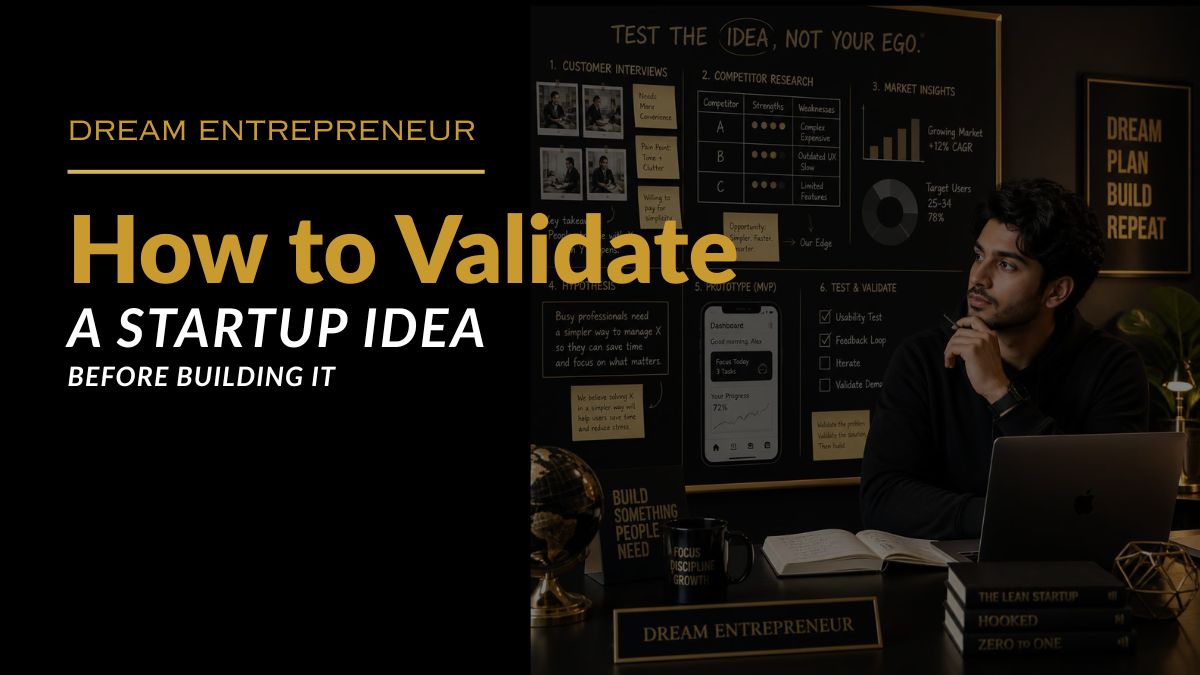
An idea can sound brilliant in your head and still fail to solve a problem customers actually care about. That gap between “this feels right” and “this is real” is where founders lose the most time and money.
Before you write a line of code, hire anyone, or spend serious money, it helps to validate startup idea assumptions the same way an investor eventually will: through evidence, not enthusiasm. Validation doesn’t mean proving your idea will definitely succeed. It means collecting enough real-world evidence to make your next decision with information instead of a hunch.
This guide walks through a practical process to validate startup idea assumptions: defining the problem, understanding the customer, testing demand, and deciding what the evidence actually supports.
Table of Contents
How Do You Validate a Startup Idea?
Start by defining the problem clearly, then identify exactly who experiences it. Talk to potential customers about how they handle this today, and study the alternatives they already use. Test whether the problem is important enough to act on, present a possible solution, and look for real behavioural evidence rather than compliments. Where it makes sense, test willingness to pay. Then review what you’ve learned and decide whether to build, improve, or change direction.
Finding, Validating, and Building: Three Different Stages
These terms often get used interchangeably, but they aren’t the same thing.
Finding a startup idea means spotting a problem worth exploring.
Validating a startup idea means gathering evidence that the problem is real, that customers care, and that a solution might have demand.
Building an MVP means creating the smallest practical version of that solution to test your remaining assumptions with real users.
Product-market fit comes later, once evidence shows strong, sustained demand. Skipping straight from idea to MVP, without validating in between, is where a lot of early effort gets wasted.
Start With the Problem, Not the Product
Validation should begin with the problem, not your solution. Ask who has it, how often it happens, and what it costs them in time or money. Ask how they solve it today, and why that isn’t good enough.
A strong startup opportunity usually begins with a meaningful problem, not an interesting product idea.
If you can’t describe the problem in one clear sentence, that’s worth fixing first.
Identify Your Target Customer
“Everyone” is not a useful target market. Define your customer by situation, industry, behaviour, or context, not just broad demographics.
For example, “freelance designers who invoice more than five clients a month” is far more useful than “small business owners.” A specific definition also helps you find early adopters: the people who feel this problem most sharply right now.
Talk to Potential Customers

Conversations with real potential customers reveal whether the problem is genuine. This is close to what Steve Blank calls customer discovery: getting out of the building to test assumptions with real people, instead of guessing from inside it.
Ask how they currently handle it, what’s most frustrating, how often it happens, and what they’ve already tried. Ask what the current approach costs them, and what happens if they do nothing at all.
Avoid asking only “would you use my product?” That question invites a polite, hypothetical answer. What you actually want is evidence of real behaviour: what they’ve paid for, tried, or abandoned.
Study Existing Solutions and Competitors
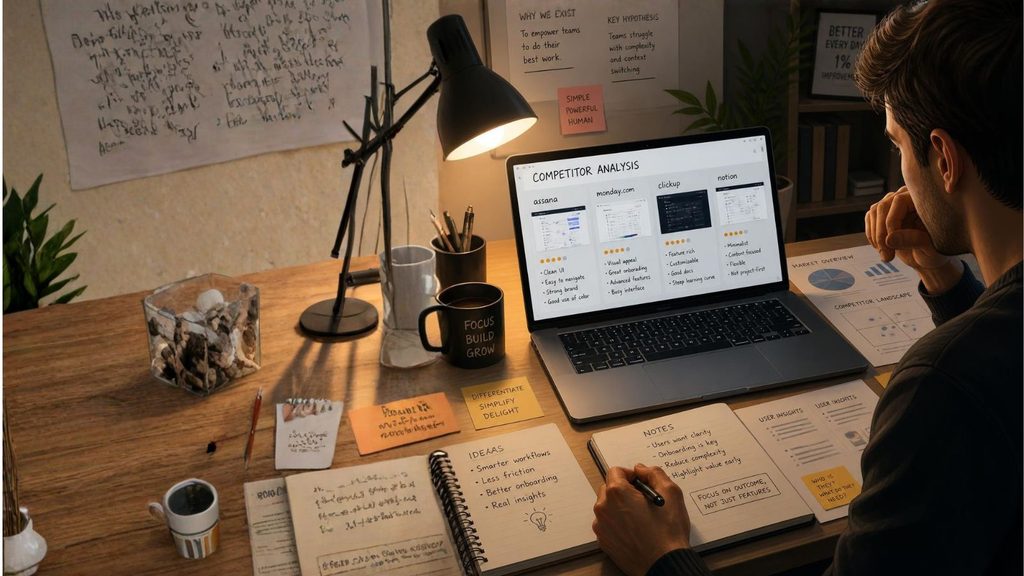
Competition isn’t automatically a bad sign. It usually means people are already spending time or money to solve this problem somehow.
Research competitor pricing, reviews, complaints, and gaps, plus workarounds like spreadsheets or repurposed tools. Then ask the sharper question: why would a customer choose your solution over what they already use? The goal isn’t to prove competitors are weak. It’s to understand what customers currently do, and where a real opportunity might exist.
Test Demand Before Building
Depending on your idea, this might mean a landing page, a waitlist, a simple prototype, a demo, or a manual concierge version. Y Combinator’s own advice on testing early ideas makes a similar point: the right test depends on the business; not every startup needs a landing page or pre-orders.
Real behaviour is generally stronger evidence than opinions. A waitlist someone actually joins can provide stronger evidence than several people simply saying, “Sounds interesting.”
Test Whether Customers Will Pay
There’s a real difference between “I like this idea” and “I am willing to spend money on this.” The first is easy to hear. The second is what matters.
Ask what people currently spend on alternatives, compare pricing, and where appropriate, offer a small paid pilot or take pre-orders. Avoid deceptive sales tactics, and don’t overinterpret a single yes.
For some products, willingness to pay is genuinely hard to test early, and that’s fine; just be honest about how much weight that uncertainty deserves.
Measure Evidence, Not Excitement
No single signal proves you have a real business. This is really the core of how you validate startup idea assumptions properly: look for multiple consistent signals instead of one encouraging conversation.
| Signal | What It Tells You |
|---|---|
| Customer complaint | The problem may exist |
| Repeated behaviour | The problem may be meaningful |
| Existing spending | Commercial demand may exist |
| Strong interview evidence | The need may be real |
| Sign-up | Initial interest |
| Paid pilot | A stronger commercial signal |
| Pre-order | Strong buying intent |
Decide What to Do With the Results
Three outcomes are all genuinely useful.
Proceed, if the evidence supports it.
Improve, if the problem is real but the customer, solution, or positioning needs adjustment.
Pivot, if the evidence points toward a significant change in direction.
None of these is a failure. Learning early, even when it means changing course, saves resources and usually leads to a better product than pushing ahead on an untested assumption.
This decision point is really the whole reason to validate startup idea assumptions early, rather than discovering the same answers months later at a much higher cost.
A Simple Startup Idea Validation Checklist
- Problem: Is it real and meaningful?
- Customer: Can you clearly identify who experiences it?
- Frequency: Does it happen often enough to matter?
- Existing alternatives: Are people already solving it somehow?
- Urgency: Do customers care enough to seek something better?
- Solution: Does your approach address the actual problem?
- Demand: Is there evidence of real interest?
- Payment: Is there evidence customers may pay?
- Reach: Can you realistically reach these customers?
- Next step: What’s the cheapest experiment that tests your biggest remaining assumption?
Common Mistakes When Validating a Startup Idea
Asking only friends and family. Talk to potential customers instead.
Asking leading questions. Ask about actual behaviour and experience, not hypotheticals.
Treating compliments as demand. Look for stronger behavioural signals.
Building too much too early. Test important assumptions before investing heavily.
Ignoring competitors. Understand the existing alternatives customers already use.
Trying to validate everything at once. Test the riskiest assumption first.
Stopping after a few positive responses. Look for patterns across multiple conversations, not one encouraging chat.
How to Validate a Startup Idea in One Week
Day 1: Define the problem, target customer, and biggest assumption.
Day 2: Research existing alternatives and competitors.
Day 3: Talk to potential customers directly.
Day 4: Look for patterns and refine your problem statement.
Day 5: Build a simple prototype, landing page, or manual test.
Day 6: Put the test in front of real potential customers.
Day 7: Review the evidence and decide your next experiment.
One week won’t fully validate every startup idea. It’s a practical starting point for learning quickly and cheaply, rather than a finish line.
Validation shouldn’t always begin with building an MVP either. If customer conversations, competitor research, or a simple experiment can answer your biggest assumption, there may be no reason to build anything yet. Once that early evidence holds up, learning how to build an MVP is a reasonable next step, but not the first one.
Frequently Asked Questions
What does it mean to validate a startup idea?
It means gathering real evidence that a problem exists, that a specific customer feels it, and that people might act, not just agree, when offered a solution, before you invest heavily in building it.
How do you validate a startup idea before building it?
Define the problem and customer, talk to real potential users, study existing alternatives, and test demand and willingness to pay through a small, low-cost experiment before building the full product.
How many customers should I talk to when validating a startup idea?
There is no fixed number. Keep speaking with relevant potential customers until you start seeing repeated patterns, while remembering that the quality and relevance of conversations matter more than hitting an arbitrary target.
Is customer feedback enough to validate a startup idea?
Not on its own. Feedback is useful, but behaviour, sign-ups, pilots, or actual spending is a stronger signal than opinions collected in conversation.
How can I test whether people will pay for my startup idea?
Look for real commitment: pre-orders, a paid pilot, or a landing page with genuine sign-ups, rather than compliments or hypothetical interest.
Should I build an MVP before validating my startup idea?
Generally no. Validate the problem and demand first through conversations and small tests. Build an MVP once that evidence justifies testing the actual solution.
Key Takeaways
These are the habits that help you validate startup idea assumptions well:
- Start with the problem, not the product.
- Identify a specific customer, not a broad audience.
- Talk to real potential customers, not just friends and family.
- Study existing alternatives before assuming there’s no competition.
- Test behaviour, not opinions.
- Test commercial interest where it’s appropriate to the business.
- Run inexpensive experiments before bigger ones.
- Treat pivoting as learning, not failure.
What to Do After Validating Your Startup Idea
- Summarise what you learned.
- Identify your strongest piece of evidence.
- Revisit your customer and problem definition if needed.
- Decide whether to proceed, improve, or pivot.
- Define the next assumption worth testing.
- Build an MVP only when it’s the right next experiment.
- Keep learning from real users as you go.
Conclusion
Validation was never about finding certainty. It’s about replacing assumptions with evidence before you commit real time and money. That is what it takes to validate a startup idea’s potential properly: better questions, careful listening, sensible experiments, and the willingness to learn quickly.
Believe in the problem worth solving. Build your understanding of it with discipline. Let real evidence inspire what you build next.
