
Table of Contents
Most entrepreneurs do not lack ambition. They lack a clear way to turn ambition into something they can act on this week.
“Grow the business” or “make more money” feels like a goal, but it gives you nothing specific to do on Monday morning. Without a clear target, days fill up with urgent tasks and important work keeps getting pushed back.
This guide explains how to set business goals for entrepreneurs in a simple, practical way. You will learn how to choose the right business goals for entrepreneurs, turn them into measurable targets, and create an action plan you can actually follow.
Goal setting begins with knowing where you want the business to go. If you are still shaping that direction, our guide on the entrepreneur mindset is a good place to start.
Note: All figures and business examples in this article are illustrative. Replace them with numbers relevant to your own business.
What Are Business Goals?
Business goals are specific results a business wants to achieve within a defined period, such as increasing monthly revenue, winning new customers, or improving profit.
They turn a general ambition into a clear target that you can measure and work towards.
Four terms often get mixed up, so here is how they differ:
- Business vision: The long-term picture of what the business will become.
- Business goal: A specific result that moves the business towards that vision.
- Business objective: A measurable target that supports a goal.
- Action: A task you complete to reach the objective.
Example: Priya runs a small online store selling handmade candles.
- Vision: Become a trusted handmade candle brand in India.
- Goal: Build steady repeat sales this year.
- Objective: Reach 150 orders per month by December.
- Action: Email past customers every two weeks with a small offer.
In everyday use, “goal” and “objective” are often treated as the same thing. What matters is that each one is clear enough to guide action.
Why Are Business Goals Important for Entrepreneurs?
Business goals for entrepreneurs matter because a business has limited time, money and energy. Clear goals help entrepreneurs decide where those resources should go and which activities deserve attention.
Here are the practical benefits of setting clear goals:
- Direction: You know what you are working towards.
- Focus: You can say no to work that does not move the business forward.
- Prioritisation: When everything feels urgent, goals show what is actually important.
- Progress measurement: You can tell whether the business is moving forward or standing still.
- Better decisions: Choices become easier when you can ask, “Does this help me reach my goal?”
- Team alignment: Everyone knows what the team is trying to achieve.
- Manageable growth: Big ambitions become smaller, actionable steps.
Goals do not guarantee success. Markets change, customers behave unexpectedly, and plans sometimes need to change. But research supports the basic value of specific goals. In a well-known review of decades of studies, psychologists Edwin Locke and Gary Latham found that specific, challenging goals can lead to higher performance than vague “do your best” goals when people are committed and receive feedback.
How to Set Business Goals: A Step-by-Step Process
Setting business goals for entrepreneurs starts with your business direction. Choose one important outcome, make it measurable, add a realistic target and deadline, then break it into milestones, actions and regular reviews.
Here is the full process.
1. Start With Your Bigger Business Direction
What to do: Write one or two sentences about where you want the business to be in three to five years.
Why it matters: Goals without direction can pull your business in different ways. A clear direction helps you choose goals that fit together.
Example: “In five years, I want my candle business to have a loyal customer base and a small team, without depending on one sales channel.”
2. Identify What Matters Most Right Now
What to do: Look at your business today and ask what is holding it back. It might be low sales, too few customers, weak cash flow, or an inefficient process.
Why it matters: The right goal depends on your stage. A new business may need customers, while a growing business may need stronger systems or better cash flow.
Example: Priya finds that most of her orders come from friends and family. Her real gap is reaching new customers.
If you are unsure which area to prioritise, sort your options by impact and urgency. Our guide on decision-making skills for entrepreneurs can help you evaluate choices when you cannot pursue everything at once.
3. Choose a Specific Outcome
What to do: Turn the problem into a clear result. Say exactly what you want to change.
Why it matters: A vague goal is difficult to track and even harder to turn into action.
Example: Instead of “get more customers,” write “increase first-time buyers through Instagram and marketplace listings.”
4. Make the Goal Measurable
What to do: Attach a number to the outcome. Choose a metric you can actually check, such as monthly orders, revenue, leads, or repeat purchase rate.
Why it matters: Numbers show whether you are making progress. Without measurable business goals, you are largely relying on guesswork.
Example: “Increase monthly orders from 60 to 150.”
5. Set a Realistic but Meaningful Target
What to do: Choose a target that stretches you without ignoring your actual resources and circumstances. Consider your past results, capacity, budget, and market.
Why it matters: A target that is too easy may not create meaningful progress. A target that is unrealistic can make planning and execution harder.
Example: Going from 60 to 150 orders is a significant jump. If Priya’s past growth has been slow, she may set 100 orders first and then increase the target after building a stronger sales process.
6. Give the Goal a Deadline
What to do: Pick a clear end date.
Why it matters: Without a deadline, important work can keep getting postponed. A date gives you a timeframe for planning and execution.
Example: “By 31 December” or “within 90 days.”
7. Break the Goal Into Smaller Milestones
What to do: Divide the goal into checkpoints. Working backwards from the final date often makes this easier.
Why it matters: Milestones let you see progress early and correct course before it is too late. Small business advisors also recommend giving milestones due dates and assigning responsibility for completing them. Source: Business milestone guidance
Example: To reach 100 monthly orders in six months, Priya sets targets of 70 orders in month two, 85 in month four, and 100 in month six.
8. Assign Actions and Responsibilities
What to do: List the specific tasks needed for each milestone. Decide who will do each task and when.
Why it matters: A goal without actions is only an intention. If you work alone, the “who” is you and the “when” should be a specific slot in your calendar.
Example:
- Publish three product reels every week.
- Ask five past customers for reviews every week.
- Improve two marketplace product listings every month.
Actions are more likely to happen when you reserve time for them. That is where time management for entrepreneurs becomes important. Block time for goal-related work before other tasks fill your calendar.
9. Track Progress Using Simple Metrics
What to do: Choose one to three numbers that show whether you are on track. These are your key performance indicators, or KPIs.
Why it matters: Tracking tells you what is working and where you need to make changes.
Example: Priya tracks orders per week, visitors to her store, and the percentage of customers who buy again.
10. Review and Adjust Regularly
What to do: Set a fixed time to review your numbers. Ask what worked, what did not and what needs to change.
Why it matters: Business conditions change. A goal that made sense three months ago may need to be adjusted based on new information. The U.S. Small Business Administration describes business planning as an ongoing process that includes setting goals, tracking results, and revising the plan. SBA guidance on business planning
Example: After two months, Priya sees that reels bring views but few sales. She shifts some of her effort towards marketplace listings and customer reviews.
What Are SMART Business Goals?
SMART business goals are goals that are Specific, Measurable, Achievable, Relevant and Time-bound.
The SMART framework provides a simple checklist for turning a general idea into a goal you can plan and track.
- Specific: What exactly do you want to achieve?
- Measurable: How will you know you have reached it?
- Achievable: Is it realistic with your current time, money, and skills?
- Relevant: Does it support your broader business direction?
- Time-bound: By when will you achieve it?
You do not need to make the process complicated. If your goal answers these five questions, it is usually clear enough to start working on.
SMART Business Goal Examples

Example 1: Sales
Vague goal: Increase sales.
SMART goal: Increase monthly sales from ₹60,000 to ₹1,00,000 in six months by improving product listings, collecting customer reviews, and running one monthly offer.
Example 2: Customers
Vague goal: Get more customers.
SMART goal: Add 25 new paying customers in the next 90 days by contacting 10 potential customers every week and following up with each one.
Example 3: Cash Flow
Vague goal: Manage money better.
SMART goal: Build a cash reserve equal to two months of business expenses within eight months by setting aside 10% of every payment received.
Example 4: Marketing
Vague goal: Improve marketing.
SMART goal: Grow email subscribers from 150 to 500 in four months by adding a signup offer to the website and publishing one useful email every week.
SMART is a useful framework, but it is not the only way to set goals. Some entrepreneurs use other planning methods. The important thing is to create goals that are clear, measurable, and connected to practical actions.
Examples of Business Goals for Entrepreneurs
Here are practical business goals for entrepreneurs that startups and small businesses can adapt to their own stage, resources, and priorities. Adjust the numbers and deadlines to match your own situation.
| Area | Example Business Goal |
|---|---|
| Revenue | Increase monthly revenue from ₹80,000 to ₹1,20,000 within six months |
| Profit | Improve profit margin from 15% to 20% by the end of the year by reducing packaging costs |
| Sales | Close 12 new sales per month by following up with every enquiry within 24 hours |
| Customers | Win 30 new paying customers in 90 days |
| Marketing | Publish two useful blog posts per month and increase organic website visits over the next six months |
| Customer retention | Increase repeat purchases from 20% to 30% of customers within a year |
| Productivity | Reserve two hours of focused work every morning for the next 60 days |
| Operations | Cut average order delivery time from five days to three days within four months |
| Product development | Launch one improved product version by the end of the quarter based on customer feedback |
| Personal development | Complete one course on sales or finance in the next 90 days and apply one lesson to the business |
If your immediate goal is winning customers, our guide on how to get your first 10 customers covers practical ways to start.
Short-Term vs Long-Term Business Goals
Short-term business goals cover periods from days to about a year, while long-term business goals usually cover several years. The two work together because short-term goals provide the steps and milestones that support long-term direction.
| Time frame | What it covers | Example |
|---|---|---|
| Daily or weekly | Small actions and habits | Contact five potential customers each day |
| Monthly | Targets you can check regularly | Reach 100 orders this month |
| Quarterly | Bigger milestones | Add 30 new customers by the end of the quarter |
| Annual | Main results for the year | Reach ₹12 lakh in yearly revenue |
| Long-term | Direction over three to five years or more | Build a team of five and a stable base of repeat customers |
Think of it like a staircase. The long-term goal is the top floor. Annual goals are landings, quarterly goals are flights of stairs, and weekly actions are individual steps.
A useful approach is to start with the long-term goal and work backwards. Ask:
“If I want this in three years, what must be true by the end of this year? By the end of this quarter? By the end of this week?”
How to Turn Business Goals Into an Action Plan
To turn a business goal into an action plan, follow this sequence:
Goal → Milestone → Action → Metric → Deadline → Review.
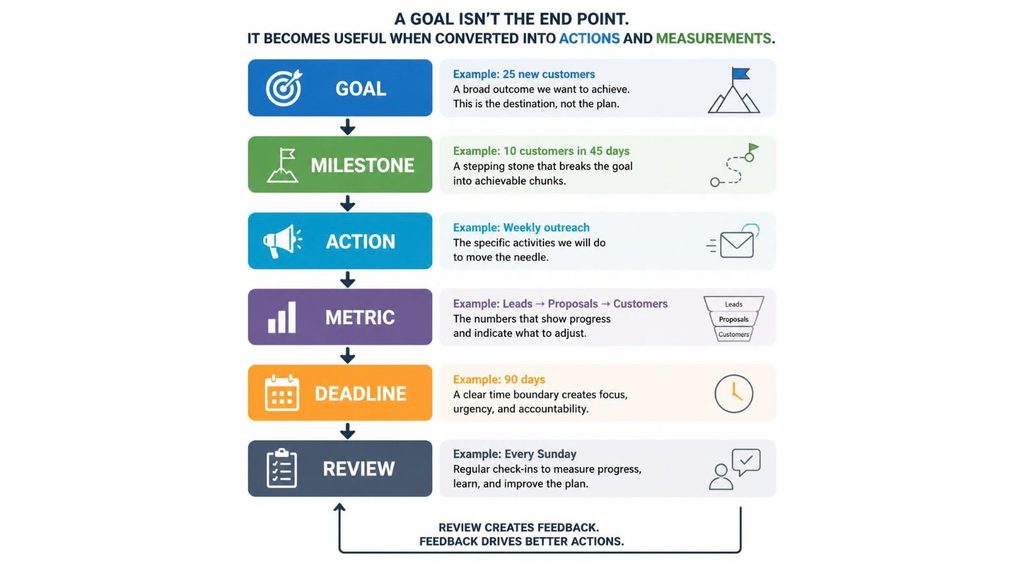
Here is how it works with a simple example:
- Goal: Get 25 new paying customers for a design service.
- Milestone: Reach 10 customers in the first 45 days.
- Action: Contact 10 potential clients every week, share two portfolio examples, and follow up after three days.
- Metric: Number of conversations, proposals sent, and clients signed.
- Deadline: 90 days from the start date.
- Review: Every Sunday, check the numbers and decide what to change next week.
If the numbers show that 40 conversations lead to only two clients, you have useful information. You can investigate your offer, follow-up process, targeting or sales conversation instead of simply assuming that you need more leads.
A goal is only useful when it leads to consistent action. If you are still building the skills needed to plan and execute, read our guide on essential skills for entrepreneurs.
How Entrepreneurs Can Track Business Goals
You do not need expensive software to track business goals. A simple system that you actually use is better than a complex one that you ignore.
Here are practical options:
- KPIs: Choose one to three numbers linked to the goal, such as weekly sales, new leads, or repeat customers.
- A spreadsheet: List your goal, milestones, actual results, and notes. Update it weekly.
- A simple dashboard: Put your main numbers on one page so you can see the trend at a glance.
- Weekly review: Spend 15 to 30 minutes checking completed actions and planning the next week.
- Monthly review: Compare results with the milestone and decide what to keep, stop, or change.
- Quarterly review: Step back and ask whether the goal is still relevant to the business.
Tracking also depends on consistency. Motivation rises and falls, so it helps to have a routine that keeps you reviewing your progress even on low-energy days. Our article on building discipline as an entrepreneur explains how to stay consistent when motivation fades.
Common Business Goal-Setting Mistakes
Most goal-setting problems become easier to fix once you identify them.
- Setting too many goals: When everything is a priority, focus becomes difficult. Choose a few goals that matter most.
- Choosing vague goals: Add a measurable target and a deadline.
- Focusing only on revenue: Revenue matters, but profit, customer retention, and cash flow matter too.
- Setting unrealistic targets: Use past results and available resources to set meaningful targets.
- Ignoring cash flow: A business can generate sales and still face cash shortages. Track money coming in and going out.
- Not assigning deadlines: Give every important goal an end date.
- Not breaking goals into actions: If you cannot identify the next action, the goal may still be too broad.
- Failing to track progress: Set a recurring reminder for your weekly review.
- Never reviewing goals: Adjust goals when business conditions or priorities change.
- Copying someone else’s goals: Another founder’s targets may not fit your stage, market or resources. Use examples for inspiration, not as a template.
How Many Business Goals Should an Entrepreneur Set?
Many entrepreneurs can start with one to three main goals at a time.
There is no universal number because the right amount depends on the business, team, and available resources.
Consider these factors:
- Business stage: A new business may need one clear focus, such as getting its first customers.
- Team size: A solo founder has limited hours. A larger team may be able to manage several objectives.
- Resources: Money, people, and time limit what you can pursue at once.
- Complexity: A business with several products, markets, or locations may need goals for different areas.
Fewer goals can make execution easier because your time, attention, and budget stay focused on the most important outcomes. You can add new goals once existing priorities are under control.
A Simple Business Goal-Setting Framework for Entrepreneurs
Choose → Define → Measure → Break Down → Act → Track → Review
You can remember it as one sentence:

Choose it, define it, measure it, break it down, act on it, track it, and review it.
- Choose: Pick one important business outcome based on what matters most right now.
- Define: Write the goal clearly, including what will change and why.
- Measure: Attach a number and a deadline.
- Break Down: Split the goal into manageable milestones.
- Act: List the weekly actions and block time for them.
- Track: Check your main metrics on a fixed schedule.
- Review: Learn from the results and adjust the plan.
This framework is one practical option, not the only correct method. The purpose is to help you move from a broad ambition to specific actions you can measure.
Frequently Asked Questions
What are good business goals for entrepreneurs?
Good business goals are specific, measurable and connected to the current stage of the business. A new business may focus on winning its first customers, validating demand or improving cash flow. A growing business may focus on increasing profit, retaining customers or building better systems.
How do entrepreneurs set business goals?
Entrepreneurs can set business goals by deciding where the business needs to go, identifying the most important outcome and making it measurable. They can then add a deadline, break the goal into milestones and actions, and review progress regularly.
What are the five SMART goals?
SMART is an acronym, not five separate goals. It stands for Specific, Measurable, Achievable, Relevant and Time-bound. These five criteria help make a goal easier to understand, plan and track.
What is an example of a business goal?
An example is: “Increase monthly sales from ₹60,000 to ₹1,00,000 in six months by improving product listings, collecting reviews and running one monthly offer.”
It has a clear result, measurable target, timeframe and supporting actions.
How many goals should a small business have?
Many small businesses can start with one to three main goals at a time. The appropriate number depends on the team, budget, business stage and complexity. The key is to keep enough focus to execute each goal properly.
What is the difference between a business goal and an objective?
A goal is the broader result you want to achieve, such as building steady repeat sales. An objective can be a measurable target that supports that goal, such as reaching 150 orders per month by December. In everyday business language, the two terms are often used interchangeably, so clarity is more important than the terminology.
How do you measure business goals?
Choose a metric that directly relates to the goal, such as revenue, number of customers, conversion rate, profit margin or repeat purchase rate. Record the metric regularly, compare it with your milestone and note what changed. A simple spreadsheet is enough to begin.
How often should entrepreneurs review their goals?
A weekly check of actions and numbers, a monthly progress review and a quarterly review of the goal itself can provide a useful routine for many businesses. Review sooner when something significant changes, such as a major shift in customer demand, competition or sales performance.
Conclusion
Effective business goals for entrepreneurs do two things at once: they give the business direction and give you something specific to work on this week. The right business goals for entrepreneurs also make it easier to measure progress and decide what deserves your time.
The process is simple. Choose what matters most, define it clearly, add a measurable target and deadline, break it into milestones and actions, and review your progress on a fixed schedule. Keep the number of goals manageable so you can follow through.
Start today with one step.
Pick one important business outcome, write it as a specific goal with a deadline, and list the first three actions you will take in the next seven days.
