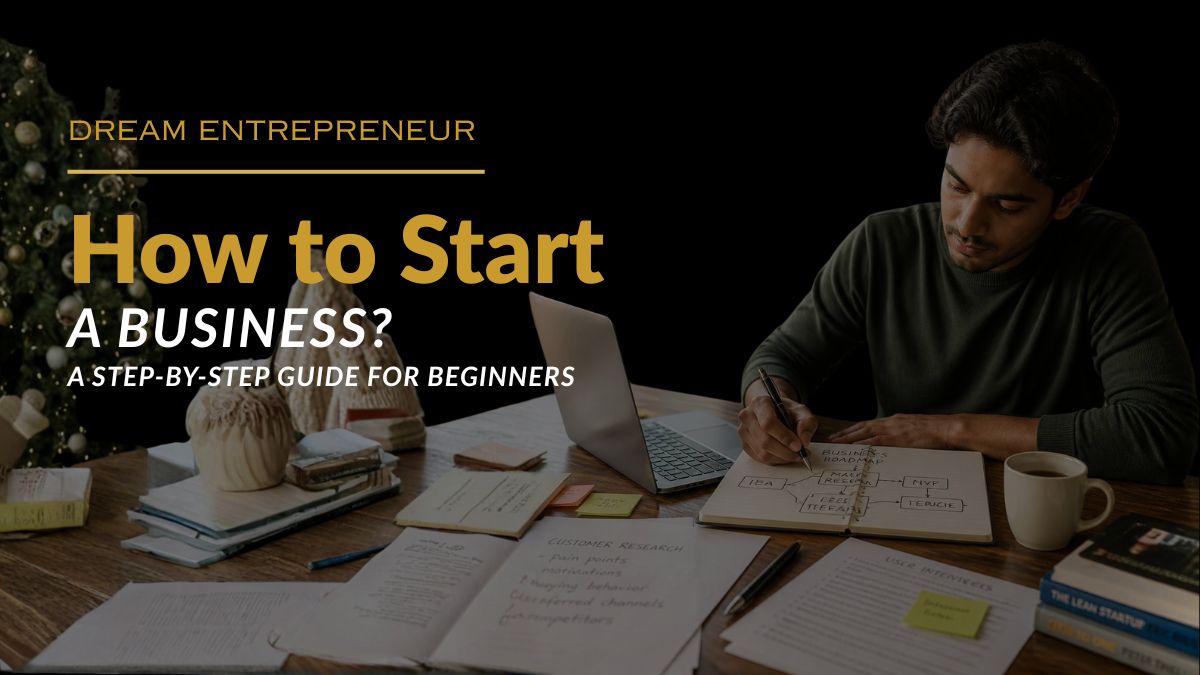
You do not need a perfect idea to begin. You need a real problem, a willingness to test your assumptions, and a plan for taking small, controlled steps forward.
That is really what how to start a business comes down to once you strip away the noise. Most beginners overthink the starting point, waiting for confidence, savings, or the “right” moment. But businesses are rarely built by people who felt fully ready. They are built by people who started small and learned as they went.
This guide walks you through the full process, from spotting a problem worth solving to finding your first paying customers. Believe. Build. Inspire. That is the approach we will take, one practical step at a time.
Table of Contents
How Do You Start a Business?
Starting a business generally follows a logical sequence: identify a real problem, understand who experiences it, do simple market research, and validate your idea before investing heavily. From there, decide how the business will make money, estimate your costs, and choose a funding approach that fits your situation.
Once you’ve tested the idea, choose a suitable business structure, complete any required registrations, and build a simple first version of your product or service. Launch to a small group of early customers, gather feedback, and improve continuously. How to start a business is less about one big decision and more about a series of smaller, well-informed ones.
What Should You Do Before Starting a Business?
Before you touch a business name or a registration form, sit with one question: what problem are you actually solving?
Beginners often start with a product idea. Experienced founders usually start with a problem. Ask yourself:
- What problem are you solving?
- Who experiences this problem regularly?
- How do people solve it today?
- Why might someone choose your solution instead?
- Is this problem important enough that people would pay to fix it?
This is really the first real lesson in how to start a business the right way: a product built around a specific, well-understood problem has something to hold onto when things get difficult. You also will not have complete information when you start; nobody does. Starting a business also requires the right entrepreneur mindset, especially when you have to make decisions without having complete information.
How to Start a Business: The Complete Step-by-Step Process
These are the core steps for how to start a business, from the first idea to your first paying customer. Work through them in order, but don’t feel like every step needs to be perfect before you move to the next one.
Step 1: Choose a Business Idea That Solves a Real Problem
Good ideas rarely appear out of nowhere. They usually come from something you have personally experienced, noticed in your community, or seen repeatedly at work. Look at problems you deal with, complaints you hear often, gaps in products you already use, and skills you already have.
You don’t need to avoid competition. In fact, some competition is a healthy sign that a paying market exists. What you need is a clear reason someone would choose you.
Try this: Write down 10 problems you observe in your work, community or daily life. Shortlist 2-3 that you understand best.
Step 2: Identify Your Target Customer
“Everyone” is not a customer group. It’s a sign you haven’t thought this through. For your first version, you need a specific group of people who feel this problem clearly. Ask who exactly will buy, what they use today, what frustrates them about it, and what they would realistically pay.
A clearly defined first customer group makes every later decision easier: messaging, pricing, where you find customers, even what to build first. Starting narrow is not a weakness; it’s how most businesses actually begin, and it’s a detail beginners researching how to start a business often skip too quickly.
Step 3: Conduct Simple Market Research
At the beginner stage, this needs curiosity more than expensive tools.
A simple framework:
- Ask what problem exists and how big it is.
- Observe how people solve it today.
- Compare existing alternatives and their pricing
- Discover where those alternatives fall short.
Authoritative business guidance also places market research near the beginning of the process because it reveals whether a genuine opportunity exists, and where a competitive advantage might sit.
Step 4: Validate Your Idea Before Spending Too Much
This step gets skipped most often, and it’s usually why early businesses struggle. Validation means evidence, not encouragement. A compliment isn’t validation; a pre-order, a paid pilot, or someone joining a waitlist is.
Try direct conversations with 10-15 potential customers, a short survey, a basic landing page to gauge interest, pre-orders, or a small paid pilot. Look for real commitment (time, attention, or money), not just polite enthusiasm.
Step 5: Decide How Your Business Will Make Money
Any real plan for how to start a business needs a clear answer here: how it will actually make money. This is your business model. Work through what exactly you’re selling, who pays, how much and how often, what it costs you to deliver, and what remains after costs.
Common models include a one-time purchase, subscription, service fee, commission, marketplace, licensing, or advertising. None is inherently better; the right one depends on your customer and how you deliver value. Keep it simple until real customer feedback tells you what to refine.
Step 6: Create a Simple Business Plan
You don’t need a fifty-page document. A useful plan answers: what problem you’re solving, who the customer is, what you’re offering, why they’ll choose you, how you’ll reach them, how you’ll make money, what it will cost, and your goals for the first 90 days. One page is enough.
The SBA similarly treats market research, business planning, startup-cost calculation, and funding as core activities that belong early in the process. Before going further, it’s worth developing the essential skills for entrepreneurs, especially communication, problem-solving, decision-making and basic financial understanding.
Step 7: Calculate Your Startup Costs
Split costs into two buckets. One-time costs: equipment, website, initial inventory, design, registration, tools. Recurring costs: rent, software, salaries, marketing, internet, accounting, delivery.
Remember that revenue is not profit. Revenue is what comes in; profit is what remains after every cost. There’s no single accurate figure for how much you need to start; it depends entirely on your business model, so calculate your own numbers rather than trusting generic claims online.
Step 8: Decide How You Will Fund the Business
Funding should match your business model, not the other way around. Common sources include personal savings, bootstrapping through early revenue, support from family or friends handled carefully, bank loans, angel investors, or venture capital.
Not every business needs outside funding. Many service businesses run entirely on savings and early revenue. Venture capital suits businesses aiming at rapid, large-scale growth; it isn’t a requirement for starting a business, and chasing it without genuine need adds pressure you don’t yet require. If you’d rather build with your own resources, bootstrapping a startup can be an alternative to raising outside funding.
Step 9: Choose the Right Business Structure
Common structures include a sole proprietorship (simplest, but no separation between you and the business), a partnership, an LLP, a One Person Company where applicable, and a private limited company (more formal, often preferred for scaling or raising funds).
The right choice depends on the number of owners, your comfort with personal liability, tax considerations, compliance capacity, and long-term plans. India’s Income Tax Department outlines several business structures in India, noting that the appropriate form depends on business activity, scale and capital requirements. This is one area where personalised advice genuinely matters, so consider speaking with a qualified CA, CS or legal professional for your circumstances.
Step 10: Complete the Required Registrations and Licences
Requirements depend heavily on your country, state, industry, structure, employee count, turnover and business activity, so there’s no single checklist for everyone. In India, commonly relevant items include PAN, GST registration where applicable, Udyam/MSME registration, and any local or industry-specific licences.
Entrepreneurs building an eligible startup in India can also explore the official Startup India platform for recognition and government support. Rules and thresholds change over time, so confirm current requirements through official sources or a qualified professional rather than treating this section as final.
Step 11: Build the First Version of Your Product or Service
Don’t try to build everything at once. Your first version needs to solve the core problem well enough for real people to use it and give honest feedback: a minimum useful version, a clearly defined service offer, a basic prototype, or a manually delivered pilot.
An MVP doesn’t mean poor quality; it means learning before making unnecessary investment. If your idea is designed around innovation and real scalability, it’s worth understanding what is a startup and how startups differ from traditional small businesses.
Step 12: Find Your First Customers
Your first goal isn’t thousands of customers. It’s evidence that real people value what you offer. Start with people who already have the problem: your personal network, referrals, relevant communities, social media, useful content, small partnerships, and marketplaces where relevant.
Direct outreach, even when uncomfortable, usually produces your first customers faster than passive marketing. Once you have a reliable base, the next challenge is learning how to scale a small business without losing quality or control.
Step 13: Launch Small, Learn and Improve
Launching isn’t the finish line. It’s the starting gun for the next phase. Follow a simple loop: launch, measure, learn, improve, repeat. Track leads, customers, conversion rate, revenue, profit, repeat purchases, and cash flow. Avoid vanity metrics like follower counts that don’t reflect real business outcomes.
How to Start a Business With Limited Money
One of the most common questions beginners ask is how to start a business with little or no savings. Limited capital is common for first-time founders and doesn’t have to stop you:
- Start with a service business, which usually needs less upfront capital
- Use skills you already have instead of hiring immediately
- Work from home where practical
- Pre-sell before you fully build the product
- Use free or low-cost tools for your website and payments
- Avoid unnecessary office costs early on
- Start with a narrow customer segment and reinvest early revenue
This doesn’t mean you can start with zero investment in every case; some costs are unavoidable. But careful planning meaningfully reduces what you need before your first sale. If you’re considering a digital business, our guide on how to start an online business with low investment can help you explore a more specific path.
Common Beginner Mistakes to Avoid
Knowing how to start a business also means knowing what tends to slow beginners down. These are not meant to discourage you. They’re lessons framed as prevention, not negativity.
Waiting for the perfect idea. Beginners can reduce unnecessary risk by testing small versions instead of waiting for certainty that never arrives.
Building before talking to customers. Validate the problem and offer before investing time and money in a full build.
Spending too much too early. Protecting cash flow in the first months gives you room to adjust and learn.
Trying to serve everyone. Start with a specific customer group, then expand once you have proof of demand.
Confusing revenue with profit. Know your basic numbers well enough to understand what you’re actually keeping.
Copying another business blindly. Study competitors closely, but build around the customer problem you understand best.
Waiting for motivation. Build simple routines and discipline instead of relying on motivation, which naturally comes and goes.
If fear, uncertainty, or overthinking keep delaying your first step, our guide on why aspiring entrepreneurs struggle to start explores these barriers and practical ways to move forward.
A Simple 30-Day Plan to Start Moving
If you want a condensed version of how to start a business in a single month, use this roadmap.
- Days 1-7: Choose one problem. Define your target customer. Research alternatives. Speak with potential customers.
- Days 8-14: Refine the idea. Define your offer. Test willingness to pay. Calculate basic costs.
- Days 15-21: Build the first version. Create a simple landing page or offer. Start outreach.
- Days 22-30: Get first users or customers. Collect feedback. Improve. Decide your next step.
Thirty days won’t give you a finished business. It will give you clarity, which is what most beginners are actually missing.
Key Takeaways
If you remember nothing else about how to start a business, remember these points:
- Start with a real problem, not a random idea
- Define a specific customer group before building anything
- Research the market to understand demand and competition
- Validate your idea with real evidence before spending heavily
- Understand your business model: what you sell, to whom, and how you get paid
- Protect your cash flow and separate revenue from profit
- Start small and resist building everything at once
- Find your first customers through direct, honest outreach
- Treat launch as the beginning of learning, not the end
What Should You Do Today?
- Write down three business problems you personally understand well
- Choose one specific customer group to focus on first
- Talk to three potential customers about the problem, not your solution
- Write down your first simple offer in plain language
- Set a realistic 30-day test goal for yourself
Frequently Asked Questions
How do I start a business?
Identify a real problem and a specific customer who experiences it. Research how it’s solved today, validate your idea with real conversations or a small pilot, then decide on a business model, estimate costs, and build a simple first version before launching to early customers.
What is the first step in starting a business?
The first real step in how to start a business is identifying a genuine problem worth solving, rather than starting with a product idea. A problem-first approach tends to produce clearer, more resilient businesses.
How much money do I need to start a business?
It depends entirely on your business model. A home-run service business can start with very little; a product business with inventory or equipment typically needs more. Calculate your specific costs rather than relying on generic figures.
Can I start a business with little money?
Yes, particularly with service-based or digital models, or by pre-selling before you build. It requires careful cost management and a narrower initial focus, but it’s realistic for many businesses.
Do I need a business plan to start a business?
Not a lengthy formal one. A simple page covering your customer, offer, pricing, costs, and 90-day goals is usually enough to guide early decisions.
How do I find my first customers?
Start with people who already experience the problem you solve: your personal network, direct outreach, referrals, relevant communities, and simple content that reaches your target audience.
Should I quit my job to start a business?
Not necessarily, and not immediately. Many founders test their idea alongside a stable income before making a full transition, which reduces financial pressure and leaves room to learn without rushing.
Do I need to register my business immediately?
It depends on your business structure, location, industry, and applicable laws, which vary by country and state. Check current requirements through official government sources, and consider a qualified professional for guidance specific to your situation.
Conclusion
If you take one thing away from this guide on how to start a business, let it be this: it is really a sequence of manageable decisions, not one giant leap. It means understanding a real problem, getting to know your customer, testing your assumptions, choosing a business model that fits, managing your costs carefully, setting up the right structure, and finding your first customers with honest, direct effort.
You do not need to build everything today. You need the next useful step, taken with care. Believe in the problem you’re solving. Build something real, even if it starts small. Inspire yourself to keep improving as you learn.
