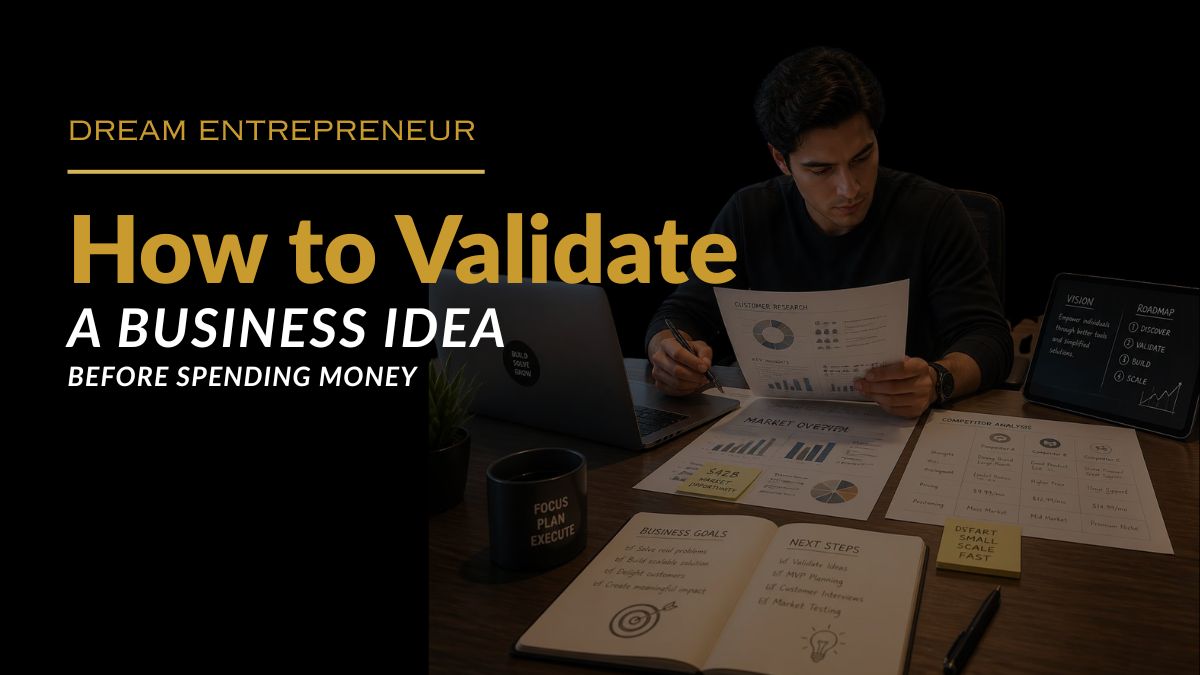
A good idea can still be wrong about the customer, the problem, the price, or the market. That is the part founders often skip. You can be genuinely excited about something and still build it for people who don’t actually want it.
This is why you need to validate a business idea before committing serious time or money. Validation is not about proving your idea is brilliant. It is about gathering enough evidence, early and cheaply, to make a smarter decision about what to do next.
The process is simple in principle: define the problem, identify the customer, research demand, study competitors, talk to real customers, test willingness to pay, run a small experiment, and then decide based on the evidence.
Table of Contents
How Do You Validate a Business Idea?
To validate a business idea, start by clearly defining the problem and the customer who has it. Research whether people are already looking for solutions, study competitors and alternatives, and talk directly to potential customers about how they solve the problem today. Test for meaningful commitment through an appropriate action such as a pre-order, paid pilot, deposit, or early purchase. Then run a small, low-cost experiment and use the evidence to decide whether to proceed, refine, or pause.
What Does It Mean to Validate a Business Idea?
Business idea validation is the process of gathering evidence to determine whether a specific customer has a meaningful problem, whether existing alternatives fall short, and whether there is enough interest and commercial potential for a solution.
It does not guarantee success. Nothing can do that. The purpose is to replace guesswork with evidence so you can make a better decision before increasing your investment.
Harvard Business School Online describes market validation as a process that can help entrepreneurs assess market need through assumptions, market size, search behaviour, customer interviews and testing. Harvard Business School Online’s market validation framework
Before you start testing, write down your biggest assumptions. These might include who the customer is, how serious the problem is, what they currently use, what they might pay, and why they would choose your solution. Those assumptions are what your validation process needs to challenge.
Why Validate a Business Idea Before Spending Money?
Validating early can protect your time and money, but that is only part of the benefit.
It can also help you understand customers better, discover stronger opportunities, identify competitors, improve pricing, and remove unnecessary features from your first version.
One common mistake is building the complete product before anyone outside your own circle has confirmed that the problem matters. The better lesson is simple: test the riskiest assumption first.
Market research can also help you assess demand, market size, pricing, and market saturation before you commit to a launch. The U.S. Small Business Administration recommends combining market research with competitive analysis to understand customers and identify opportunities for differentiation. U.S. Small Business Administration: Market Research and Competitive Analysis
Step 1: Define the Problem and the Customer
Start with the problem, not the solution.
A useful way to frame it is:
We help [specific customer] solve [specific problem] when [specific situation].
For example, “We help freelance designers keep track of unpaid invoices without manually chasing clients” is far easier to test than “We want to build a finance app for small businesses.”
Then ask:
- Who exactly has this problem?
- How often does it happen?
- How serious or costly is it?
- What do they currently do?
- What does the current solution cost them?
- Why is the existing approach not good enough?
A broad audience often makes validation harder. Your first customer segment does not need to represent everyone who could eventually buy from you. It needs to be specific enough for you to find, understand, and speak with.
Step 2: Research Demand Before You Build Anything
Before writing a line of code or ordering inventory, look for evidence that people already care about the problem.
Search trends, online communities, forums, product reviews, marketplace listings, and customer complaints can reveal useful patterns. Keyword research can also show what people are actively searching for and the language they use when describing the problem.
Google Trends is useful for exploring search interest over time and across locations, but it should not be treated as proof that a business opportunity exists. Google explains that Trends reflects search interest and should be considered one data point among others. Google Trends data guidance
The principle is important:
Look for evidence that people care about the problem, not just evidence that they like your idea.
Also consider whether the opportunity is large enough to support the business you want to build. Look at the number of potential customers, typical spending in the category, purchase frequency, and how much of the market you could realistically reach.
A large market does not automatically make a good business. At the same time, a real problem in an extremely narrow market may limit your growth.
Step 3: Study Competitors and Existing Alternatives

Competition is not automatically a bad sign. It can be evidence that customers already recognise the problem and spend money trying to solve it.
Study direct competitors, but also indirect alternatives. Your competitors may include spreadsheets, manual processes, freelancers, internal staff, DIY workarounds, substitute products or even doing nothing.
Look at:
- Pricing
- Customer segments
- Reviews and complaints
- Strengths and weaknesses
- Features and service levels
- Positioning
- How customers discover them
The SBA recommends examining competitors’ strengths, weaknesses, market position, indirect competitors, and possible barriers to entry.
Then ask the question that matters:
What can you actually do better, simpler, faster, cheaper, or more conveniently?
Do not assume an empty competitive landscape means your idea is excellent. It may also mean customers have little interest in the problem or that serving them is difficult.
Step 4: Talk to Potential Customers

Customer conversations are one of the most valuable things you can do at this stage, yet they are also one of the easiest steps to skip.
Talk to people who genuinely fit your target customer profile. Avoid relying mainly on friends and family because they may be supportive without being realistic buyers.
Ask about actual behaviour:
- How do you solve this problem today?
- How often does it happen?
- What is frustrating about your current approach?
- What have you already tried?
- What does the problem cost you?
- What would make you switch?
Avoid leading questions such as, “Would you buy my product?”
That question asks people to predict what they might do. A better conversation explores what they have already done.
Steve Blank’s customer discovery material emphasises speaking directly with customers, finding patterns and testing assumptions rather than relying on what founders think customers want. Steve Blank’s Customer Discovery resources
Step 5: Test Willingness to Pay
Interest is not the same as purchasing intent.
Someone can genuinely like your idea and still never spend money on it. That is why willingness to pay deserves its own test.
Depending on the type of business, useful signals may include:
- Pre-orders
- Deposits
- Paid pilots
- Early sales
- Trial-to-paid conversions
- Service commitments
- Letters of intent where appropriate
A landing-page sign-up can also be useful, but treat it mainly as a signal of interest rather than proof that someone will pay.
Not every business should collect money before building. The right test depends on the product, buying cycle, and customer type. The important thing is to look for a meaningful commitment somewhere in the process.
The strongest validation often comes from behaviour, not compliments.
Step 6: Run a Small, Low-Cost Experiment
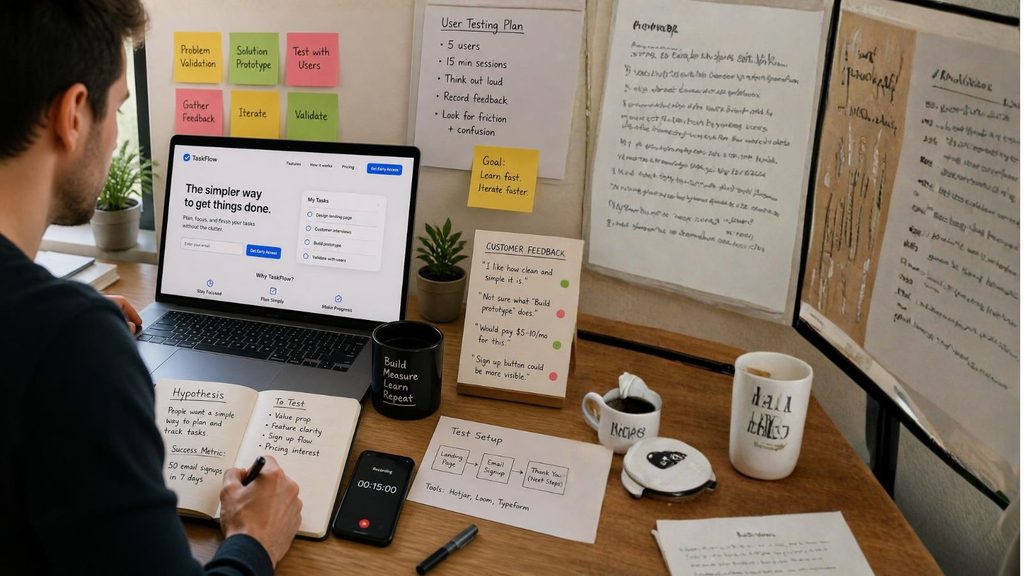
You do not need the complete business to test the idea.
A landing page, simple prototype, manual or concierge service, no-code MVP, small local pilot, one-product test, or short pre-order campaign can help you learn without taking on unnecessary costs.
The experiment should answer one important question.
For example:
Will freelance professionals pay for a simple service that removes a recurring bookkeeping task?
You do not need sophisticated software to test that question. You might first deliver the service manually to a small group, charge an appropriate fee, and observe what customers value.
Once you have evidence that the problem is worth solving, learning how to build an MVP can help you test the solution without immediately investing in the full product.
Step 7: Evaluate the Evidence and Decide
By this point, you should have several pieces of evidence.
Some are stronger than others.
Strong signals
- The customer problem is clear and recurring.
- People are actively looking for solutions.
- Customers already spend money on alternatives.
- Conversations confirm the problem is meaningful.
- Customers take real commercial action.
- Your proposed solution offers a meaningful improvement.
- The business can realistically be delivered profitably.
Signals that need more testing
- People like the concept but do not act.
- Demand appears inconsistent.
- Pricing remains unclear.
- The audience is too broad.
- Customers already have strong alternatives.
- Customer acquisition appears difficult.
- The economics of serving the customer are uncertain.
Then make one of three decisions:
- Proceed: The evidence supports the next level of investment.
- Refine: The problem appears real, but the solution, pricing, positioning, or customer segment needs improvement.
- Pause: The evidence is currently too weak to justify spending more.
A decision to pause or change direction is useful learning. The time and money spent testing an assumption can be valuable precisely because you learned before making a much larger commitment.
A Simple Validation Scorecard
| Validation Area | Question to Ask |
|---|---|
| Problem | Does the target customer have a meaningful problem? |
| Customer | Can you clearly identify who experiences it? |
| Demand | Is there evidence people actively seek solutions? |
| Competition | Are people already spending money on alternatives? |
| Differentiation | Can you offer a meaningful improvement? |
| Willingness to Pay | Will customers take a real commercial action? |
| Feasibility | Can you realistically deliver the solution? |
| Next Step | Does the evidence justify further investment? |
You can score each area from 1 to 5 if that helps you compare assumptions, but do not treat the total as a scientific prediction. The purpose of the scorecard is to identify where you still need evidence.
Common Validation Mistakes Entrepreneurs Should Avoid
- Building before validating. Test the biggest assumption first instead of investing in everything at once.
- Asking only friends and family. Speak with people who actually fit your target customer.
- Relying only on surveys. Combine opinions with observed behaviour and other evidence.
- Ignoring competitors. Understand what customers already use and why they choose it.
- Treating search volume as proof. Search demand is useful, but it should be combined with customer and commercial evidence.
- Spending heavily on branding or technology too early. Prove the core business assumption first, then increase the investment.
A Hypothetical Example
Imagine a founder wants to start an online bookkeeping service for freelancers.
Instead of hiring a team, building custom software, and spending heavily on advertising, the founder takes a smaller path.
First, they interview freelancers about their biggest bookkeeping problems. They discover which tasks are repeated, what customers currently use, and what frustrates them.
Next, they study existing services, pricing, and customer complaints. Then they create a simple service offer and approach a small number of potential customers.
A few customers agree to a paid trial. The founder watches what they actually use, what they value, and what they ask to change.
If customers continue paying, refer others, or describe the problem as important, the evidence becomes stronger. If people show interest but do not commit, the founder has a clear reason to refine the offer before spending more.
That is what it means to validate a business idea in practice: small tests, real behaviour, and better decisions.
Key Takeaways
- Start with the problem, not the solution.
- Define your target customer clearly.
- Research demand without treating search interest as proof.
- Study competitors and existing alternatives.
- Talk to real customers about actual behaviour.
- Test willingness to pay.
- Run a small experiment before making a large investment.
- Use several evidence sources before deciding what to do next.
A Simple Business Idea Validation Checklist
- Write down the problem clearly.
- Identify the target customer.
- List existing alternatives.
- Research search and market demand.
- Check the size and attractiveness of the opportunity.
- Talk to potential customers.
- Test the offer with a real audience.
- Measure actual behaviour.
- Review the evidence honestly.
- Decide whether the next investment is justified.
Frequently Asked Questions
What does it mean to validate a business idea?
It means gathering real evidence about the customer, problem, demand, competition, feasibility, and willingness to pay before making a larger investment. Business idea validation does not guarantee success. It reduces uncertainty and gives you better information for your next decision.
How do you validate a business idea before spending money?
Define the problem and customer, research demand, study competitors, interview potential customers, and run a small test. Look for meaningful behaviour such as enquiries, trials, pre-orders, paid pilots or purchases rather than relying only on positive opinions.
What is the best way to test a business idea?
There is no single best method. A stronger approach combines several forms of evidence, such as customer interviews, market research, competitor analysis and a small real-world experiment. The right test is the one that answers your biggest unresolved business assumption.
How do you know if people will pay for your business idea?
Look for real commitment through an appropriate action such as a pre-order, deposit, paid pilot or purchase. You can also test pricing during customer conversations. Actual behaviour is stronger evidence of willingness to pay than compliments or hypothetical statements.
Can you validate a business idea without building a product?
Yes. Customer interviews, landing pages, prototypes, manual services, no-code tests and small pilots can all generate useful evidence before a complete product exists. The goal is to test the riskiest assumption with the least unnecessary investment.
How long does it take to validate a business idea?
The timeframe depends on the business, customer, and buying cycle. A simple consumer offer may generate useful evidence quickly, while B2B, high-value, or complex products may require longer interviews and pilot programs. The goal is not to meet an arbitrary deadline but to gather enough evidence for the next decision.
Conclusion
You do not need certainty before you start. You need enough evidence to make your next decision intelligently.
That means moving from assumptions to conversations, from conversations to small tests, and from small tests to real evidence. Sometimes the evidence supports the original idea. Sometimes it shows you a better customer, a better offer or a better way to solve the problem.
The important part is learning before you invest heavily.
Validate → Learn → Improve → Invest
Once your idea has stronger evidence behind it, you can move from validation toward the practical steps involved in how to start a business.
Believe in the possibility, build with evidence, and let what you learn inspire your next step.
Believe • Build • Inspire
